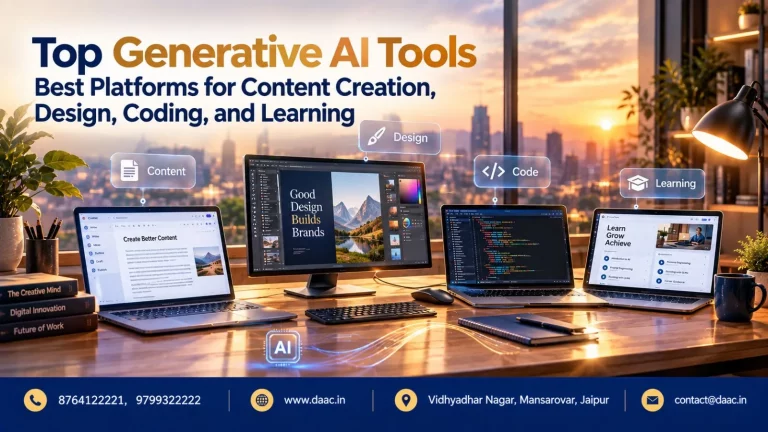
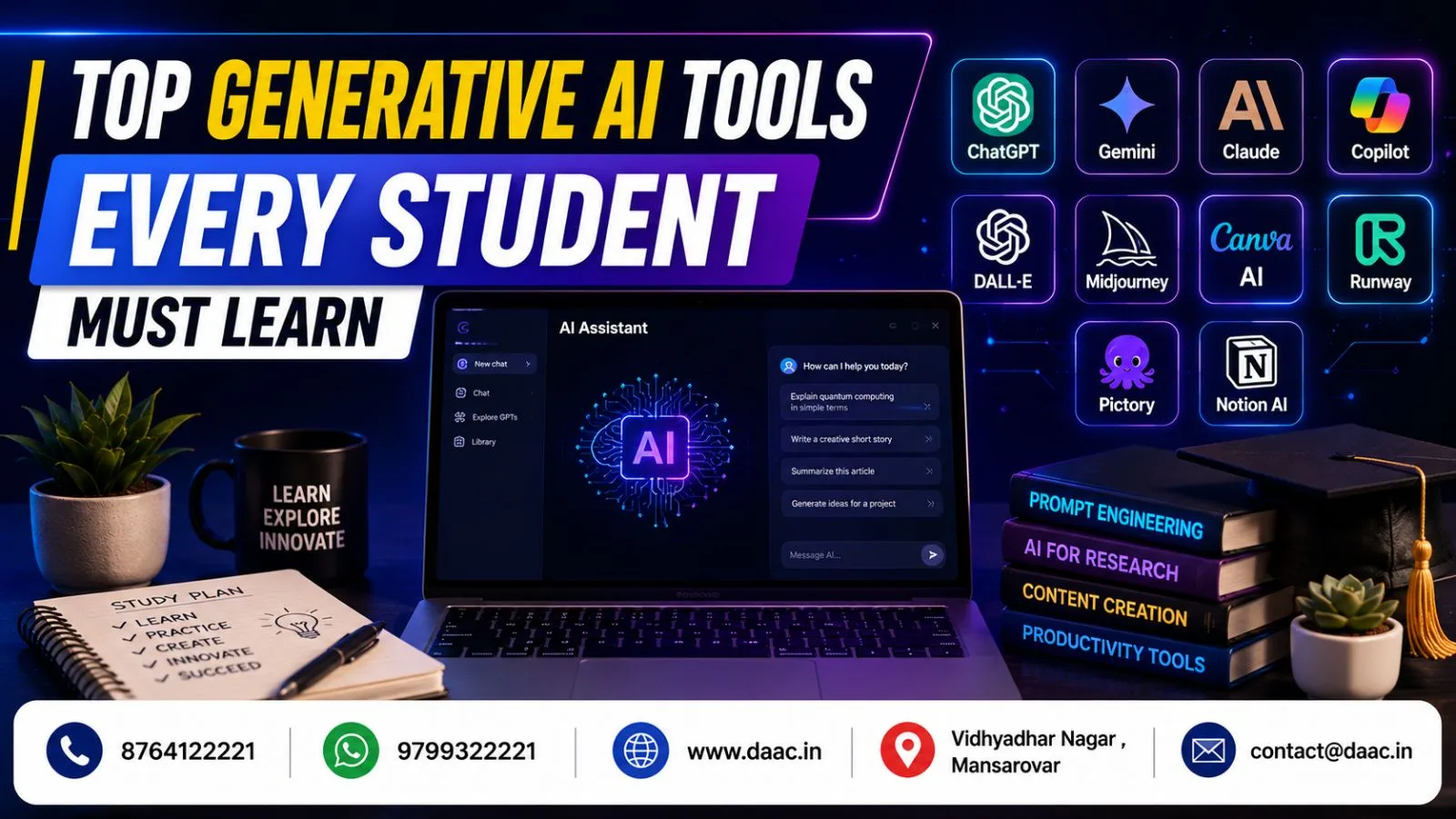
Artificial Intelligence is no longer limited to researchers and technology companies. In 2026, students across engineering, management, design, marketing, and computer science are using AI-powered tools to improve productivity, accelerate learning, and build industry-ready skills.
Employers are now looking beyond theoretical knowledge and focusing on practical AI experience. Students who understand how to use modern AI platforms effectively have a significant advantage during internships, placements, freelancing projects, and full-time job opportunities.
The biggest shift in recent years is the move from AI awareness to AI implementation. Organizations want candidates who can solve real problems using AI tools rather than simply discussing AI concepts. This is why learning the right Generative AI platforms has become an important step toward career growth.
In this guide, we will explore the most valuable AI tools students should learn in 2026, their practical applications, and how these platforms are shaping future careers.
Why Generative AI Skills Matter More Than Ever
The adoption of AI has expanded across almost every industry. Companies are using AI to automate repetitive tasks, generate content, analyze data, improve customer experiences, and increase operational efficiency.
Students who develop practical AI skills can benefit in several ways:
- Improve academic productivity
- Build stronger portfolios
- Complete projects faster
- Enhance problem-solving abilities
- Increase employability
- Explore freelancing opportunities
According to industry hiring trends, candidates with AI tool experience often stand out because they can contribute to projects from day one.
Text-Based AI Tools Every Student Should Master
ChatGPT
ChatGPT remains one of the most widely used AI tools in 2026. Students use it for research assistance, content creation, coding support, brainstorming, summarization, and learning complex concepts.
Practical uses include:
- Assignment support
- Content drafting
- Programming assistance
- Interview preparation
- Research summaries
Students who learn prompt engineering techniques can significantly improve output quality and productivity.
Google Gemini
Google Gemini has become a powerful multimodal platform capable of handling text, images, and advanced reasoning tasks. Its integration with Google Workspace makes it particularly useful for students.
Benefits include:
- Academic research
- Document analysis
- Presentation support
- Data interpretation
- Workflow management
Many universities now encourage students to use AI responsibly to improve research efficiency and learning outcomes.
Claude AI
Claude AI is known for handling long-form content and large documents effectively. Students involved in research projects often use Claude for reviewing reports, summarizing information, and extracting insights.
Key advantages include:
- Long document analysis
- Research support
- Detailed summaries
- Structured responses
- Context retention
Its ability to process large amounts of information makes it valuable for academic work.
AI Design Tools Transforming Student Creativity
Visual communication has become essential across multiple fields. Whether creating presentations, social media content, or project reports, students increasingly rely on AI-powered design platforms.
DALL·E
DALL·E enables users to generate images from text prompts. Students can create custom visuals for projects, presentations, branding concepts, and creative assignments.
Applications include:
- Academic presentations
- Marketing campaigns
- Concept visualization
- Creative storytelling
- Portfolio development
The ability to convert ideas into visual assets quickly makes DALL·E a valuable learning tool.
Midjourney
Midjourney is widely recognized for producing high-quality artistic visuals. Design students and creative professionals frequently use it for concept generation and digital artwork.
Benefits include:
- Creative image generation
- Professional-quality outputs
- Branding concepts
- Visual experimentation
- Artistic development
Many agencies now use AI-generated concepts during early-stage design planning.
Canva AI
Canva AI continues to be one of the most student-friendly platforms available. It simplifies design tasks and helps users create professional content without advanced graphic design skills.
Features include:
- AI-generated presentations
- Social media graphics
- Posters and banners
- Resume creation
- Video editing
Students working on marketing and branding projects often combine Canva with AI-generated content for faster execution.
Coding and Development AI Platforms
Software development is among the industries experiencing the strongest AI transformation. Students who learn AI-assisted coding tools gain a competitive advantage.
GitHub Copilot
GitHub Copilot acts as an AI coding assistant that suggests code snippets, functions, and solutions in real time.
Advantages include:
- Faster coding
- Reduced errors
- Learning support
- Code optimization
- Productivity improvement
Developers use Copilot to accelerate workflows while maintaining code quality.
Students interested in software development often strengthen their technical foundation through a Python Django Course in Jaipur, where they learn how AI tools can complement modern web application development.
Replit AI
Replit AI provides a cloud-based coding environment that allows students to write, test, and deploy applications directly from a browser.
Key benefits include:
- No complex setup
- Instant code execution
- Collaborative development
- Beginner-friendly environment
- Real-time AI assistance
Its accessibility makes it ideal for students starting their programming journey.
Cursor AI
Cursor AI has gained popularity among developers because it combines coding assistance with intelligent project understanding.
Features include:
- AI-powered code generation
- Project-wide context awareness
- Code explanations
- Debugging assistance
- Faster development cycles
Many startups and software teams are adopting AI-assisted development workflows to improve efficiency.
AI Tools for Audio and Video Creation
Multimedia content continues to dominate digital platforms. Students who understand AI-powered media creation can develop valuable communication and content production skills.
AI Voice Generators
Modern AI voice tools can generate realistic voiceovers for videos, presentations, podcasts, and educational content.
Common use cases:
- Training videos
- Narration projects
- Educational content
- Marketing materials
- Podcast creation
These tools help students produce professional content without expensive recording equipment.
Synthesia
Synthesia allows users to create videos using AI-generated avatars and voiceovers. Businesses increasingly use it for training and educational purposes.
Benefits include:
- Professional video production
- Corporate training content
- Presentation videos
- Educational tutorials
- Global communication
Students can create polished video projects quickly and efficiently.
Pictory
Pictory converts written content into engaging videos automatically. It is particularly useful for content creators and marketing students.
Advantages include:
- Text-to-video conversion
- Easy editing
- Content repurposing
- Social media content creation
- Time savings
This platform enables students to transform blogs and reports into visual content with minimal effort.
Automation and AI Integration Tools
Automation skills are becoming increasingly valuable because businesses want to streamline workflows and reduce manual effort.
Zapier AI
Zapier AI helps connect multiple applications and automate repetitive tasks.
Examples include:
- Automatic email workflows
- Lead management
- Data synchronization
- Task automation
- Productivity enhancement
Students working on business or marketing projects can significantly improve efficiency using automation tools.
LangChain
LangChain is one of the most important frameworks for building AI-powered applications using large language models.
Students can use it to:
- Build AI chatbots
- Develop custom AI solutions
- Create automation workflows
- Integrate AI APIs
- Experiment with advanced AI applications
Learning frameworks like LangChain prepares students for more advanced AI development roles.
How Students Can Build Career-Ready AI Skills
Simply using AI tools occasionally is not enough. Employers value candidates who can apply AI effectively in real-world situations.
To build practical expertise:
- Complete AI-based projects
- Create a professional portfolio
- Participate in hackathons
- Learn prompt engineering
- Explore automation workflows
- Build AI-powered applications
Students serious about AI careers often combine tool knowledge with structured learning through a Generative AI Course in Jaipur to gain hands-on project experience and industry exposure.
Building projects remains one of the most effective ways to demonstrate skills during interviews and internships.
Future Trends in AI Tools Beyond 2026
The next generation of AI platforms is expected to become more powerful, autonomous, and integrated.
Major trends include:
- Multimodal AI systems
- Autonomous AI agents
- AI-powered personal assistants
- Enterprise workflow automation
- Real-time collaboration tools
- Ethical and responsible AI frameworks
Students who begin learning AI tools today will be better positioned to adapt as these technologies continue evolving.
Conclusion
Generative AI has become a practical skill rather than a future concept. Students who learn how to use AI platforms effectively can improve productivity, enhance creativity, accelerate learning, and strengthen career opportunities.
From ChatGPT and Gemini to GitHub Copilot, Canva AI, Zapier, and LangChain, each platform serves a unique purpose in modern education and professional development. The most successful students will be those who combine theoretical understanding with hands-on experience and real-world projects.
As AI adoption continues to grow across industries, mastering these tools will help students stay competitive and future-ready in an increasingly technology-driven job market.
FAQs
1. Which Generative AI tool is best for beginners?
ChatGPT and Canva AI are excellent starting points because they are easy to use and offer practical applications for students across different fields.
2. Do students need coding knowledge to use AI tools?
No. Many AI tools are designed for non-technical users. However, coding knowledge becomes helpful when working with advanced AI platforms and automation frameworks.
3. Which AI tool is best for programming students?
GitHub Copilot, Cursor AI, and Replit AI are among the most useful platforms for learning and improving programming skills.
4. Can AI tools improve academic performance?
Yes. AI tools can help with research, summarization, content creation, organization, and project management when used responsibly.
5. Will AI tools replace traditional learning methods?
No. AI tools enhance learning and productivity but cannot replace critical thinking, problem-solving abilities, and foundational subject knowledge.