
Software testing continues to be one of the most promising career options in the IT industry. As companies focus on delivering high-quality software products faster than ever, the demand for skilled testing professionals is increasing across startups, product companies, and multinational organizations.
However, one question confuses almost every beginner entering the testing field: should they choose manual testing or automation testing? Both career paths play an important role in software quality assurance, but they differ significantly in terms of skills, responsibilities, salary potential, and long-term growth opportunities.
In 2026, organizations are investing heavily in automation technologies, but manual testing remains essential for usability testing, exploratory testing, and user experience validation. Understanding the strengths of both career paths can help students make an informed decision and build a successful future in software testing.
Understanding the Role of Software Testing in Modern Development
Software testing is the process of evaluating applications to identify defects, verify functionality, and ensure a seamless user experience. Every software product, whether it is a mobile app, website, banking platform, or enterprise solution, goes through testing before release.
Modern development methodologies such as Agile and DevOps have increased the need for continuous testing. As a result, testing professionals are expected to understand both quality assurance processes and modern testing tools.
Today’s testing teams focus on:
- Functional testing
- Performance testing
- Security testing
- User experience validation
- Continuous integration testing
- Automated regression testing
Because software releases happen more frequently than before, testing professionals who continuously upgrade their skills remain highly valuable in the job market.
What Is Manual Testing?
Manual testing involves executing test cases manually without using automation scripts. Testers interact directly with the application to identify bugs, validate requirements, and evaluate the overall user experience.
Despite the growth of automation, manual testing remains a critical component of software quality assurance because human observation often identifies issues that automated scripts may overlook.
Key Responsibilities of Manual Testers
- Understanding business requirements
- Preparing test cases
- Executing test scenarios
- Reporting defects
- Performing exploratory testing
- Conducting usability testing
- Verifying bug fixes
Manual testing provides an excellent foundation for beginners because it helps them understand software behavior, testing methodologies, and quality assurance processes before moving into advanced testing domains.
What Is Automation Testing?
Automation testing uses specialized tools and scripts to execute test cases automatically. Instead of manually repeating the same tests, automation frameworks perform testing tasks faster and with greater consistency.
Automation testing has become increasingly important because companies release software updates frequently and require faster testing cycles.
Common Automation Testing Tools
- Selenium
- Cypress
- Playwright
- TestNG
- JUnit
- Appium
- Jenkins
Automation testing helps organizations reduce testing time, improve accuracy, and accelerate software delivery. This growing adoption has created strong demand for automation professionals across the industry.
Manual Testing vs Automation Testing: Skill Comparison
Choosing the right path depends largely on your interests and technical strengths.
| Factor | Manual Testing | Automation Testing |
|---|---|---|
| Technical Complexity | Beginner Friendly | Intermediate to Advanced |
| Coding Requirement | Minimal | Essential |
| Learning Curve | Easier | Steeper |
| Tool Dependency | Low | High |
| Entry-Level Opportunities | High | Moderate |
| Salary Growth | Steady | Faster |
| Career Advancement | Good | Excellent |
| Industry Demand | Stable | Rapidly Growing |
Both fields offer opportunities, but automation testing generally provides higher scalability and faster career progression.
Why Manual Testing Still Matters in 2026
Many students assume automation will completely replace manual testing. However, that is not the reality.
Certain testing activities still require human judgment, creativity, and business understanding.
Areas Where Manual Testing Excels
- Exploratory testing
- User acceptance testing
- Visual validation
- Accessibility testing
- User experience evaluation
- Requirement verification
For example, when testing a food delivery app, automation can verify button functionality, but human testers can better evaluate whether the user journey feels intuitive and convenient.
This is why companies continue hiring manual testers even as automation adoption increases.
Why Automation Testing Is Growing Rapidly
Automation testing aligns perfectly with modern software development practices. Companies want faster releases without compromising quality, making automation an essential part of the development lifecycle.
Several factors are driving automation growth:
- Continuous software delivery
- Agile development practices
- Increasing application complexity
- Cost optimization
- Faster release cycles
Organizations that previously relied heavily on manual testing are now investing in automation frameworks to improve efficiency and reduce repetitive work.
Students interested in advanced testing careers often strengthen their programming skills through a Core Python Course in Jaipur, as Python remains one of the most widely used languages for automation scripting and testing frameworks.
Salary Comparison: Manual Testing vs Automation Testing
Salary remains one of the biggest factors when choosing a career path.
Average Salary in India (2026)
| Role | Experience | Average Salary |
|---|---|---|
| Manual Tester | Fresher | ₹3–5 LPA |
| QA Analyst | 2–4 Years | ₹5–8 LPA |
| Automation Tester | Fresher | ₹5–8 LPA |
| QA Automation Engineer | 3–5 Years | ₹8–15 LPA |
| SDET | 5+ Years | ₹15–25 LPA |
Automation professionals generally earn higher salaries because they combine testing expertise with programming and framework knowledge.
However, salary growth ultimately depends on skills, certifications, project experience, and problem-solving abilities.
Career Opportunities in Software Testing
The software testing industry offers multiple career paths beyond traditional testing roles.
Manual Testing Careers
- Manual Tester
- QA Analyst
- Test Engineer
- Quality Assurance Executive
- UAT Specialist
Automation Testing Careers
- Automation Tester
- Selenium Engineer
- QA Automation Engineer
- SDET
- Test Architect
Automation roles often provide broader exposure to development processes and modern engineering practices.
Which Career Path Is Better for Beginners?
For most students, manual testing is the ideal starting point.
Learning manual testing first helps beginners understand:
- Software Development Life Cycle
- Software Testing Life Cycle
- Defect management
- Requirement analysis
- Test case design
Without these fundamentals, automation tools become difficult to understand effectively.
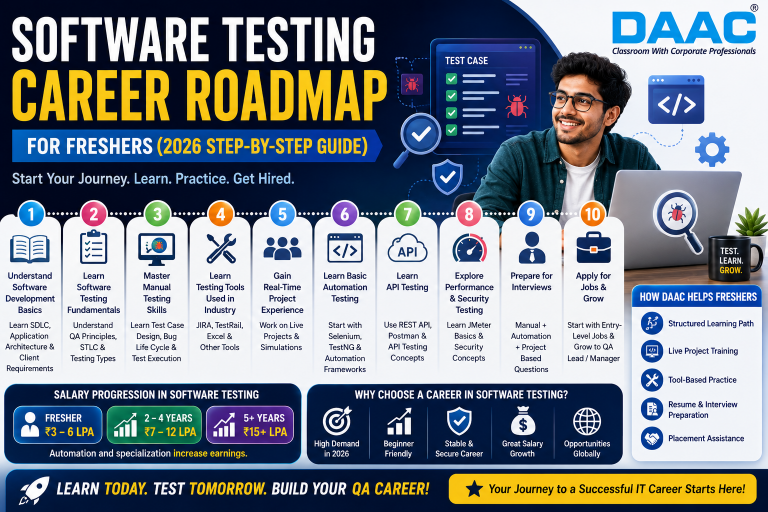
A practical career roadmap could look like this:
- Learn Manual Testing
- Understand SDLC and STLC
- Learn SQL Basics
- Learn Programming
- Move to Automation Testing
- Learn Advanced Testing Frameworks
This structured approach creates stronger long-term career growth.
Skills Required to Become a Successful Automation Tester
Automation testing requires both testing expertise and technical knowledge.
Important skills include:
- Programming fundamentals
- Selenium automation
- API testing
- Test frameworks
- CI/CD concepts
- Version control systems
- Database testing
Many professionals also learn development technologies through a Full Stack Developer Course in Jaipur to better understand application architecture and strengthen their automation capabilities.
Having development knowledge gives automation engineers a competitive advantage in today’s software industry.
How DAAC Prepares Students for Software Testing Careers
A quality software testing program should combine theory with practical implementation.
Students should receive training in:
- Manual testing concepts
- Bug tracking tools
- Test case creation
- Automation frameworks
- Real-time projects
- Interview preparation
- Placement support
Hands-on experience remains one of the most important factors employers consider during recruitment.
Working on live projects helps students understand real-world testing scenarios and improves confidence during technical interviews.
Future of Software Testing Beyond 2026
The software testing industry is evolving rapidly due to artificial intelligence, machine learning, and cloud technologies.
Future trends include:
- AI-assisted testing
- Self-healing automation frameworks
- Predictive defect analysis
- Continuous testing pipelines
- Cloud-based testing environments
While automation adoption will continue growing, manual testing skills will remain valuable because software quality still requires human judgment and domain expertise.
Professionals who combine both manual and automation skills will have the strongest career prospects in the coming years.
Conclusion
The debate between manual testing and automation testing should not be viewed as choosing one over the other. Instead, students should see them as complementary skills that work together in modern software development.
Manual testing provides the foundation needed to understand quality assurance principles, software behavior, and user expectations. Automation testing builds upon that foundation by improving efficiency, scalability, and career growth opportunities.
For beginners entering the software testing industry in 2026, starting with manual testing and gradually transitioning into automation testing is often the most practical and rewarding career path. Professionals who master both areas will enjoy better job opportunities, stronger salary growth, and long-term relevance in the evolving technology landscape.
FAQs
1. Should I learn manual testing before automation testing?
Yes. Manual testing helps build a strong understanding of software testing fundamentals, making automation concepts easier to learn later.
2. Is automation testing replacing manual testing?
No. Automation testing is growing rapidly, but manual testing remains essential for usability, exploratory, and user experience testing.
3. Which testing career offers a higher salary?
Automation testing generally offers higher salaries because it requires programming skills and advanced technical expertise.
4. Is coding mandatory for automation testing?
Yes. Basic programming knowledge is required to create, maintain, and execute automation scripts effectively.
5. Can freshers get jobs in software testing in 2026?
Absolutely. Software testing remains one of the most accessible entry-level IT career paths, with opportunities available in both manual and automation testing.