
The question what is Salesforce developer is becoming increasingly relevant as businesses continue adopting cloud-based customer relationship management (CRM) platforms. A Salesforce developer is a technology professional who builds, customises, and maintains applications on the Salesforce platform to help organisations manage customer information, automate business processes, and improve operational efficiency. These professionals use programming languages, development frameworks, APIs, and CRM tools to create solutions according to business requirements.
Salesforce is widely used across industries such as banking, healthcare, retail, education, real estate, and information technology. As companies look for better ways to manage customer relationships, the need for skilled Salesforce professionals continues to create opportunities for developers. Understanding the responsibilities, technical knowledge, and career possibilities associated with this role can help aspiring developers plan their professional journey.
Who Is a Salesforce Developer? What Is Salesforce Developer?
A Salesforce developer is a software development professional who works with the Salesforce CRM ecosystem to create customised applications, improve existing functionality, and connect different business systems. Unlike professionals who only configure CRM settings, developers use programming and technical tools to build advanced solutions that address specific organisational requirements.
Their work involves understanding business processes, developing application features, managing customer data, and ensuring that Salesforce applications operate efficiently. They collaborate with administrators, business analysts, project managers, and other developers throughout the development process.
Definition and Responsibilities
The primary responsibility of a Salesforce developer is to customise and extend the platform beyond its standard capabilities. Businesses often require features that are not available through default configurations. Developers solve these requirements through custom programming, application development, and integrations.
Common responsibilities include:
- Understanding business requirements and converting them into technical solutions.
- Developing custom applications using Apex and Lightning Web Components.
- Creating custom objects, fields, validation rules, and database relationships.
- Writing queries to retrieve and manage CRM information.
- Integrating Salesforce with external applications through APIs.
- Testing applications and identifying technical errors.
- Maintaining application security, performance, and scalability.
- Updating existing features according to changing business needs.
For example, an organisation may want an automated customer follow-up system. A developer can create custom functionality that tracks customer interactions, manages follow-up activities, and connects relevant information with other business applications.
These responsibilities require technical knowledge as well as an understanding of how businesses use CRM platforms.
Importance in Salesforce Projects
Salesforce projects involve more than installing software and adding customer records. Organisations frequently need customised workflows, reporting systems, dashboards, integrations, and applications that match their operational requirements.
This is where developers become important members of implementation teams.
They help businesses:
Improve business efficiency: Developers create automated solutions that reduce repetitive manual work and improve productivity.
Customise CRM functionality: Custom applications allow organisations to manage processes that standard Salesforce features may not fully support.
Connect business applications: API integrations enable information exchange between Salesforce and accounting, marketing, payment, and enterprise systems.
Improve customer experiences: Developers create applications that help teams access relevant customer information and respond more effectively.
Maintain system performance: Proper coding, testing, and database management help applications remain reliable as business requirements grow.
A well-developed Salesforce solution can help organisations improve data management, customer communication, reporting accuracy, and operational performance.
Types of Salesforce Developers
Different projects require different technical specialisations. Salesforce professionals can develop expertise in several areas depending on their interests and programming knowledge.
- Salesforce Platform Developer: Builds custom applications, business logic, and platform functionality using Apex, SOQL, and other development tools.
- Lightning Web Components Developer: Creates interactive user interfaces using JavaScript, HTML, CSS, and the LWC framework.
- Salesforce Integration Developer: Connects Salesforce with external applications using REST APIs, SOAP APIs, and integration technologies.
- Salesforce Commerce Developer: Works on customised commerce experiences, product catalogues, and online purchasing functionality.
- Salesforce Marketing Cloud Developer: Develops customer engagement solutions, marketing automation, and data-driven communication systems.
The right specialisation depends on the developer’s technical background, project experience, and long-term career goals.
Key Salesforce Developer Skills Required for Professional Development
A successful developer needs a combination of programming knowledge, CRM understanding, database management, and problem-solving abilities. Learning the Salesforce platform alone is not enough because professional projects require developers to understand how different technologies work together.
Developing these technical abilities through structured practice can help beginners prepare for real-world assignments and improve their employment opportunities.
Apex Programming Language
Apex is Salesforce’s proprietary, strongly typed, object-oriented programming language. It allows developers to implement business logic, process records, create automation, and customise platform behaviour.
Its syntax is similar to Java, making it relatively familiar to developers who already understand object-oriented programming concepts.
Important Apex concepts include:
- Variables and data types: Store and manage different types of information.
- Classes and objects: Organise reusable application functionality.
- Methods: Perform specific operations within an application.
- Triggers: Execute custom logic when records are inserted, updated, deleted, or restored.
- SOQL: Retrieve Salesforce records using structured queries.
- DML operations: Insert, update, delete, and manage database records.
- Exception handling: Identify and manage errors during application execution.
- Test classes: Verify application functionality and support reliable deployments.
For example, a company may need to calculate a discount automatically when a sales opportunity reaches a particular stage. A developer can use Apex to implement the required business rules.
Understanding bulk processing, governor limits, and secure coding practices is equally important. These concepts help developers build applications that work efficiently within Salesforce platform restrictions.
Lightning Web Components (LWC)
Lightning Web Components is a modern framework used to develop reusable and responsive user interfaces on the Salesforce platform. It uses standard web technologies such as JavaScript, HTML, and CSS.
LWC allows developers to build interactive components that improve the experience of Salesforce users.
Important concepts include:
Component structure: Developers organise application interfaces into reusable components that perform specific functions.
JavaScript fundamentals: JavaScript handles application logic, user interactions, and dynamic behaviour.
HTML templates: HTML defines the structure and presentation of individual components.
CSS styling: Styling creates responsive interfaces that follow consistent design principles.
Component communication: Developers exchange information between components to create connected application experiences.
Salesforce data services: Wire services and Lightning Data Service help components access and manage platform information.
For example, a business may need a customised dashboard that displays customer details, sales performance, and recent activities. LWC allows developers to create an interactive interface that presents this information clearly.
Learning LWC alongside Apex gives developers the ability to work on both frontend interfaces and backend business logic.
Salesforce Data Modeling
Data modelling is another essential part of professional Salesforce development. It involves organising business information into objects, fields, relationships, and records so that applications can store and retrieve data accurately.
Developers must understand how different types of information are connected within a CRM environment.
Important concepts include:
- Standard objects: Predefined objects such as Accounts, Contacts, Leads, and Opportunities.
- Custom objects: Objects created to store organisation-specific information.
- Fields: Individual attributes that describe records.
- Relationships: Connections between different objects using lookup and master-detail relationships.
- Validation rules: Conditions that help maintain accurate data entry.
- Security settings: Controls that determine who can access or modify records.
For example, a training organisation may use Salesforce to manage students, courses, enquiries, admissions, and payment records. Proper data relationships help connect these records and make information easier to manage.
A strong understanding of data modelling, SOQL queries, security, and database design helps developers create reliable applications.
Daily Responsibilities of a Salesforce Developer
The daily work of a developer depends on the organisation, project requirements, and experience level. Some professionals focus mainly on application development, while others work on integrations, automation, debugging, and system maintenance.
Most projects follow a structured development process that includes requirement analysis, solution planning, coding, testing, deployment, and ongoing improvements.
Custom Application Development
One of the main responsibilities involves creating customised applications according to business needs.
Standard Salesforce features may not provide every functionality required by an organisation. Developers use Apex, LWC, custom objects, and other platform capabilities to create additional features.
Typical development activities include:
- Understanding the application requirements.
- Planning the database structure and application architecture.
- Developing frontend components using LWC.
- Implementing backend functionality using Apex.
- Connecting components with Salesforce records.
- Testing application behaviour.
- Deploying the completed solution.
For instance, an organisation may need a custom customer support application that allows employees to register complaints, assign support teams, monitor progress, and update customers.
A developer can create this functionality using Salesforce tools and programming concepts.
Custom application development requires attention to usability, security, performance, and maintainability. Developers must also ensure that new features work correctly with existing applications.
System Integrations and APIs
Modern businesses use multiple software applications to manage different operations. Salesforce may need to communicate with payment gateways, ERP systems, websites, email platforms, and third-party applications.
Developers use APIs to establish communication between these systems.
Important integration concepts include:
- REST APIs: Enable applications to exchange information through HTTP-based requests.
- SOAP APIs: Support structured communication between different software systems.
- HTTP methods: GET, POST, PATCH, and DELETE perform different operations.
- Authentication: Protects application communication through authorised access.
- JSON: Provides a commonly used format for exchanging structured information.
- Named Credentials: Help manage authentication and endpoint configuration securely.
For example, an e-commerce company may want customer orders created on its website to appear automatically in Salesforce. An integration developer can establish the connection so that relevant information moves between both systems.
Understanding API documentation, authentication methods, error handling, and data formats is important for developing reliable integrations.
Automation and Workflow Creation
Automation helps organisations reduce repetitive tasks and maintain consistent business processes. Salesforce provides tools such as Flow Builder, Apex, and platform events to support different automation requirements.
Developers work with these technologies to create solutions that execute specific actions when business conditions are met.
Common examples include:
- Automatically assigning new customer enquiries to sales representatives.
- Sending notifications when important records are updated.
- Updating related records after specific business events.
- Creating follow-up tasks for customer support teams.
- Validating information before saving records.
- Automating approval-related business processes.
Salesforce Flow is particularly useful for automating many processes without writing extensive code. Developers must understand when declarative automation is sufficient and when custom Apex logic is more appropriate.
The ability to select the right approach helps prevent unnecessary complexity and improves application maintainability.
Salesforce Developer Career Path and Salary Expectations
A Salesforce developer career offers opportunities across software development companies, consulting firms, IT service providers, and organisations that use CRM platforms.
Career progression generally depends on technical knowledge, practical experience, certifications, communication skills, and the ability to handle increasingly complex projects.
As professionals gain experience, they can move towards specialised development positions, technical leadership, and solution architecture.
Entry-Level Salesforce Developer Roles
Beginners can start their professional journey by learning CRM fundamentals, programming concepts, and Salesforce development tools.
Entry-level opportunities may include:
- Junior Salesforce Developer
- Salesforce Development Trainee
- Associate Salesforce Developer
- Salesforce Administrator
- Junior CRM Developer
- Salesforce Support Developer
Some organisations prefer candidates with programming knowledge, while others offer opportunities to individuals who have completed structured Salesforce training and demonstrated practical project skills.
Freshers should focus on understanding Apex, SOQL, LWC, data modelling, and basic application development.
Creating projects such as a student management application, customer enquiry system, or sales tracking dashboard can demonstrate practical knowledge to potential employers.
Mid-Level and Senior Opportunities
After gaining professional experience, developers can take responsibility for more complex technical assignments and enterprise-level applications.
Mid-level professionals generally work on custom application development, API integrations, advanced automation, performance optimisation, and debugging.
With further experience, they can explore positions such as:
Senior Salesforce Developer: Handles complex development requirements, reviews code, and supports junior team members.
Salesforce Technical Lead: Coordinates development activities, reviews technical solutions, and guides project implementation.
Salesforce Consultant: Understands business requirements and recommends suitable CRM solutions.
Salesforce Architect: Designs scalable application structures, integration strategies, security models, and enterprise-level technical solutions.
Continuous learning is important because Salesforce regularly introduces new platform features, development capabilities, and technologies. Developers who remain updated can adapt to changing project requirements.
Salesforce Developer Salary Trends
The Salesforce developer salary depends on several factors, including experience, technical specialisation, certifications, location, company size, and project complexity.
In India, entry-level professionals generally earn less than experienced developers. Professionals with strong Apex, LWC, API integration, and enterprise project experience may access better compensation opportunities.
The following figures are indicative career-planning estimates rather than guaranteed salary offers:
| Experience Level | Indicative Annual Salary |
|---|---|
| Fresher (0–1 year) | ₹3–6 LPA |
| Junior (1–3 years) | ₹5–9 LPA |
| Mid-level (3–5 years) | ₹8–15 LPA |
| Senior (5–8 years) | ₹12–22 LPA |
| Lead / Architect (8+ years) | ₹18–35+ LPA |
Actual compensation can fall outside these ranges depending on the employer and candidate profile. Salary reports also differ because some measure job postings, while others use employee-reported compensation.
Candidates should focus on developing practical expertise rather than choosing a learning path based only on salary expectations. Strong project experience, problem-solving abilities, and relevant certifications can improve long-term career prospects.
How to Become a Salesforce Developer
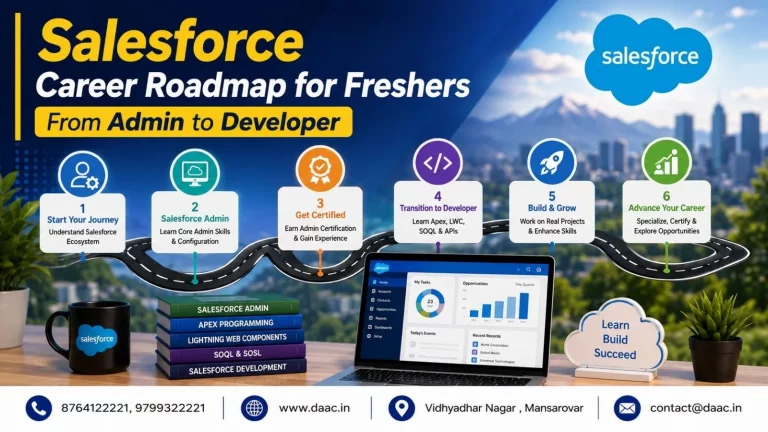
Building a career in Salesforce development requires a planned learning approach. Beginners should start with CRM fundamentals, gradually develop programming knowledge, and apply their skills through practical projects.
DAAC offers a Salesforce training programme in Jaipur that covers administration, Apex, Visualforce, Lightning Web Components, automation, integrations, and project-based learning. Its structured programme can help learners understand the development ecosystem and prepare for professional responsibilities.
For individuals exploring an IT course in Vidhyadhar Nagar Jaipur, selecting a programme with practical training, experienced mentors, and career guidance can provide a useful starting point.
The following steps can help aspiring professionals prepare for this career.
Learn Salesforce Fundamentals
Start by understanding what CRM means and how organisations use Salesforce to manage customer information, sales activities, and business processes.
Learn the Salesforce interface, objects, records, fields, relationships, reports, dashboards, and security settings.
Once the fundamentals are clear, move towards Apex programming, SOQL, triggers, and Lightning Web Components.
Beginners should also develop a foundation in JavaScript, HTML, CSS, and object-oriented programming. These technologies support the development of customised applications.
Practice regularly by creating small applications and exploring different platform features. Consistent practical learning makes complex development concepts easier to understand.
Earn Salesforce Certifications
Salesforce certifications help professionals validate their platform knowledge and demonstrate their understanding of specific technical areas.
Some relevant certifications include:
- Salesforce Certified Platform Developer I: Validates foundational Salesforce development knowledge.
- Salesforce Certified Platform Developer II: Focuses on advanced development capabilities and complex technical solutions.
- Salesforce Certified Administrator: Demonstrates knowledge of platform configuration, user management, and administration.
- Salesforce Certified JavaScript Developer I: Validates JavaScript knowledge relevant to modern application development.
Candidates should select certifications according to their experience and career goals. Certification preparation should include hands-on practice rather than relying entirely on theoretical study.
Build Projects and Gain Experience
Practical experience is one of the most important parts of becoming job-ready. Developers should build projects that demonstrate their ability to solve business problems using Salesforce technologies.
Useful beginner projects include:
- Student admission and management system.
- Customer relationship tracking application.
- Sales performance dashboard.
- Automated customer enquiry management system.
- Support ticket management application.
Work with Salesforce Developer Edition or suitable practice environments to explore development features and test applications.
Document your projects, explain the technical decisions, and maintain a portfolio that demonstrates your coding and problem-solving abilities.
DAAC’s Salesforce course in jaipur includes practical projects, mentor guidance, certification preparation, and placement assistance. The institute focuses on helping learners develop industry-oriented knowledge through structured training.
With consistent practice, relevant certifications, and a strong project portfolio, aspiring developers can prepare for Salesforce jobs and build a long-term career in the growing CRM technology ecosystem.