If you are interested in website development, you may have heard about PHP. But what is PHP, and why is it still relevant when developers have access to many modern programming languages and frameworks?
PHP is a general-purpose scripting language that is especially suited to web development. It is commonly used on the server side to process requests, work with databases, manage application logic, and generate dynamic web pages.
PHP has been part of web development for decades, but it has continued to evolve. Modern PHP includes improvements in performance, syntax, type handling, error management, and developer productivity.
The language is used in many types of web applications, from content-driven websites to business applications and e-commerce platforms. Popular technologies and platforms in the PHP ecosystem include WordPress, Laravel, Symfony, and various custom-built applications.
For beginners, PHP can be a practical language to learn because its concepts can be applied directly to web development.
PHP Full Form and Meaning
The PHP full form is commonly given as PHP: Hypertext Preprocessor.
Interestingly, PHP is a recursive acronym, meaning the first “P” in PHP refers to PHP itself.
PHP is primarily used as a server-side scripting language. It allows developers to write code that runs on a web server rather than directly in the visitor’s browser.
For example, PHP can process a login form, retrieve customer information from a database, calculate an order total, or generate personalized webpage content.
A simplified definition is:
PHP is a server-side scripting language widely used to build dynamic websites and web applications.
The language can also be used for command-line scripting and other programming tasks, but web development remains one of its best-known applications.
History and Evolution of PHP
PHP has a long history in web development. It originated in the 1990s and was initially created to handle basic web-related tasks.
Over the years, it evolved from a collection of simple scripts into a complete programming language used for sophisticated applications.
Different PHP versions introduced improvements in areas such as:
- Object-oriented programming
- Performance
- Error handling
- Type declarations
- Modern syntax
- Security
- Developer tooling
Modern PHP development is significantly different from early PHP programming.
Frameworks such as Laravel and Symfony have also helped developers build structured and maintainable applications using PHP.
This evolution is important for beginners because learning modern PHP should involve current coding practices rather than relying only on older tutorials.
Why Millions of Websites Still Use PHP
One reason PHP remains popular is its large existing ecosystem.
A huge number of websites and applications have been developed using PHP, creating continued demand for developers who can build, maintain, update, and migrate PHP-based systems.
PHP also works well with common web hosting environments and databases.
Its ecosystem includes:
- WordPress
- Laravel
- Symfony
- Drupal
- WooCommerce
- MySQL
- Apache
- Nginx
Another advantage is the availability of learning resources and developer communities.
Businesses also frequently need PHP developers for website maintenance, custom web applications, e-commerce development, backend programming, and modernization of existing systems.
How PHP Works Behind the Scenes
To understand PHP web development, you need to understand the difference between code that runs in the browser and code that runs on the server.
PHP is primarily a server-side language, which means the PHP code itself is processed before the resulting response reaches the user’s browser.
Client-Side vs Server-Side Languages
A client-side technology runs primarily in the user’s browser.
JavaScript is a common example. HTML and CSS are also processed by the browser to create the visible webpage.
A server-side language runs on the web server.
PHP is commonly used in this role.
The basic difference can be represented as:
Client Side:
Browser → Processes HTML, CSS, JavaScript → Displays webpage
Server Side:
Browser → Sends request → Server processes PHP → Generates response → Browser displays webpage
This separation allows developers to keep application logic and database operations on the server.
PHP Request Processing Explained
Suppose a user opens:
example.com/products.php
The browser sends a request to the web server.
A simplified processing sequence is:
Browser → Web Server → PHP Interpreter → Application Logic → Database → PHP Response → Browser
The server identifies that the requested resource needs PHP processing.
The PHP engine executes the relevant PHP code, performs calculations or database operations if required, and generates an output.
The resulting response is then sent back to the browser.
The browser generally receives the generated HTML rather than the original PHP source code.
This is an important security and architecture concept for beginners learning PHP.
How PHP Generates Dynamic Web Pages
A static webpage generally displays predetermined content.
A dynamic webpage can change depending on user input, database information, login status, time, or other conditions.
For example, an e-commerce website can use PHP to retrieve products from a database and generate a product listing.
A simple flow could be:
User Requests Products → PHP Processes Request → Database Returns Products → PHP Generates HTML → Browser Displays Products
This makes PHP useful for applications where content changes frequently.
Dynamic functionality can include:
- Login systems
- User dashboards
- Product catalogs
- Shopping carts
- Contact forms
- Search systems
- Content management
- Admin panels
Key Features of PHP Programming Language
The popularity of PHP programming is supported by several practical characteristics.
Open-Source and Free to Use
PHP is open-source software and can be used without purchasing a proprietary language license.
Developers can access the source code, documentation, development tools, frameworks, and a large ecosystem of community resources.
This accessibility has contributed to PHP’s widespread adoption.
For students and beginners, the availability of free development environments and learning resources also makes it relatively easy to start experimenting with the language.
Developers can install PHP locally and create projects without requiring expensive software.
Cross-Platform Compatibility
PHP can run across major operating systems, including:
- Windows
- Linux
- macOS
This makes it possible for developers to build and test applications in different development environments.
The language is also compatible with widely used web servers and hosting environments.
Cross-platform development becomes particularly useful when development, testing, and production environments use different operating systems.
Easy Database Integration with MySQL
Database interaction is an important part of most dynamic web applications.
PHP supports interaction with several database systems, with MySQL being one of the most common combinations in traditional PHP web development.
For example, a user registration system might use PHP to:
- Receive registration information.
- Validate the submitted data.
- Connect to a database.
- Store the user’s information.
- Return a success message.
PHP applications can also work with other database technologies, depending on project requirements.
For beginners, learning PHP alongside SQL and database fundamentals provides a stronger understanding of complete web application development.
Essential PHP Syntax Every Beginner Should Know
Learning PHP syntax is one of the first steps in becoming comfortable with the language.
PHP code is commonly embedded within PHP tags, allowing developers to combine server-side programming with HTML.
A basic example looks like:
<?php
echo "Hello World";
?>
The echo statement outputs content.
Beginners should focus on understanding programming logic rather than memorizing every syntax rule.
Variables, Data Types, and Operators
Variables store information that a program needs to use.
In PHP, variables begin with the $ symbol.
For example:
<?php
$name = "Rahul";
$age = 21;
?>
PHP supports different data types, including:
- Strings
- Integers
- Floats
- Booleans
- Arrays
- Objects
- Null
Operators allow developers to perform calculations and comparisons.
Common operators include:
+for addition-for subtraction*for multiplication/for division==for comparison===for strict comparison>and<for comparisons
Understanding variables and operators provides the foundation for writing useful programs.
Conditional Statements and Loops
Programs often need to make decisions.
PHP provides conditional statements such as if, else, and elseif.
For example:
<?php

$age = 20;

if ($age >= 18) {
    echo "Eligible";
} else {
    echo "Not eligible";
}

?>
Loops allow developers to repeat operations.
Common PHP loops include:
forwhiledo...whileforeach
For example, a foreach loop can be used to process items in an array.
These concepts are essential because real applications constantly make decisions and process collections of data.
Functions and Arrays in PHP
Functions allow developers to organize reusable blocks of code.
A simple function can look like:
<?php

function greet($name) {
    return "Hello " . $name;
}

echo greet("Rahul");

?>
Instead of repeating the same logic throughout an application, developers can create a function and call it whenever required.
Arrays allow developers to store multiple values in a single variable.
For example:
<?php

$skills = ["PHP", "MySQL", "HTML", "CSS"];

?>
PHP supports indexed arrays and associative arrays, among other structures.
Understanding functions and arrays is essential before moving toward object-oriented programming and PHP frameworks.
Career Opportunities After Learning PHP
Learning PHP can provide a foundation for several web development career paths.
However, professional opportunities depend on more than knowing basic syntax. Developers should combine PHP with databases, frameworks, frontend technologies, APIs, Git, security, and practical projects.
PHP Developer Roles and Responsibilities
A PHP developer may be responsible for creating, maintaining, testing, and improving web applications.
Typical responsibilities include:
- Writing PHP code
- Developing backend functionality
- Creating APIs
- Connecting applications to databases
- Fixing bugs
- Improving application performance
- Implementing authentication
- Working with frameworks
- Integrating third-party services
- Maintaining existing applications
Common job titles include:
- PHP Developer
- Backend Developer
- Web Developer
- Laravel Developer
- Full Stack Developer
- WordPress Developer
- PHP Application Developer
The exact responsibilities depend on the organization and technology stack.
Salary and Job Market Trends
PHP continues to have a large installed base, which supports demand for developers who can maintain and improve existing applications.
However, salaries vary considerably based on factors such as:
- Experience
- Location
- Technical skills
- Framework knowledge
- Company size
- Project complexity
- Communication skills
Beginners should therefore avoid choosing PHP solely based on salary expectations.
A stronger strategy is to develop skills that increase your value as a developer.
For example, a developer who knows only basic PHP may have fewer opportunities than someone who combines PHP with:
PHP + Laravel + MySQL + JavaScript + Git + REST APIs + HTML/CSS
Students can also improve their career prospects by developing real-world projects and learning modern software development practices.
Best Way to Learn PHP Professionally
The most effective way to learn PHP is through a combination of theory, coding practice, and project development.
A beginner-friendly learning path can be:
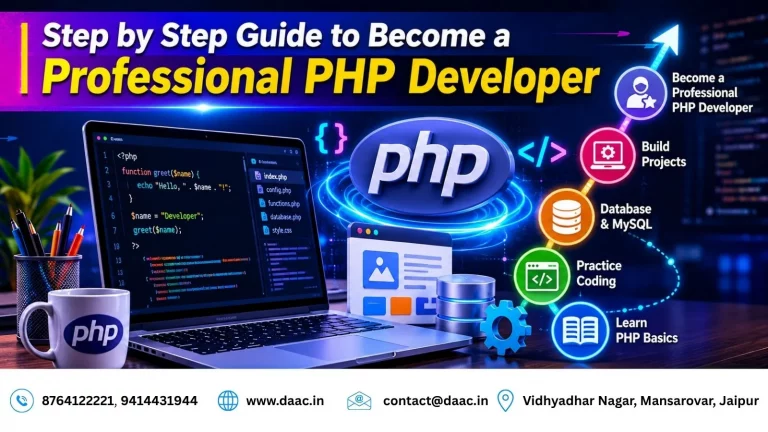
- Learn HTML and CSS fundamentals.
- Understand programming concepts such as variables, conditions, loops, functions, arrays, and object-oriented programming.
- Start PHP programming and practice basic syntax.
- Learn SQL and database concepts.
- Connect PHP applications with MySQL.
- Learn forms, sessions, cookies, authentication, and validation.
- Learn object-oriented PHP.
- Learn a modern framework such as Laravel.
- Understand REST APIs and Git.
- Build real-world projects and deploy them.
Suitable beginner projects include:
- Student management system
- Blog website
- User registration system
- E-commerce website
- Job portal
- Inventory management application
- Business website with an admin panel
For students looking for PHP training in {City}, a structured IT course can make the learning process more organized by combining programming concepts with practical development projects.
At DAAC, students can approach PHP as part of a broader web development skill set and gradually move from basic programming to professional application development.
Final Thoughts
Understanding what is PHP provides beginners with a foundation for entering web development. PHP remains relevant because of its mature ecosystem, large installed base, frameworks, CMS platforms, and ability to build dynamic web applications. While the language has evolved significantly, the core concepts of variables, functions, conditions, loops, databases, and server-side programming continue to be valuable for anyone learning backend development.
For students starting their IT career, PHP becomes more useful when combined with modern development skills. Learning MySQL, Laravel, JavaScript, REST APIs, Git, security, and deployment can help turn basic programming knowledge into practical development capability. If you are considering PHP training in {City}, choose a program that emphasizes coding practice and real-world projects. At DAAC, learners can build their PHP foundation progressively and use it as a pathway toward web development, backend development, WordPress, Laravel, and full stack career opportunities.
Frequently Asked Questions About PHP
1. What is PHP in simple words?
PHP is a server-side scripting language commonly used to create dynamic websites and web applications. It can process user requests, communicate with databases, manage application logic, and generate web content.
2. What is PHP mainly used for?
PHP is mainly used for server-side web development. It can be used to build websites, content management systems, e-commerce applications, APIs, dashboards, portals, and other dynamic web applications.
3. Is PHP easy to learn for beginners?
PHP can be approachable for beginners, especially when they first understand basic programming concepts. Learning HTML, CSS, programming fundamentals, databases, and then PHP can provide a smoother learning experience.
4. Should I learn PHP with MySQL?
Yes. Learning PHP with MySQL can be useful because many web applications need to store and retrieve data. Understanding SQL and database concepts also helps developers work with other database systems.
5. Is PHP still a good career option in 2026?
PHP can still be a useful career skill because of its large ecosystem and existing web applications. Learning modern PHP together with frameworks such as Laravel, databases, APIs, Git, JavaScript, and practical project development can improve career opportunities.