Becoming a Professional PHP Developer in 2026 can be a valuable career choice for students and aspiring IT professionals interested in backend programming. PHP remains widely used for building dynamic websites, content management systems, and web applications. According to W3Techs, PHP powers approximately 69.7% of websites whose server-side programming language is known, highlighting its continued presence in web development.
However, learning basic syntax alone is not enough to become job-ready. You need a strong understanding of web technologies, database management, secure coding, and practical application development. Structured learning, regular practice, and real-world projects can help you build these skills step by step.
1. Understand How the Web Works Before Learning PHP
Before writing PHP code, understand how websites communicate with browsers, servers, and databases. These fundamentals make backend programming easier to learn and help you troubleshoot technical problems effectively.
Learn the Basics of Web Technology
Start with HTTP and HTTPS, URLs, domains, DNS, web servers, sessions, and cookies. Learn how a browser sends a request and how a server processes it before returning a response.
For example, when a user submits a registration form, the browser sends the information to the server. PHP can validate the submitted data, communicate with a database, and return an appropriate response.
Understand Client-Side and Server-Side Development
Client-side technologies control what users see and interact with, while server-side programming handles application logic and data processing. Understanding this distinction helps you identify where PHP fits into a complete web application.
Learners planning to pursue a PHP Development Course in Jaipur should build this foundation before moving to advanced programming concepts.
2. Learn HTML and CSS for Frontend Understanding
Although PHP is primarily a server-side language, knowledge of HTML and CSS helps you build complete web applications. HTML defines page structure, while CSS controls the visual presentation and layout.
Practise HTML Forms and Page Structure
Learn headings, paragraphs, links, images, tables, and forms. Pay particular attention to form elements because they are frequently used to collect information from website visitors.
Practise creating registration forms, login pages, contact forms, and profile pages. Later, use PHP to process and validate the information submitted through these forms.
Understand Responsive Design
CSS helps websites adapt to different screen sizes. Learn layouts, Flexbox, CSS Grid, and media queries to make pages easier to use on mobile devices, tablets, and desktops.
A developer with frontend knowledge can collaborate more effectively with designers and create applications that work smoothly across devices.
3. Set Up a Proper PHP Development Environment
A working development environment allows you to write, run, test, and debug PHP programs. Setting up these tools early helps you develop consistent coding habits.
Install the Required Tools
Start with a supported PHP version, a local development environment, and a code editor such as Visual Studio Code. Tools such as XAMPP can help beginners run PHP and MySQL locally.
Learn how to organise project folders, execute scripts, read error messages, and manage configuration settings. As your skills improve, explore Git for version control and Composer for managing PHP dependencies.
Practise Writing and Debugging Code
Begin with small scripts that display messages, accept user input, perform calculations, and process forms. When an error occurs, read the error message carefully and identify its cause rather than simply copying a corrected solution.
These habits help you become more independent and confident as a developer.
4. Strengthen Your Core PHP Programming Skills
Core PHP provides the foundation for building dynamic websites and backend applications. Mastering its concepts will make advanced frameworks and application architectures easier to understand.
Learn Essential PHP Concepts
Start with variables, data types, operators, conditional statements, loops, arrays, strings, and functions. Practise using these concepts to solve small programming problems.
Next, learn how to handle forms, manage sessions and cookies, validate input, and organise reusable code. These skills are important for creating login systems, registration pages, dashboards, and other common web features.
Explore Object-Oriented Programming
Object-oriented programming, or OOP, helps developers organise code into reusable and maintainable structures. Learn classes, objects, inheritance, interfaces, traits, and encapsulation.
Also practise exception handling, namespaces, and type declarations. As your projects become more complex, these concepts will help you write cleaner code and make applications easier to maintain.
5. Learn MySQL and Database Management
Most dynamic websites need to store and retrieve information. MySQL is commonly used with PHP to manage user accounts, product catalogues, orders, and other application data.
Understand SQL Fundamentals
Learn how to create databases and tables, insert records, retrieve information, update data, and delete records. Practise writing SQL queries using conditions, sorting, joins, and aggregate functions.
You should also understand primary keys, foreign keys, relationships, and database normalisation. These concepts help you structure information accurately and reduce unnecessary duplication.
Connect PHP with MySQL Securely
Learn how PHP applications connect to databases using PDO or MySQLi. Practise retrieving records, inserting new data, updating information, and displaying database results on web pages.
Security is equally important. Use prepared statements to reduce SQL injection risks, validate user input, and apply appropriate access controls. Never store passwords as plain text; use PHP’s password-hashing functions to handle them securely.
6. Learn JavaScript and Backend Integration
PHP handles server-side operations, while JavaScript adds interactivity to the browser. Understanding both technologies helps you develop more responsive and user-friendly applications.
Learn JavaScript Fundamentals
Start with variables, functions, arrays, objects, events, and DOM manipulation. Practise building interactive forms, simple validation messages, dropdown menus, and dynamic page elements.
JavaScript complements PHP by handling interactions in the browser, while PHP processes requests and performs server-side operations.
Understand APIs and Asynchronous Requests
Learn how applications exchange data through APIs. Practise working with JSON, HTTP methods, status codes, and asynchronous requests using JavaScript’s Fetch API.
For example, an application might use JavaScript to request product information from a PHP endpoint without reloading the entire page. Understanding this interaction is useful for developing modern web applications.
7. Build Real-World Projects and Practise Regularly
Practical experience is essential for becoming a capable Professional PHP Developer. Projects help you apply programming concepts, identify mistakes, and demonstrate your skills to potential employers.
Start with Beginner-Friendly Projects
Build small applications such as a contact form, calculator, personal blog, or basic registration system. These projects help you practise form processing, validation, functions, and database operations.
Once you are comfortable with the basics, move on to more complex applications such as an inventory management system, an appointment booking website, or an e-commerce platform.
Develop a Complete Database-Driven Application
Choose a project that includes user authentication, database integration, CRUD operations, and appropriate error handling. Add role-based access where needed and test the application with different types of input.
A structured learning programme, such as a PHP Development Course in Jaipur, can help learners follow a progressive path from programming fundamentals to practical project development.
8. Learn Advanced PHP Concepts and Modern Development Practices
After mastering the fundamentals, explore the tools and techniques used to build larger, maintainable applications. These skills help you move beyond simple scripts and understand professional development workflows.
Understand MVC Architecture and PHP Frameworks
Model-View-Controller (MVC) separates application data, user interface, and business logic. This structure makes larger applications easier to organise and maintain.
Explore frameworks such as Laravel or Symfony after developing a solid understanding of core PHP. Learn routing, controllers, templates, middleware, validation, authentication, and database migrations.
Focus on Testing, Security, and Code Quality
Learn to write reusable functions, follow consistent coding standards, and test important application behaviour. Explore automated testing tools and understand how to identify common security risks.
You should also learn the basics of deployment, environment configuration, logging, and application maintenance. Use supported PHP versions and apply security updates regularly. The official PHP documentation provides version-support information that can help developers make informed maintenance decisions.
9. Join Developer Communities and Keep Learning
Web development changes over time, so continuous learning is important for professional growth. Developer communities provide opportunities to explore new tools, discuss technical problems, and learn from other programmers.
Use Documentation and Developer Resources
Read official PHP documentation when learning a new function or feature. Practise by modifying examples and building small applications instead of relying entirely on tutorials.
GitHub can help you explore open-source projects, understand coding practices, and maintain your own repositories. Reviewing well-organised code also helps you learn how experienced developers structure applications.
Improve Problem-Solving and Collaboration Skills
Practise debugging, explaining your code, reviewing feedback, and documenting your work. These skills are useful when collaborating with developers, designers, testers, and project managers.
Keep learning about secure coding, performance optimisation, API integration, and modern development workflows as your experience grows.
10. Build a Strong Portfolio and Apply for Jobs
A portfolio gives employers practical evidence of your development skills. Instead of relying only on certificates, demonstrate what you can build and how you approach technical challenges.
Showcase Your Best Projects
Select two or three well-developed projects that demonstrate different skills. Include a clear project description, the technologies used, key features, and screenshots or a live demonstration where possible.
Keep your code organised and document how to install and run each project. Remove passwords, API keys, and other confidential information before publishing code publicly.
Prepare for Interviews and Entry-Level Roles
Revise PHP fundamentals, OOP, SQL queries, database relationships, security practices, and debugging techniques. Practise explaining how your projects work and why you selected particular approaches.
Depending on your skills and experience, explore opportunities such as junior PHP developer, backend developer, web developer, or PHP development intern. Tailor your CV to each role and keep improving your portfolio based on feedback.
Conclusion
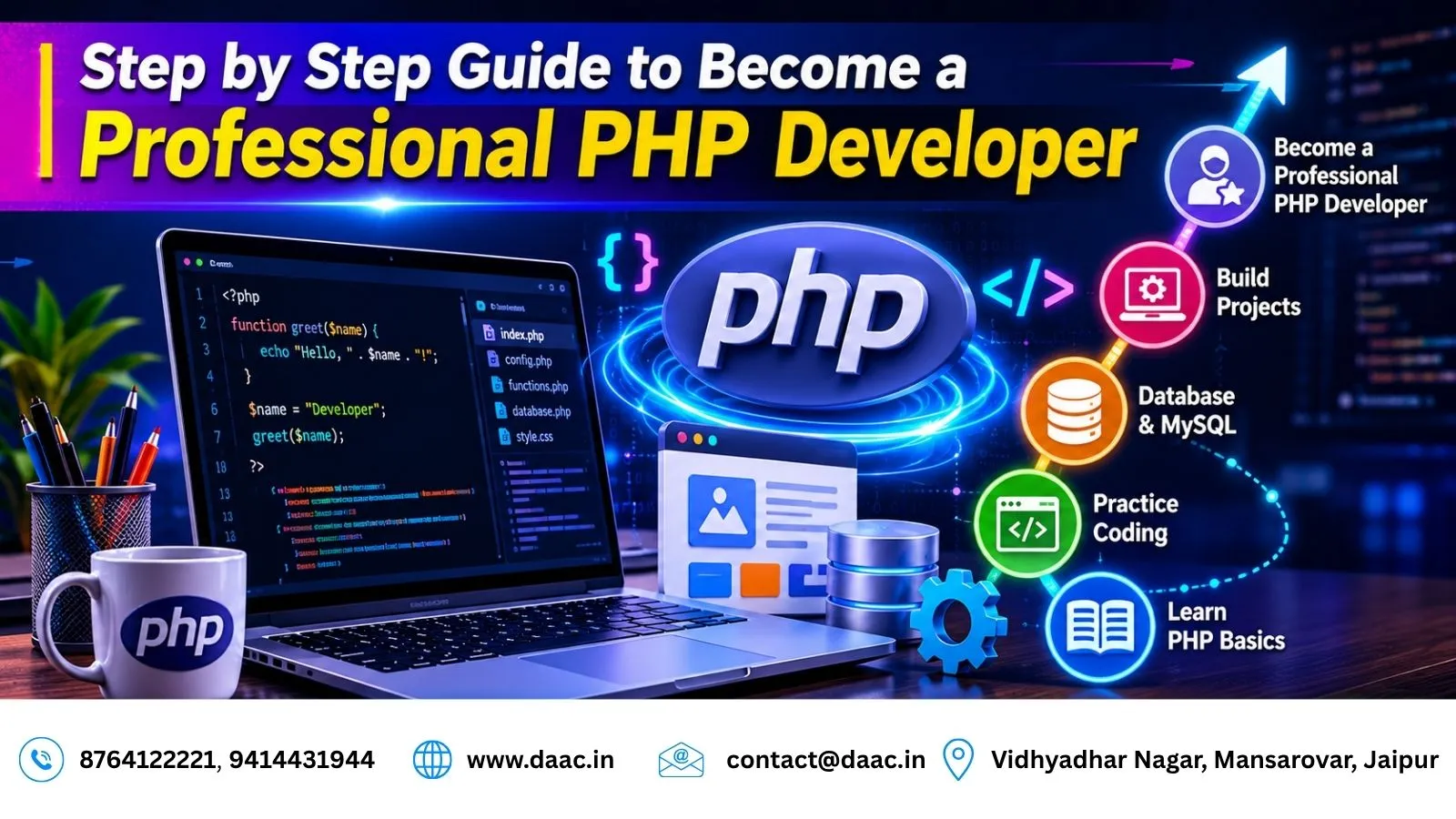
Becoming a Professional PHP Developer requires a combination of programming fundamentals, database knowledge, secure coding practices, and consistent project work. Start with web basics and core PHP, then progress to MySQL, JavaScript, APIs, frameworks, testing, and deployment.
Focus on building applications that solve practical problems rather than simply completing tutorials. A strong portfolio, problem-solving ability, and willingness to learn will help you prepare for development opportunities. DAAC supports aspiring developers through career-focused technical learning and practical skill development, helping learners work towards their web development goals.