Artificial Intelligence has evolved from systems that primarily analyze information to technologies that can create new content. This shift has made generative AI one of the most important areas of modern technology.
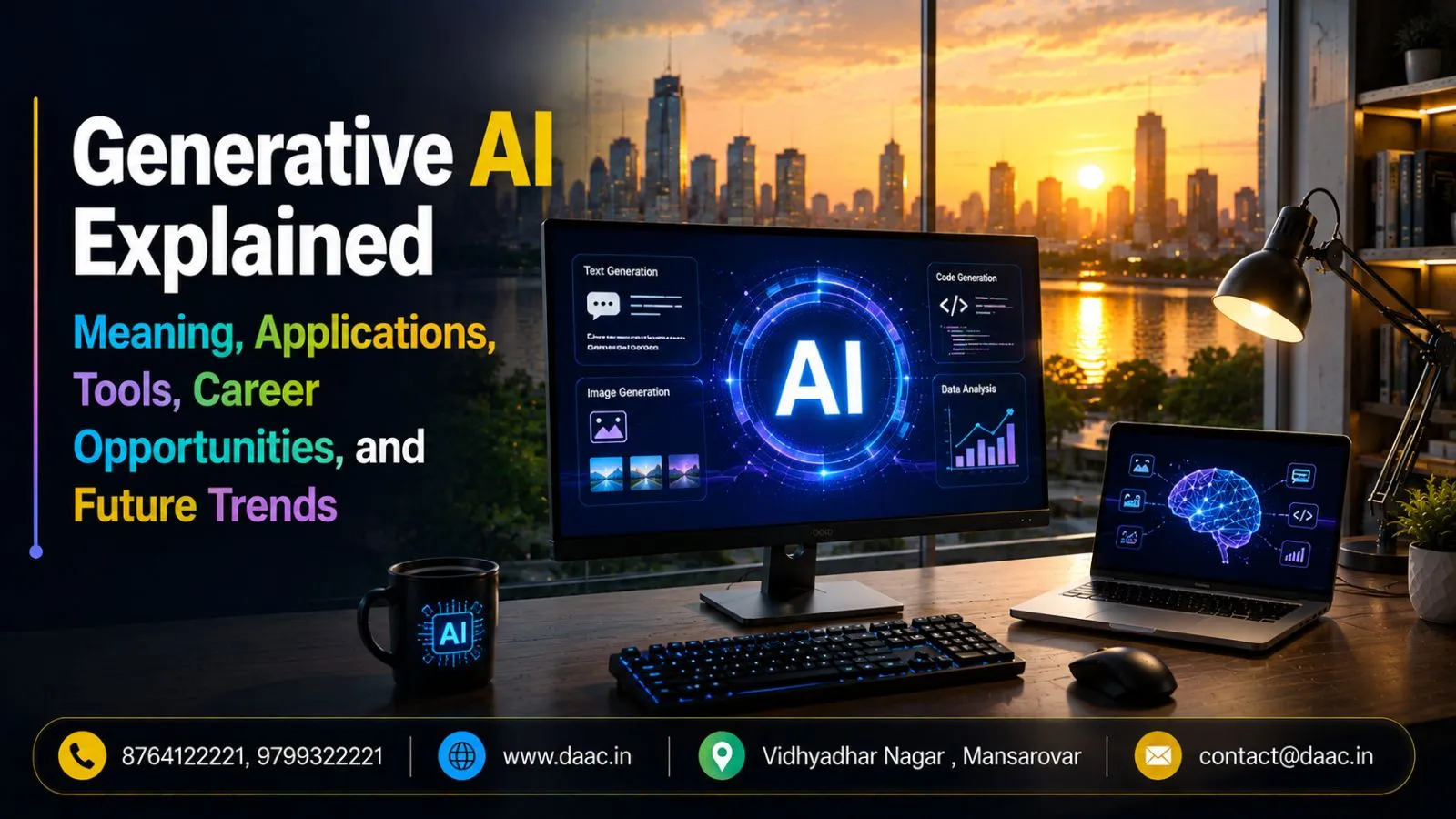
So, what is generative AI? In simple terms, generative AI refers to artificial intelligence systems that can create new content based on patterns learned from large datasets. Depending on the model, that content can include text, images, audio, video, computer code, or other forms of digital output.
For example, a user can provide a text prompt asking an AI system to write an article, generate an image concept, summarize a document, create software code, or analyze information. The system processes the request and produces an output based on its learned patterns and capabilities.
Generative AI is being adopted across industries because it can assist with tasks that traditionally required significant amounts of human time. However, it works best when people provide appropriate instructions, review the output, and apply human judgment.
Generative AI Meaning in Simple Terms
The simplest generative AI meaning is:
Generative AI is a type of artificial intelligence that can create new content in response to user instructions or prompts.
Traditional AI systems are often designed to classify, predict, recommend, or analyze existing information. Generative systems focus on producing new outputs.
For example:
Traditional AI:
“Is this email spam or not?”
Generative AI:
“Write a professional response to this email.”
Similarly:
Traditional AI:
“Identify objects in this image.”
Generative AI:
“Create an illustration of a city based on this description.”
This distinction helps explain why generative systems have attracted significant attention from businesses, educators, developers, designers, and content professionals.
How Generative AI Works Behind the Scenes
At a high level, generative models learn patterns from large datasets during a training process.
For a language model, training can involve processing large amounts of text. The model learns relationships between words, phrases, concepts, and other patterns. When a user enters a prompt, the model generates a response based on those learned patterns.
Modern generative systems can involve technologies such as:
- Neural networks
- Transformer architectures
- Large language models
- Diffusion models
- Machine learning algorithms
- Natural language processing
- Computer vision
The exact architecture depends on what the model is designed to generate.
For instance, large language models are primarily designed to work with language, while diffusion-based systems are widely used for image generation.
It is important to remember that AI-generated content is not automatically factual or correct. Models can produce inaccurate information, so human review remains important, especially in professional and high-stakes situations.
Why Businesses and Professionals Are Adopting Generative AI
Businesses are exploring generative AI because it can assist employees with repetitive and time-consuming tasks.
Common use cases include:
- Drafting content
- Summarizing documents
- Generating marketing ideas
- Creating software code
- Analyzing information
- Producing design concepts
- Customer support assistance
- Research assistance
- Internal knowledge systems
For example, a marketing team may use AI to generate multiple campaign concepts before refining the best one. A developer may use an AI coding assistant to explain existing code or suggest implementation approaches.
The goal is often not to replace every human task but to increase productivity and allow professionals to spend more time on decision-making, creativity, and problem-solving.
Different Types of Generative AI Models
There is no single type of generative AI model. Different models are designed to work with different forms of data and produce different types of outputs.
Understanding these categories provides a useful introduction to generative AI for beginners.
Large Language Models (LLMs)
Large Language Models, commonly known as LLMs, are AI models designed to understand and generate human language.
They can perform tasks such as:
- Answering questions
- Summarizing text
- Generating content
- Translating languages
- Explaining concepts
- Writing code
- Extracting information
- Brainstorming ideas
LLMs are behind many conversational AI applications.
They can also interact with external tools, databases, documents, and software systems depending on how the application is designed.
For students interested in AI careers, understanding concepts such as tokens, prompts, context windows, embeddings, retrieval-augmented generation, and model APIs can provide a stronger technical foundation.
Text-to-Image and Image Generation Models
Image generation models create or modify visual content based on prompts or other inputs.
A user might provide a description such as:
“Create a professional technology classroom with students learning artificial intelligence.”
The model can generate an image based on the concepts contained in that instruction.
These systems are increasingly used for:
- Marketing visuals
- Concept art
- Advertising
- Product concepts
- Social media content
- Graphic design assistance
- Creative experimentation
Image generation technology can accelerate creative workflows, although professional designers still play an important role in concept development, editing, brand consistency, and final production.
Audio, Video, and Multimodal AI Models
Generative AI is no longer limited to text and static images.
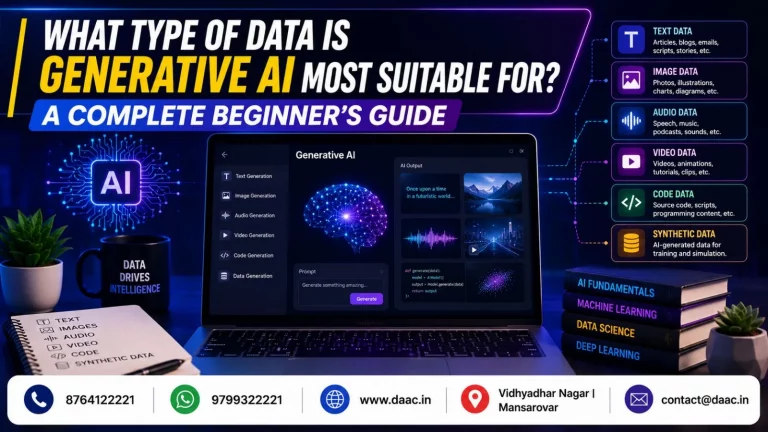
Modern models can work with multiple forms of information, including:
- Text
- Images
- Audio
- Video
- Code
These are often described as multimodal AI systems.
For example, a multimodal system may analyze an image, understand a written question about it, and produce a text response.
Generative audio models can assist with speech and music-related applications, while video generation systems can create or modify visual sequences.
The development of multimodal AI is expanding the range of tasks that AI systems can support.
Top Generative AI Applications Across Industries
The growing number of generative AI applications is one reason the technology has become important for organizations across different sectors.
Its practical value depends on the specific workflow, data, business requirements, and level of human oversight involved.
Generative AI in Content Creation and Marketing
Content teams can use generative AI to accelerate parts of the content production process.
Potential applications include:
- Blog ideation
- Content outlines
- Social media concepts
- Ad copy variations
- Email drafts
- Product descriptions
- Content summarization
- Creative brainstorming
For example, an SEO professional can use an AI tool to brainstorm content topics and outline an article. The professional can then verify information, add original insights, optimize the content for search intent, and edit it for accuracy and quality.
This approach is more effective than publishing unreviewed AI-generated content.
Marketing teams can also use AI to generate variations of messages for different audiences. Human marketers remain responsible for brand positioning, factual accuracy, strategy, and compliance.
Generative AI in Healthcare and Drug Discovery
Healthcare is another field where AI is being explored for research, documentation, and analysis.
Potential applications include:
- Medical research assistance
- Document summarization
- Clinical workflow support
- Drug discovery research
- Molecular design
- Healthcare documentation
In drug discovery, AI models can help researchers explore potential molecular structures and analyze large amounts of scientific information.
However, healthcare applications require particularly strong validation, privacy protection, regulatory compliance, and expert oversight. Generative AI should not be treated as an independent replacement for qualified medical professionals or established clinical processes.
Generative AI in Education, Software Development, and Design
Education is another area where generative systems can support personalized learning.
Students can use AI tools to:
- Explain difficult concepts
- Generate practice questions
- Summarize study material
- Brainstorm project ideas
- Receive programming explanations
Teachers can use AI to assist with lesson planning, activity ideas, and educational material preparation.
Software development is also being transformed. AI coding assistants can generate code suggestions, explain functions, identify potential issues, and help developers work through programming problems.
Designers can use generative systems for rapid concept creation, visual exploration, and prototyping.
For students at DAAC, these applications demonstrate why learning AI alongside existing technical skills can be valuable across fields such as programming, web development, digital marketing, and design.
Popular Generative AI Tools You Should Know
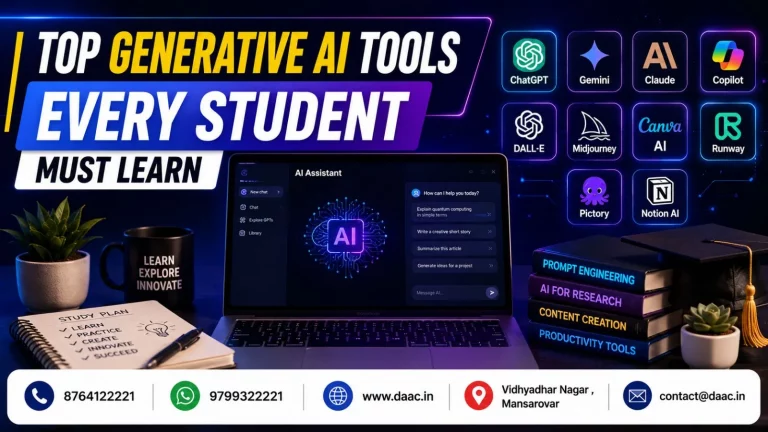
The ecosystem of generative AI tools has expanded rapidly. Different tools are designed for different purposes, so beginners should understand their use cases instead of assuming that one tool is best for every task.
ChatGPT, Gemini, and Claude
Conversational AI platforms can assist users with tasks involving language, reasoning, research, writing, brainstorming, and programming.
ChatGPT is used for conversational assistance, content generation, coding support, analysis, and many other tasks.
Gemini is Google’s AI platform and is designed to support a broad range of text and multimodal use cases.
Claude is an AI assistant developed by Anthropic and is known for applications involving writing, analysis, coding, and working with large amounts of information.
The capabilities of these platforms change over time, so students should focus on understanding general AI concepts rather than learning only one interface.
Midjourney, Adobe Firefly, and DALL·E
Visual generation tools are designed to help users create images from natural-language instructions.
They can support:
- Concept development
- Advertising visuals
- Creative experimentation
- Illustrations
- Design workflows
- Social media graphics
Adobe Firefly is integrated into Adobe’s creative ecosystem, while Midjourney is widely associated with AI-generated visual creation.
DALL·E has also been used for generating images from textual descriptions.
When using AI-generated visuals commercially, users should understand the applicable tool terms, licensing conditions, and intellectual-property considerations.
GitHub Copilot and AI Coding Assistants
AI coding assistants are changing how developers approach programming tasks.
They can assist with:
- Code completion
- Function generation
- Code explanation
- Documentation
- Debugging assistance
- Refactoring suggestions
- Test generation
GitHub Copilot is one well-known example.
However, developers should not blindly accept generated code. AI-generated code needs to be reviewed, tested, secured, and adapted to the application’s requirements.
This makes programming fundamentals even more important. Developers who understand algorithms, databases, security, APIs, and software architecture are better positioned to evaluate AI-generated suggestions.
Career Opportunities and Future Scope of Generative AI
The growth of generative AI is creating new opportunities while also changing existing technology roles.
Learning AI does not necessarily mean that every student needs to become a machine learning researcher. Different career paths require different levels of technical expertise.
In-Demand Generative AI Skills
Students preparing for an AI-focused career can develop a combination of technical and practical skills.
Important areas include:
AI Fundamentals:
Understand machine learning, neural networks, model training, inference, and generative model concepts.
Programming:
Python is particularly useful for AI and machine learning development. Knowledge of APIs and software development is also valuable.
Prompt Engineering:
Learn how to create clear instructions, provide context, structure inputs, and evaluate outputs.
Data Skills:
Understand data preparation, databases, embeddings, vector databases, and information retrieval.
Generative AI Development:
Explore model APIs, LLM applications, RAG systems, AI agents, evaluation, and application integration.
Responsible AI:
Understand issues involving privacy, bias, security, copyright, hallucinations, and human oversight.
A combination of these skills can be more valuable than knowing how to use a single AI application.
Career Paths After Learning Generative AI
Generative AI can complement several existing technology careers.
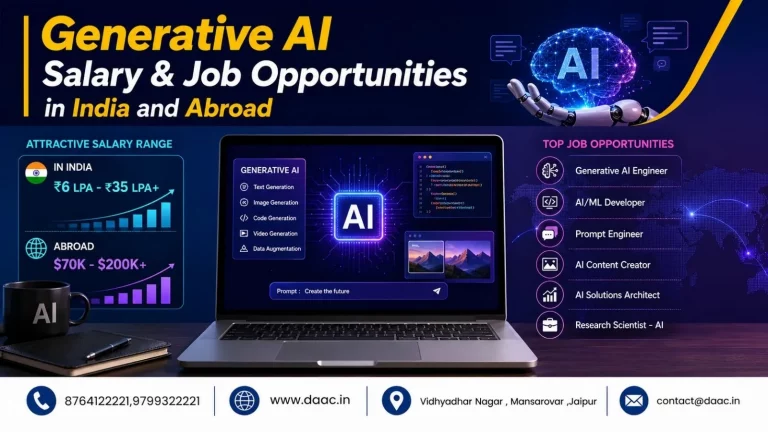
Potential roles include:
- Generative AI Developer
- AI/ML Engineer
- Machine Learning Engineer
- AI Application Developer
- Prompt Engineer
- AI Automation Specialist
- AI Solutions Architect
- Data Scientist
- AI Product Specialist
- AI Consultant
Some roles require advanced mathematics and machine learning knowledge, while others focus more on integrating existing AI models into business applications.
For beginners, a practical progression could be:
Programming Fundamentals → Python → AI Fundamentals → Machine Learning Basics → Generative AI → LLMs → APIs → RAG → AI Applications → Projects
Building projects is particularly important. A student could create a document question-answering system, AI chatbot, content assistant, coding assistant, or business automation tool.
Future Trends and Industry Growth
Generative AI is likely to continue influencing software, business, education, marketing, design, and research.
Several trends are particularly important.
Multimodal AI:
AI systems are increasingly capable of working across text, images, audio, video, and other forms of information.
AI Agents:
AI applications are moving beyond generating responses toward systems that can plan tasks, use tools, access information, and complete multi-step workflows.
AI-Powered Software Development:
Coding assistants are becoming part of everyday development workflows, supporting developers with coding, testing, documentation, and debugging.
Smaller and Specialized Models:
Organizations may increasingly use models optimized for specific tasks, environments, cost requirements, or privacy needs.
Enterprise AI Adoption:
Businesses are integrating AI into internal knowledge systems, customer support, analytics, automation, and productivity workflows.
Responsible AI:
As adoption grows, organizations will place greater emphasis on security, privacy, transparency, evaluation, governance, and human oversight.
For students entering the IT industry, this means AI literacy can become a useful complementary skill across many technology careers.
Final Thoughts
Understanding what is generative AI is becoming increasingly important for students and professionals entering the technology industry. The technology can generate text, images, audio, video, and code, while its applications are expanding across marketing, healthcare, education, software development, research, and design. However, effective AI adoption requires more than knowing how to write prompts. Understanding programming, data, AI fundamentals, evaluation, security, and responsible usage can make these tools significantly more useful.
For students planning an IT career, generative AI can be learned alongside existing technical skills rather than treated as an isolated subject. A structured Generative AI course in {City} can help learners move from basic AI concepts to practical applications, APIs, projects, and modern AI workflows. At DAAC, students can build their foundation progressively and explore how generative AI can complement careers in software development, web development, automation, data, an
Frequently Asked Questions About Generative AI
1. What is generative AI in simple words?
Generative AI is artificial intelligence that can create new content such as text, images, audio, video, and code based on user instructions or other inputs. It learns patterns from data and uses those patterns to generate outputs.
2. What are some examples of generative AI?
Examples include AI chatbots that generate text, image-generation systems that create visuals from prompts, AI coding assistants that suggest software code, and multimodal systems that work with multiple types of information.
3. What is generative AI used for?
Generative AI is used for content creation, software development, marketing, education, design, research, customer support, document processing, and other workflows where generating or transforming information can improve productivity.
4. Which skills are needed to learn generative AI?
Beginners can start with programming fundamentals, Python, AI and machine learning basics, prompt engineering, APIs, data concepts, and practical generative AI applications. Advanced roles may require deeper knowledge of mathematics, machine learning, and model development.
5. Is generative AI a good career option in 2026?
Generative AI can be a valuable career area because organizations are adopting AI across many workflows. Students can explore roles in AI development, machine learning, automation, data science, AI application development, and AI consulting depending on their technical background.d other technology domains.