Generative AI is becoming one of the fastest-growing areas in the technology industry. Students and fresh graduates are increasingly asking whether choosing a Generative AI Career 2026 is a smart decision or just a trending hype. With companies rapidly adopting AI tools for automation, content creation, coding, and analytics, understanding the real scope of this field is extremely important.
This article explains the truth behind Generative AI careers, clears common myths, and shows real opportunities in AI Career Opportunities and Artificial Intelligence Jobs for students in 2026.
What is Generative AI in Simple Terms?
Generative AI is a branch of artificial intelligence that can create new content such as text, images, videos, and even code. Tools like ChatGPT, image generators, and AI coding assistants are real examples of this technology.
This technology is not just a trend; it is actively shaping the Future of AI Careers by transforming industries like IT, marketing, healthcare, and education. As a result, demand for skilled professionals in a Generative AI Career 2026 is increasing rapidly.
Why Generative AI Career is Growing So Fast
The rise of Generative AI is driven by real industry needs and global digital transformation.
1. High Industry Demand
Companies are adopting AI systems to automate tasks and improve productivity. This is creating massive growth in Artificial Intelligence Jobs across industries.
2. Business Automation Trends
Organizations are investing heavily in AI tools to reduce manual work, leading to new AI Career Opportunities for skilled professionals.
3. Attractive Salary Growth
Due to limited skilled professionals, AI Salary Trends 2026 are showing strong growth in both India and global markets.
4. Student Interest in Technology
More students are choosing AI-based careers after graduation, increasing demand for structured learning programs and a Generative AI Career 2026 path.
Truth vs Myths About Generative AI Career
| Truth | Myth | Reality |
|---|---|---|
| Generative AI is creating new jobs in tech and non-tech sectors | AI will replace all human jobs | AI is creating more jobs than it is replacing |
| Basic programming and AI tools are enough to start | You need PhD-level mathematics | Python, data basics, and tools are enough for beginners |
| Demand for AI professionals is increasing globally | AI careers are only for experts | Students can start a Generative AI Career 2026 after graduation |
| AI skills improve job and salary growth | AI jobs are limited | Artificial Intelligence Jobs are expanding rapidly |
Top Career Options in Generative AI
1. Generative AI Engineer
These professionals design and build AI models that generate content. It is one of the most in-demand roles in a Generative AI Career 2026.
2. AI Research Scientist
They work on advanced AI models and innovations, shaping the Future of AI Careers globally.
3. Prompt Engineer
This is a new role focused on designing effective AI prompts for tools like ChatGPT, increasing AI Career Opportunities significantly.
4. Data Scientist with AI Skills
They analyze large datasets using AI tools and contribute to better decision-making systems in organizations.
5. AI Consultant
They help companies implement AI solutions, expanding Artificial Intelligence Jobs across industries.
Salary Trends in Generative AI (2026)
Salary in AI careers depends on skills and experience:
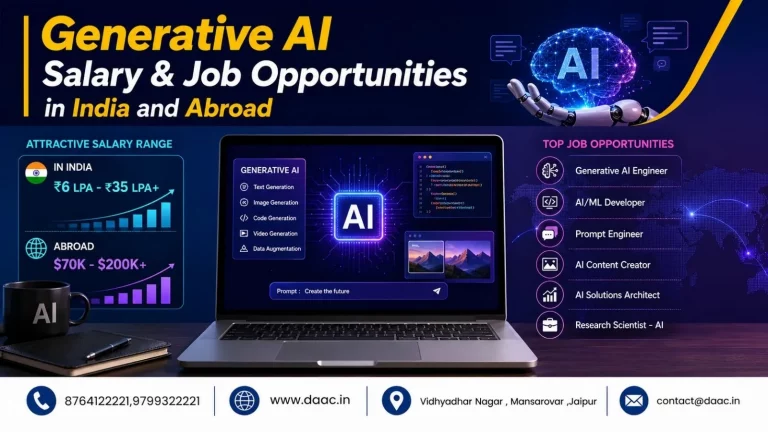
- Fresher: ₹6–10 LPA
- Mid-Level: ₹12–20 LPA
- Senior Roles: ₹25+ LPA
These rising numbers show strong AI Salary Trends 2026, making AI one of the most rewarding career paths.
Skills Required for Generative AI Career
To succeed in a Generative AI Career 2026, students must build the following skills:
1. Programming Skills
Python, JavaScript, and basic coding knowledge are essential.
2. Machine Learning Basics
Understanding algorithms and data models is important for Artificial Intelligence Jobs.
3. AI Tools & Prompt Engineering
Hands-on experience with AI tools improves chances in AI Career Opportunities.
4. Analytical Thinking
Problem-solving ability helps in building effective AI systems.
5. Continuous Learning
AI technology changes fast, so staying updated is crucial for the Future of AI Careers.
How to Start a Generative AI Career Step by Step
Step 1: Learn AI Basics
Start with fundamentals of AI, ML, and data science.
Step 2: Practice AI Tools
Use real AI platforms to understand how systems work.
Step 3: Build Real Projects
Create projects like chatbots, AI content tools, or prediction systems.
Step 4: Build Portfolio
Showcase your work to apply for a Generative AI Career 2026.
Step 5: Apply for Jobs or Freelance Work
Start applying for internships, entry-level roles, or freelance AI projects.
Future of Generative AI Careers
The Future of AI Careers looks extremely strong as AI becomes part of every industry. In India, the scope of Generative AI Career 2026 is expanding due to digital transformation, startup growth, and global outsourcing opportunities.
This means students entering the AI field today will have long-term stability and strong career growth.
Conclusion
A Generative AI Career 2026 is not just a trend—it is a long-term opportunity for students who are ready to learn and adapt. With growing AI Career Opportunities, rising Artificial Intelligence Jobs, and improving AI Salary Trends 2026, this field offers strong potential for future success.
However, success depends on skills, continuous learning, and practical experience. Students who invest time in building real AI skills can secure a strong position in the evolving tech industry.
FAQs
1. Is Generative AI a good career in 2026?
Yes, it is one of the fastest-growing and high-paying career options in technology.
2. What skills are needed for Generative AI jobs?
Programming, machine learning basics, and AI tool knowledge are essential.
3. Can beginners start a career in AI?
Yes, beginners can start after learning basic programming and AI concepts.
4. What is the salary in Generative AI careers?
Freshers can earn ₹6–10 LPA, with higher growth for experienced professionals.
5. Is AI a long-term career option?
Yes, AI is expected to be a major part of the Future of AI Careers globally.