
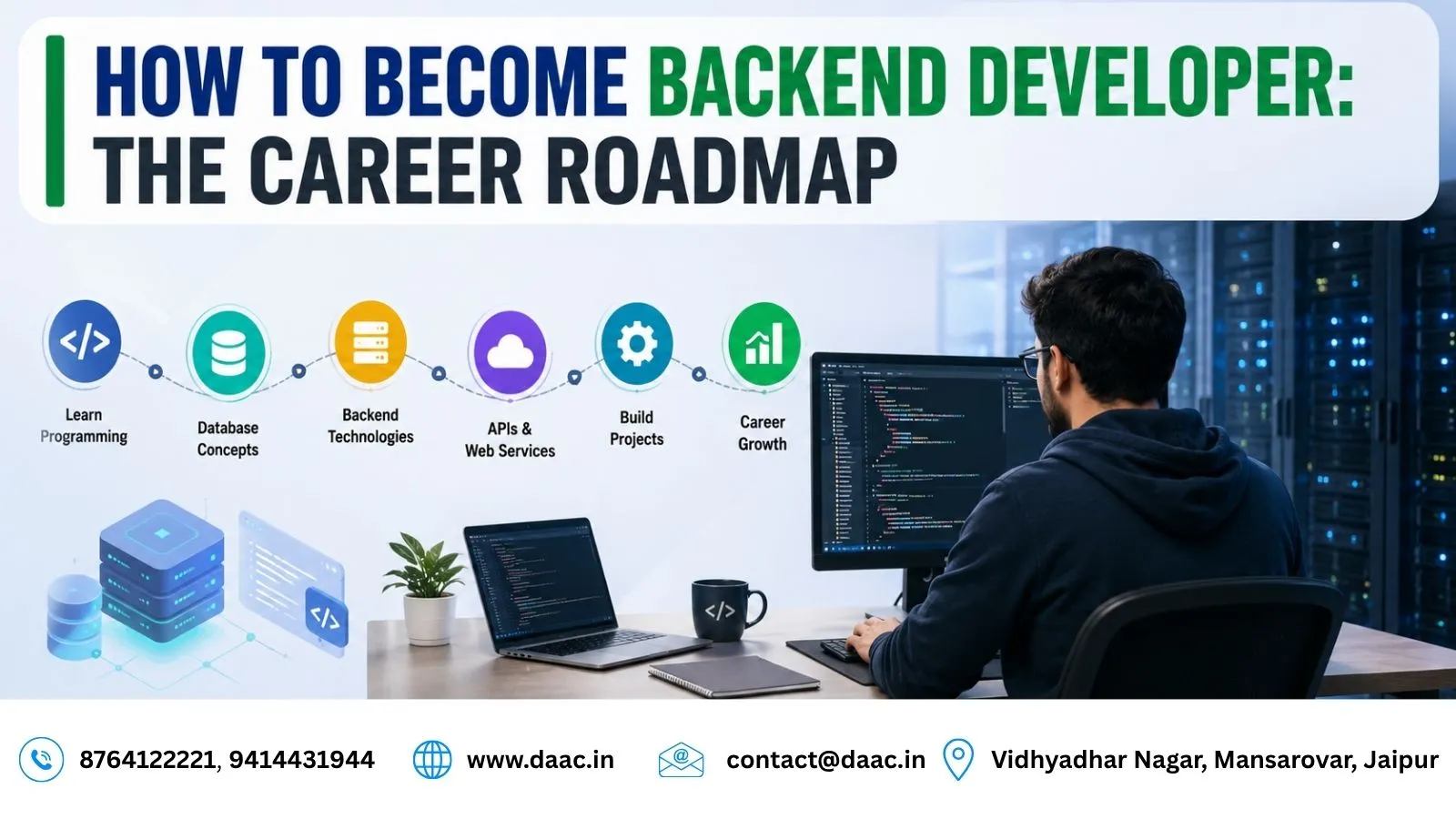
Backend development is one of the fastest-growing tech careers in 2026. Companies depend on scalable systems, secure APIs, and strong databases, which makes backend developers highly valuable. If you want to enter this field, understanding the Backend Developer Career Roadmap is the first step toward building a successful tech career.
Overview of Backend Developer Career Roadmap
The backend developer journey follows a structured learning path. You start with basic programming and gradually move toward advanced topics like system design and cloud deployment.
A proper roadmap helps beginners avoid confusion and focus on the right skills in the right order. Instead of learning random tools, you build a step-by-step foundation that matches real industry requirements.
The learning stages usually include:
- Programming fundamentals
- Backend languages
- Databases
- APIs
- Backend Development Technologies
- Cloud & deployment
- Real-world projects
Each step prepares you for professional backend development roles.
What is Backend Development?
Backend development is the server-side part of applications. It handles data processing, business logic, authentication, and communication between frontend and databases.
Users never see backend systems directly, but every app depends on them. Whether it’s banking apps, e-commerce websites, or social media platforms, backend systems keep everything running smoothly.
Without strong backend systems, applications fail in performance, security, and scalability.
Backend Developer Roles and Responsibilities
A backend developer handles the core logic of applications. Their work ensures that everything behind the screen functions correctly.
Key responsibilities include:
- Designing and managing APIs (REST & GraphQL)
- Handling databases and data storage
- Writing server-side business logic
- Managing authentication and security
- Optimizing application performance
- Working with cloud platforms
- Collaborating with frontend teams
These tasks require strong logical thinking and technical knowledge of backend systems.
Backend Programming Languages to Learn in 2026
Choosing the right language is an important part of the Backend Developer Career Roadmap. In 2026, companies mostly use a few high-demand languages.
Popular backend languages:
- JavaScript (Node.js) – widely used and beginner-friendly
- Python – strong for AI, automation, and startups
- Java – used in enterprise-level systems
- Go (Golang) – high-performance cloud applications
- PHP – still used in CMS platforms like WordPress
You should focus on one language first and master it deeply before moving to others.
Backend Development Technologies You Must Learn
Backend development is not only about coding. You also need tools and frameworks that support real-world applications.
Core technologies include:
- Frameworks: Express.js, Django, Spring Boot
- Databases: MySQL, PostgreSQL, MongoDB
- Caching: Redis
- APIs: REST, GraphQL
- Authentication: JWT, OAuth
- Cloud: AWS, Azure, Google Cloud
- DevOps tools: Docker, Kubernetes, CI/CD
These Backend Development Technologies help you build scalable and production-ready applications.
Step-by-Step Backend Developer Roadmap 2026
Step 1: Learn Programming Fundamentals
Start with basics:
- Data structures
- Algorithms
- OOP concepts
- Clean coding practices
Step 2: Choose a Backend Stack
Pick one stack and master it:
- Node.js + PostgreSQL
- Python + Django
- Java + Spring Boot
Step 3: Learn Databases
Focus on:
- SQL queries
- Database design
- NoSQL systems
- Redis caching
Step 4: APIs & System Design
Learn:
- REST API development
- GraphQL basics
- Microservices
- Load balancing
Step 5: Security & Deployment
Understand:
- Authentication systems
- API security
- Cloud deployment
- Performance optimization
Backend Developer Job Requirements in 2026
Most companies expect backend developers to have:
- Strong coding skills
- Knowledge of databases
- API development experience
- Cloud understanding
- Version control (Git)
- Basic DevOps knowledge
- Problem-solving ability
These skills define a job-ready backend developer.
Backend Developer Salary in 2026
The Backend Developer Salary 2026 is expected to remain high due to strong demand in cloud and AI industries.
Average salaries:
- Junior Developer: $60,000 – $85,000
- Mid-Level Developer: $90,000 – $130,000
- Senior Developer: $140,000+
Freelancers and remote developers can earn even more depending on skills and projects.
Backend Developer Future Scope
The Backend Developer Future Scope is very strong in 2026 and beyond.
Reasons include:
- Growth of AI-based applications
- Expansion of cloud computing
- Rise of SaaS platforms
- Demand for secure systems
- Growth of fintech and healthtech
Backend developers are now becoming system architects who design large-scale systems.
Frontend vs Backend Developer
| Backend Developer | Frontend Developer |
|---|---|
| Server-side logic | UI/UX design |
| Databases & APIs | HTML, CSS, JS |
| System performance | Visual experience |
| Security handling | User interface |
Backend is more technical and system-focused, while frontend is design-focused.
Full Stack vs Backend Developer
Backend Developer:
- Focuses only on server-side systems
- Deep technical expertise
- High scalability knowledge
Full Stack Developer:
- Works on frontend + backend
- More versatile
- Common in startups
Choose based on whether you prefer depth (backend) or flexibility (full stack).
Key Takeaways
- Backend development is a future-proof career
- Follow a structured Backend Developer Career Roadmap
- Master one stack instead of many
- Build real-world projects for experience
- Cloud and AI skills increase job opportunities
- Backend developers are highly in demand globally
FAQs
1. How to become a backend developer in 2026?
Start with programming basics, then learn backend languages, databases, APIs, and cloud technologies. Build real projects for experience.
2. Is backend development a good career in 2026?
Yes, demand is increasing due to AI, cloud, and SaaS growth.
3. Which backend language is best?
Node.js, Python, Java, and Go are the most in-demand languages.
4. What skills are required?
Coding, databases, APIs, cloud, security, and problem-solving.
5. Backend or full stack—which is better?
Backend offers deeper specialization, while full stack offers broader skills.