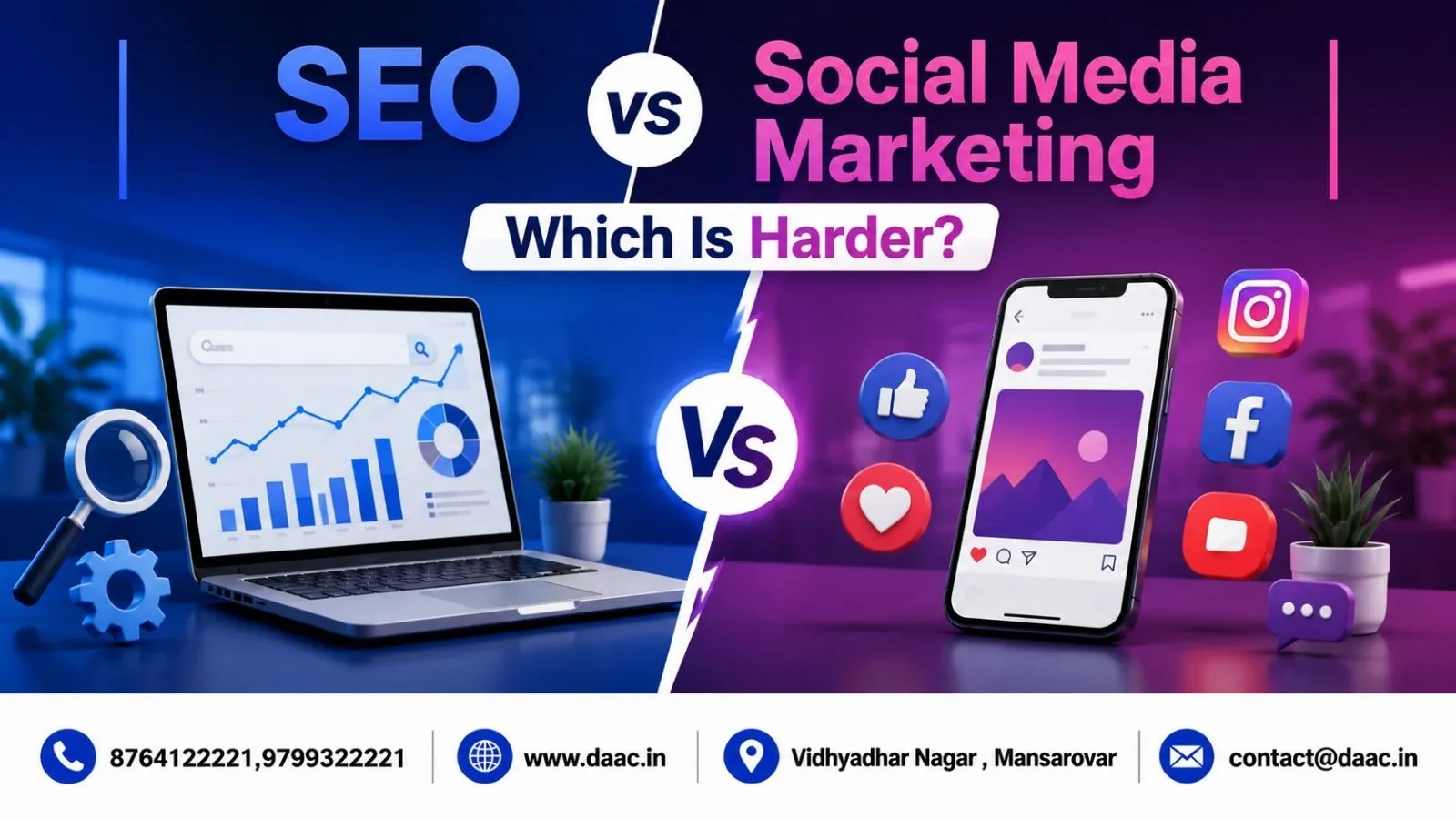
Many students entering digital marketing often ask a common question: SEO or Social Media Marketing, which is harder to learn and master? Both fields play a major role in online business growth, but they require different skills, mindsets, and daily responsibilities.
Some professionals prefer working with search engines, data, and website optimization. Others enjoy creating content, managing communities, and building brand awareness through social platforms. The challenge is that both disciplines continue evolving rapidly due to AI, changing algorithms, and increasing competition.
If you are planning a career in digital marketing or deciding which specialization to learn first, understanding the differences between these two fields can help you make a better decision. This guide provides a practical comparison based on skills, difficulty level, career opportunities, and current industry trends.
Understanding the Difference Between SEO and Social Media Marketing
Before comparing difficulty levels, it is important to understand what each discipline actually involves. Although both focus on online visibility, their methods and objectives are completely different.
Search Engine Optimization focuses on improving website rankings on search engines such as Google. The goal is to generate organic traffic by optimizing content, website structure, technical performance, and authority signals.
Social media marketing focuses on building brand awareness and audience engagement through platforms such as Instagram, Facebook, LinkedIn, YouTube, and X. It relies heavily on content creation, audience interaction, and trend-based marketing strategies.
Both channels support business growth, but the skills required to succeed are very different.
Why SEO Is Considered More Technically Challenging
Many digital marketers believe SEO has a steeper learning curve because it combines content strategy with technical website optimization. Beginners often struggle to understand how search engines evaluate and rank websites.
Some of the biggest SEO challenges include:
- Understanding search intent
- Performing keyword research
- Technical SEO implementation
- Website indexing issues
- Core Web Vitals optimization
- Backlink acquisition
- Algorithm updates
For example, a website may have excellent content but still fail to rank because of technical issues such as slow loading speed or poor site architecture. This makes SEO more analytical and process-driven than many other digital marketing specializations.
The Technical Skills Required in SEO
One reason SEO feels difficult is that it requires knowledge across multiple areas. Professionals often need to understand content, analytics, user experience, and website performance simultaneously.
Important SEO skills include:
- Keyword research
- On-page optimization
- Technical SEO
- Link building
- Search Console analysis
- Google Analytics reporting
- Content optimization
Students interested in building advanced SEO skills often combine search engine optimization with a Digital Marketing Course in Jaipur because modern SEO requires a broader understanding of digital marketing channels and user behavior.
The learning process takes time, but the long-term rewards can be significant.
Why Social Media Marketing Feels Difficult for Many Professionals
At first glance, social media marketing appears easier because creating posts and publishing content seems straightforward. However, professionals working in this field know that maintaining consistent engagement can be extremely demanding.
Major social media marketing challenges include:
- Constant content creation
- Rapid trend changes
- Platform algorithm updates
- Community management
- Audience retention
- Brand reputation management
Unlike SEO, where results may take months to appear, social media performance can change within hours. A campaign can go viral unexpectedly or completely fail despite significant effort.
This constant unpredictability makes social media marketing mentally demanding for many professionals.
Creativity Plays a Bigger Role in Social Media Marketing
Success on social platforms depends heavily on creativity and audience understanding. Brands must continuously produce engaging content that captures attention in crowded feeds.
Key skills required include:
- Content creation
- Video production
- Graphic design basics
- Copywriting
- Audience engagement
- Trend analysis
- Storytelling
A social media marketer often works with multiple content formats such as reels, videos, carousels, stories, polls, and live sessions. The pressure to consistently create fresh content can become challenging over time.
This is one of the biggest reasons many marketers consider social media marketing harder than it appears.
SEO vs Social Media Marketing: Comparing the Learning Curve
When comparing the learning process, SEO usually takes longer to master because of its technical complexity. Beginners often spend months understanding search engine behavior, ranking factors, and optimization techniques.
Social media marketing has a faster entry point. A beginner can create content and run campaigns relatively quickly. However, achieving consistent growth requires creativity, experimentation, and strong audience understanding.
A simple comparison looks like this:
| Factor | SEO | Social Media Marketing |
|---|---|---|
| Learning Curve | High | Moderate |
| Technical Knowledge | High | Low |
| Creativity Requirement | Medium | Very High |
| Results Speed | Slow | Fast |
| Data Analysis | Extensive | Moderate |
| Daily Activity | Structured | Dynamic |
Both fields require continuous learning because platforms and algorithms change regularly.
Which Career Offers Better Growth Opportunities?
Career growth depends more on your strengths than the platform itself. Both SEO and social media marketing continue to offer excellent opportunities in 2026.
Popular SEO career paths include:
- SEO Executive
- SEO Specialist
- Technical SEO Analyst
- SEO Manager
- Organic Growth Consultant
Popular social media career paths include:
- Social Media Executive
- Social Media Strategist
- Content Manager
- Brand Manager
- Community Manager
Students planning long-term careers in website growth and digital strategy often explore the Web Development Course in Jaipur alongside SEO because technical website knowledge provides a competitive advantage in search optimization roles.
Combining technical and marketing skills can significantly increase career opportunities.
Which Field Is More Future-Proof?
The rise of artificial intelligence has changed both industries. AI tools can now assist with keyword research, content creation, audience analysis, and campaign optimization.
However, neither SEO nor social media marketing is becoming obsolete. Instead, professionals are expected to work alongside AI tools while focusing on strategy, creativity, and decision-making.
Future trends include:
- AI-assisted content creation
- Voice search optimization
- Short-form video dominance
- Personalization strategies
- Predictive analytics
- Search experience optimization
Professionals who continuously update their skills will remain valuable regardless of platform changes.
SEO vs Social Media Marketing: Which Is Harder for Beginners?
The answer depends entirely on your personality and strengths.
SEO may feel harder if:
- You dislike technical concepts
- You prefer immediate results
- You are uncomfortable with data analysis
Social media marketing may feel harder if:
- You dislike content creation
- You struggle with creativity
- You do not enjoy public engagement
Analytical individuals often enjoy SEO because it involves research, optimization, and measurable results. Creative individuals usually prefer social media marketing because it allows them to experiment with content and storytelling.
Neither field is objectively harder for everyone.
The Best Approach for Digital Marketing Students
Most successful marketers today do not limit themselves to one channel. Businesses increasingly seek professionals who understand both search engines and social platforms.
Combining SEO and social media marketing provides several advantages:
- Better content distribution
- Stronger brand visibility
- Increased website traffic
- Improved audience engagement
- Higher conversion opportunities
Learning both disciplines creates a well-rounded skill set that can support long-term career growth.
Conclusion
When comparing SEO and social media marketing, the difficulty depends largely on your interests, strengths, and career goals. SEO is generally more technical and data-driven, requiring patience and analytical thinking. Social media marketing is more creative, fast-paced, and emotionally demanding because of constant audience interaction and content production.
For beginners, social media marketing may feel easier to start because results are visible more quickly. However, maintaining long-term success can be challenging. SEO takes longer to learn but often provides more stable and predictable traffic growth.
Rather than choosing one over the other, aspiring digital marketers should develop skills in both areas. Businesses increasingly value professionals who can optimize websites while also building strong social media communities.
FAQs
1. Is SEO harder than social media marketing?
SEO is generally more technical and analytical, while social media marketing requires stronger creativity and continuous audience engagement.
2. Which is better for beginners, SEO or social media marketing?
Social media marketing is usually easier to start because it has fewer technical barriers and provides faster feedback.
3. Can I learn SEO and social media marketing together?
Yes. Learning both skills creates a stronger digital marketing foundation and improves career opportunities.
4. Which field offers higher salaries?
Both offer competitive salaries. Advanced SEO specialists and experienced social media strategists can earn attractive compensation depending on expertise and industry.
5. Is SEO still a good career in 2026?
Yes. Search engine optimization remains one of the most in-demand digital marketing skills because businesses continue to rely on organic traffic for growth.