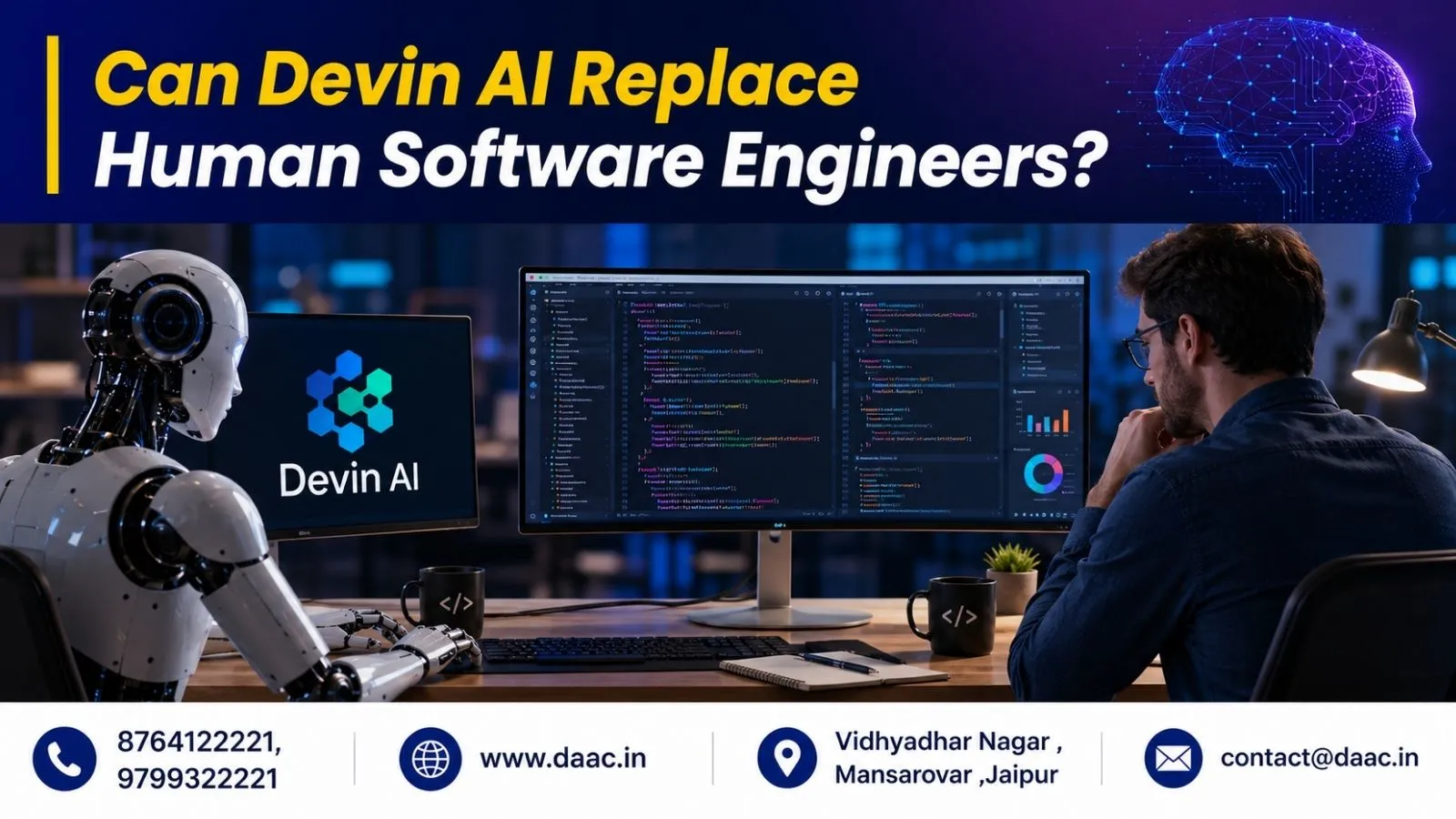
Artificial Intelligence is transforming industries at an unprecedented pace, and software development is no exception. The launch of Devin AI has sparked intense discussions among developers, students, and technology leaders worldwide. Marketed as an autonomous AI software engineer, Devin has demonstrated the ability to write code, debug applications, solve technical issues, and complete software development tasks with minimal human intervention.
As businesses increasingly adopt automation and AI-powered tools, a common question arises: Can AI truly replace human software engineers? While Devin represents a significant advancement in technology, the answer is more complex than a simple yes or no. Understanding its capabilities, limitations, and future impact is essential for anyone planning a long-term technology career.
What is Devin AI?
Devin AI is an advanced artificial intelligence system designed to perform software development tasks traditionally handled by human engineers. Unlike basic coding assistants that generate snippets of code, Devin can manage entire workflows, understand project requirements, create solutions, and perform testing independently.
The AI operates by combining large language models, machine learning techniques, and software engineering knowledge. It can interact with development environments, search documentation, execute code, and continuously refine solutions. This level of autonomy has positioned Devin as one of the most talked-about innovations in modern software development.
The emergence of autonomous coding systems demonstrates how rapidly technology is evolving. However, understanding what AI can and cannot do is crucial before predicting the future of engineering careers.
Key Capabilities of Devin AI
One reason why Devin has attracted significant attention is its ability to perform multiple development tasks without constant supervision. Traditional AI coding tools assist developers, while Devin attempts to complete projects more independently.
Some notable capabilities include:
- Writing and generating code automatically
- Identifying and fixing software bugs
- Understanding technical documentation
- Testing applications
- Creating software solutions from requirements
- Learning from previous development tasks
- Managing repetitive development activities
These features allow AI systems to accelerate workflows and improve efficiency. Businesses focused on productivity often see value in adopting AI-powered development tools to reduce development cycles and operational costs.
How Devin AI is Changing Software Development
The rise of AI in Software Development is reshaping how teams build and maintain applications. Many organizations already use AI tools for code completion, automated testing, and quality assurance. Devin expands these capabilities by taking a more active role throughout the development lifecycle.
For example, startups often need rapid prototyping to validate ideas quickly. AI tools can generate initial versions of applications within hours rather than days. This acceleration allows businesses to test concepts faster and adapt to changing market demands more effectively.
Companies are also using AI to automate repetitive coding tasks. This enables developers to spend more time on strategic planning, innovation, and solving complex business problems instead of handling routine work.
Why Human Software Engineers Still Matter
Despite impressive advancements, AI systems cannot fully replicate human intelligence and creativity. Software development involves much more than writing code. Human engineers understand business goals, user behavior, market trends, and organizational priorities in ways that AI currently cannot.
Developers contribute critical thinking skills that help organizations solve unique challenges. They evaluate trade-offs, understand customer needs, and create innovative solutions that align with broader business objectives. These capabilities remain difficult for AI systems to replicate effectively.
Human engineers also bring emotional intelligence and communication skills to projects. Successful software development often requires collaboration between designers, managers, stakeholders, and clients. These interactions involve negotiation, empathy, and contextual understanding that extend beyond technical implementation.
Creativity and Innovation Cannot Be Automated Easily
One of the strongest advantages of human engineers is creativity. While AI can analyze existing patterns and generate solutions based on training data, innovation often comes from original thinking and experimentation.
Many breakthrough technologies were developed because engineers challenged conventional approaches and explored unconventional ideas. Human creativity drives product innovation, user experience improvements, and disruptive business models.
The Future of Software Engineering will likely continue to rely heavily on individuals who can identify opportunities, think strategically, and develop innovative solutions. AI can support these efforts, but it cannot fully replace creative problem-solving abilities.
The Importance of Contextual Understanding
Software projects frequently involve industry-specific requirements. Applications developed for healthcare, finance, education, or government sectors require deep contextual understanding and regulatory awareness.
Human engineers understand cultural considerations, ethical concerns, customer expectations, and organizational goals. They can make decisions based on nuanced factors that are difficult to capture through algorithms alone.
For example, designing a healthcare platform requires knowledge of patient privacy, accessibility, and compliance requirements. While AI can assist with coding, human expertise remains essential for ensuring solutions align with real-world expectations and responsibilities.
The Rise of Hybrid Development Teams
Rather than replacing engineers, AI is more likely to become a powerful collaborator. The future may involve hybrid teams where developers work alongside intelligent systems to improve efficiency and productivity.
In this model:
- AI handles repetitive tasks.
- Engineers focus on architecture and innovation.
- AI assists with testing and debugging.
- Humans manage strategic decisions.
- Developers oversee quality and compliance.
This collaborative approach combines the speed of automation with the creativity and judgment of human professionals. Many technology leaders believe this balance will define the next generation of software development.
Impact on Software Engineering Careers
The rise of AI does not necessarily mean fewer opportunities for developers. Instead, it may transform job responsibilities and required skill sets. Professionals who adapt to emerging technologies will likely remain in high demand.
Future engineers may focus more on:
- System architecture
- AI integration
- Product strategy
- User experience design
- Cybersecurity
- Data engineering
- AI supervision and governance
Students entering technology careers should view AI as a tool rather than a threat. Learning how to collaborate with intelligent systems can create significant competitive advantages in the evolving job market.
Those interested in building future-ready skills often strengthen their foundations through a Full Stack Developer Course in Jaipur before exploring advanced AI technologies and automation tools.
Ethical Challenges and Workforce Concerns
As AI adoption increases, ethical questions continue to emerge. Organizations must address concerns related to job displacement, algorithmic bias, transparency, and accountability.
Businesses adopting AI should focus on responsible implementation that supports workforce development rather than replacing talent unnecessarily. Training and reskilling programs will play an important role in helping professionals adapt to changing industry demands.
The technology industry has experienced multiple transformations over the past decades. While automation changes job functions, it often creates new opportunities for individuals who embrace learning and innovation.
What Developers Should Learn in 2026
To remain competitive, software engineers should focus on developing skills that complement AI capabilities rather than compete directly with them.
Important areas include:
- AI-assisted development
- Cloud computing
- Cybersecurity
- Data analytics
- Product thinking
- System architecture
- Communication skills
- Problem-solving methodologies
Professionals interested in emerging technologies can also explore a Generative AI Course in Jaipur to understand how AI systems work and how they can be integrated into modern software projects.
Conclusion
Devin AI represents a major milestone in artificial intelligence and software development. Its ability to generate code, solve technical problems, and automate development tasks demonstrates how rapidly technology is advancing. However, software engineering extends far beyond coding alone.
Human engineers contribute creativity, strategic thinking, contextual understanding, collaboration, and innovation—qualities that remain difficult for AI to replicate. Instead of replacing developers entirely, AI is more likely to transform the profession by automating routine tasks and enabling engineers to focus on higher-value work.
The future belongs to professionals who can combine technical expertise with AI-powered tools. Rather than fearing automation, developers should embrace continuous learning and adapt to the evolving landscape of software engineering.
FAQs
1. What is Devin AI?
Devin AI is an autonomous artificial intelligence system designed to perform software development tasks such as coding, debugging, testing, and problem-solving with minimal human supervision.
2. Can Devin AI completely replace software engineers?
No. While Devin can automate many technical tasks, human engineers remain essential for creativity, strategic planning, communication, and complex decision-making.
3. How does AI help software developers?
AI assists developers by generating code, automating testing, identifying bugs, improving productivity, and reducing repetitive work during development projects.
4. Will software engineering still be a good career in the future?
Yes. Software engineering continues to offer strong career opportunities, especially for professionals who learn AI tools and adapt to emerging technologies.
5. What skills should developers focus on in 2026?
Developers should focus on AI integration, cloud computing, cybersecurity, system architecture, data analytics, and advanced problem-solving skills to remain competitive.