Modern web applications require several technologies to work together. The frontend creates the user interface, the backend manages business logic, and the database stores application data. The MERN Stack combines these essential technologies into one JavaScript-focused development ecosystem.
For students and beginners, understanding what is mern stack is an important step toward learning full-stack web development. MERN allows developers to use JavaScript across different layers of an application, making it easier to build and maintain modern web solutions.
This guide explains the MERN Stack, its components, how the technologies work together, required skills, career opportunities, industry demand, and future scope in 2026.
What Is MERN Stack?
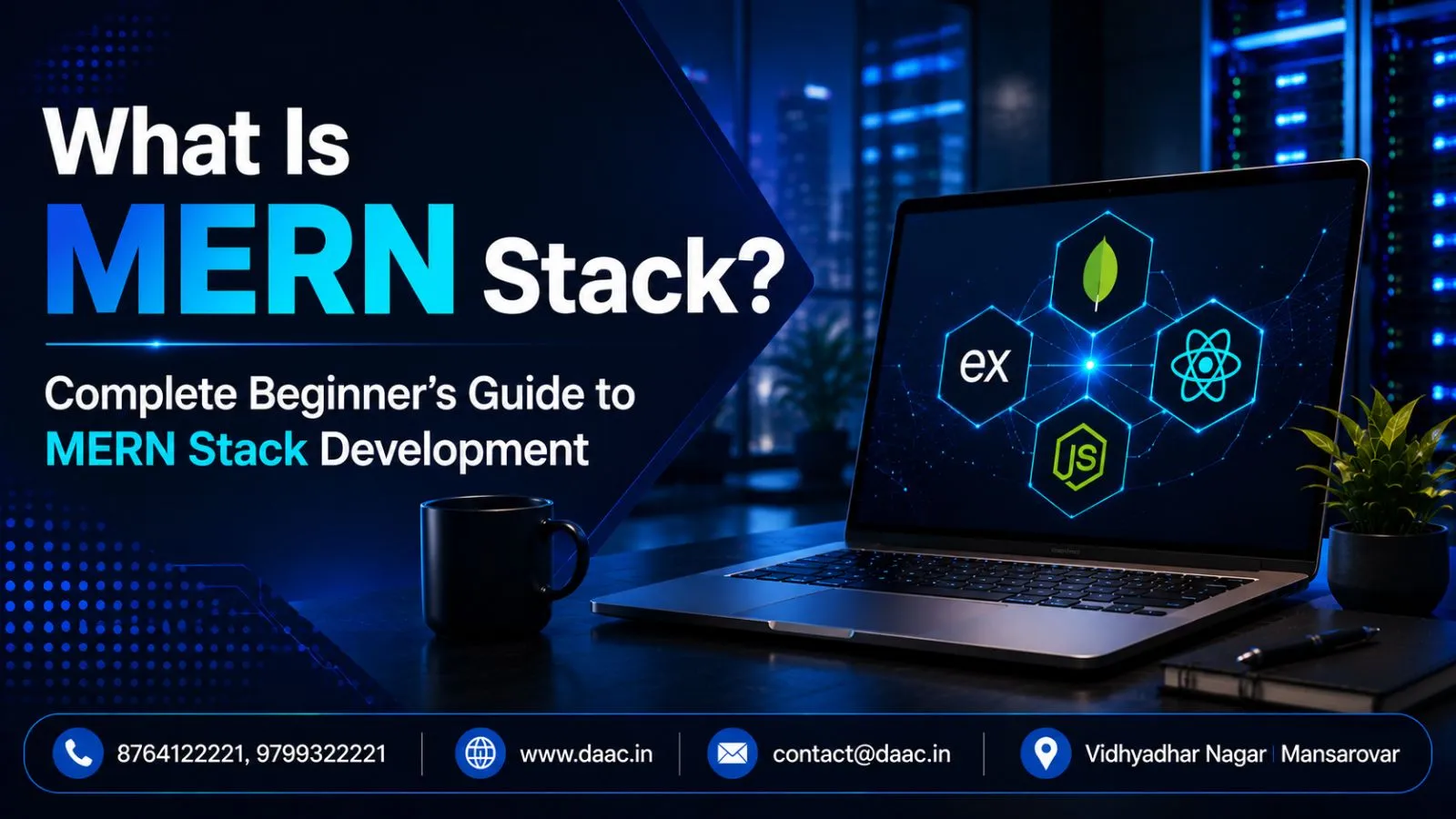
The MERN Stack is a collection of four technologies used to build full-stack web applications. These technologies are MongoDB, Express.js, React.js, and Node.js.
Each component performs a different role in application development.
MongoDB manages data.
Express.js handles backend application logic and APIs.
React.js creates the frontend user interface.
Node.js provides the runtime environment for executing JavaScript on the server.
Together, these technologies allow developers to create complete applications using JavaScript and its ecosystem.
MERN Stack Full Form Explained
The mern stack full form represents four technologies:
- M – MongoDB
- E – Express.js
- R – React.js
- N – Node.js
MongoDB is a NoSQL database that stores data in flexible document structures. Express.js is a backend framework that runs on Node.js. React.js is a JavaScript library used to build interactive interfaces, while Node.js allows JavaScript to execute outside the browser.
This combination creates a technology stack suitable for building modern web applications.
Why MERN Is Called a Full-Stack Technology
MERN is commonly described as a full-stack technology because it covers the primary layers required to build web applications.
A typical application architecture can be represented as:
React.js → Express.js → Node.js → MongoDB
The React frontend communicates with backend APIs built using Express.js and Node.js. The backend then interacts with MongoDB to store and retrieve application data.
Developers can use JavaScript throughout much of this architecture. This reduces the need to switch between different programming languages when working across frontend and backend layers.
However, MERN does not eliminate the need for other technologies. Real-world projects may also require HTML, CSS, TypeScript, authentication systems, cloud platforms, testing tools, Git, and deployment services.
How MERN Stack Works Together
Consider an online shopping application built using the MERN Stack.
A customer opens the website and interacts with the React frontend. When the customer searches for a product, React sends a request to a backend API.
Express.js handles the API route, while Node.js runs the server-side JavaScript environment. The backend sends a query to MongoDB to find matching products.
MongoDB returns the required information. The backend processes the response and sends it back to React, which displays the results to the customer.
The overall flow looks like this:
User → React → Express.js → Node.js → MongoDB
The response then travels back through the application layers to the user interface.
This architecture demonstrates the basic mern stack meaning and how its components cooperate to deliver a complete web application.
Components of the MERN Stack
Understanding each technology is essential for anyone planning to enter mern stack development. Although the four components work together, each has a specific responsibility.
MongoDB – Database Layer
MongoDB is a document-oriented NoSQL database used to store application data.
Unlike relational databases that organize information into tables and rows, MongoDB stores data in flexible documents.
For example, an eCommerce application might store a product using information such as:
- Product name
- Price
- Category
- Stock
- Product images
MongoDB’s flexible data model can be useful when application requirements change frequently.
Developers also need to understand database design, indexing, data validation, security, and query optimization to use MongoDB effectively in production applications.
Express.js – Backend Framework
Express.js is a lightweight web framework commonly used with Node.js to build backend applications and APIs.
It simplifies tasks such as:
- Handling HTTP requests
- Creating API routes
- Managing middleware
- Processing responses
- Implementing backend logic
For example, an eCommerce application might have API endpoints for products, users, orders, and payments.
Express.js receives requests from the frontend, processes them, and communicates with the database when required.
Although Express.js is popular, developers can also explore other Node.js frameworks as their skills progress.
React.js – Frontend Library
React.js is a JavaScript library for building user interfaces. It uses reusable components to create interactive application experiences.
A React application might contain components for:
- Navigation
- Product cards
- Shopping carts
- Login forms
- Dashboards
- User profiles
React communicates with backend APIs to retrieve or submit data.
Its component-based architecture allows developers to organize complex interfaces into smaller, reusable pieces.
Node.js – Runtime Environment
Node.js is a JavaScript runtime environment that allows developers to execute JavaScript outside a web browser.
It provides the foundation for running Express.js backend applications.
Node.js is known for its event-driven architecture and non-blocking I/O model, making it suitable for many network-intensive applications and APIs.
Developers use Node.js to create backend services that communicate with databases, handle requests, authenticate users, and connect different systems.
The Node.js ecosystem also provides access to NPM, which contains a large collection of reusable packages.
Why MERN Stack Is Popular in Modern Web Development
The mern tech stack has gained popularity among startups, development teams, and learners because its technologies work well together and share a strong connection with JavaScript.
Its popularity is also supported by a large developer ecosystem and extensive learning resources.
JavaScript Across Frontend and Backend
One of the major advantages of MERN is the ability to use JavaScript across multiple application layers.
Developers can work with:
Frontend: React.js
Backend: Node.js and Express.js
Database: MongoDB
This can make collaboration easier because teams can share programming concepts and development practices across different layers.
For developers who already know JavaScript, learning MERN can be a logical progression toward full-stack development.
However, professional development also requires knowledge of databases, APIs, security, testing, deployment, and software architecture.
Fast Development and Scalability
MERN can support rapid application development because developers can use reusable components, established frameworks, and a large package ecosystem.
For example, a startup can use React to create its interface, Express and Node.js to develop APIs, and MongoDB to manage application data.
The architecture can then evolve as the product grows.
However, scalability is not automatic. Developers must consider database indexing, caching, API design, application architecture, monitoring, and infrastructure.
Large applications may also introduce additional services and technologies depending on their requirements.
Growing Industry Demand for MERN Developers
MERN skills are commonly associated with frontend, backend, and full-stack development roles.
Companies looking for JavaScript-focused developers may seek skills in:
- React.js
- Node.js
- Express.js
- MongoDB
- REST APIs
- Git
- Cloud platforms
Demand varies by location, industry, and company requirements.
Developers who understand only the basic MERN components may face more competition. Professionals who combine MERN with TypeScript, testing, cloud deployment, system design, security, and DevOps practices can build a stronger technical profile.
Skills Required to Learn MERN Stack
Learning MERN requires more than understanding four technologies. Beginners need a foundation in web development and programming before moving into full-stack application development.
A structured learning path helps students progress more efficiently.
HTML, CSS, and JavaScript Fundamentals
HTML and CSS are essential for frontend development.
Before learning React, students should understand:
- HTML structure
- CSS selectors
- Responsive design
- Flexbox
- CSS Grid
- Basic accessibility
JavaScript is even more important because React, Node.js, and Express.js are part of the JavaScript ecosystem.
Students should learn:
- Variables
- Functions
- Arrays
- Objects
- Loops
- ES6+ features
- Modules
- Promises
- Async and await
- Error handling
Strong JavaScript fundamentals make it easier to understand the entire MERN architecture.
Database and API Development Basics
MERN developers need to understand how frontend applications communicate with backend services.
Important concepts include:
- REST APIs
- HTTP methods
- Status codes
- JSON
- CRUD operations
- Authentication
- Authorization
- Database queries
For example, a React application may send a GET request to retrieve products and a POST request to create a new order.
The backend processes these requests and communicates with MongoDB.
Understanding this flow is essential for becoming a practical full-stack developer.
Version Control and Deployment Skills
Professional developers need to understand Git and version control.
Git allows developers to:
- Track code changes
- Create branches
- Collaborate with teams
- Review changes
- Restore previous versions
Students should also learn basic deployment concepts.
Depending on the project, a MERN application may be deployed using cloud platforms, containerized infrastructure, or specialized hosting services.
Additional skills in environment variables, CI/CD, logging, monitoring, and security can improve deployment knowledge.
Is MERN Stack a Good Career Choice in 2026?
MERN can be a strong career path for people interested in full-stack JavaScript development. However, career success depends on more than learning the basic stack.
Students should focus on building practical applications and developing skills that employers actually use.
Career Opportunities After Learning MERN Stack
After learning MERN, developers can explore roles such as:
- MERN Stack Developer
- Full Stack Developer
- React Developer
- Node.js Developer
- Backend Developer
- JavaScript Developer
- Software Engineer
The exact responsibilities vary between companies.
A React developer may focus mainly on frontend interfaces, while a full-stack developer may work across frontend, backend, databases, APIs, and deployment.
Building a strong portfolio with real projects can help demonstrate practical abilities to potential employers.
Industries Hiring MERN Stack Developers
MERN-related skills are used across many industries.
Common sectors include:
- E-commerce
- FinTech
- Healthcare
- Education
- SaaS
- Media
- Travel
- Logistics
- Enterprise software
For example, an education platform might use React for its student dashboard, Node.js and Express.js for APIs, and MongoDB for user and course data.
An eCommerce platform could use the same architecture for product catalogs, customer accounts, and order management.
The exact technology stack depends on the project’s technical requirements.
Future Scope of MERN Stack Development
The future of mern stack web development is closely connected to broader trends in JavaScript, cloud computing, APIs, and modern application architecture.
Developers can expand their skills into:
- TypeScript
- Next.js
- Cloud computing
- Microservices
- Serverless development
- DevOps
- AI application integration
- System design
MERN itself may not be the complete solution for every future application. However, the underlying skills it teaches, including JavaScript, frontend development, backend APIs, and database management, remain valuable.
Developers should focus on understanding core concepts rather than relying only on a specific technology combination.
Final Thoughts
The mern stack provides a structured approach to learning full-stack web development using technologies that work well together. MongoDB handles data storage, Express.js manages backend routes and APIs, React.js builds interactive user interfaces, and Node.js provides the server-side runtime.
For beginners, the best approach is to learn the technologies in a logical sequence.
A practical roadmap is:
HTML & CSS → JavaScript → React.js → Node.js → Express.js → MongoDB → REST APIs → Authentication → Git → Deployment
After learning the fundamentals, developers should build real applications instead of relying only on tutorials.
A complete project such as an eCommerce platform, task management system, or SaaS dashboard can help learners understand how frontend components communicate with APIs and databases.
MERN can provide a strong foundation for modern full-stack development in 2026. However, successful developers should continue expanding their skills beyond the basic stack. Learning TypeScript, cloud platforms, testing, security, system design, and deployment can help professionals adapt to changing industry requirements.
Ultimately, the value of mern stack development comes from understanding how software systems work as a whole. When developers combine technical knowledge with practical project experience and strong problem-solving skills, they can build scalable applications and pursue a wide range of opportunities in modern web development.
AQs
1. What is MERN Stack?
MERN Stack is a JavaScript-based technology stack used to build full-stack web applications. It consists of MongoDB for database management, Express.js for backend development, React.js for user interfaces, and Node.js for server-side JavaScript execution.
2. What is the full form of MERN Stack?
The MERN Stack full form is MongoDB, Express.js, React.js, and Node.js. Each technology performs a different role in application development, allowing developers to build frontend interfaces, backend APIs, and database-driven applications.
3. Is MERN Stack good for beginners?
Yes, MERN can be a good choice for beginners interested in full-stack web development. However, learners should first understand HTML, CSS, and JavaScript before progressing to React, Node.js, Express.js, and MongoDB.
4. How long does it take to learn MERN Stack?
The learning time depends on your existing programming knowledge and practice schedule. Beginners may need several months to understand the fundamentals and build complete applications. Becoming job-ready generally requires additional project experience and knowledge of APIs, Git, testing, authentication, and deployment.
5. What career opportunities are available after learning MERN Stack?
After learning MERN, you can explore roles such as MERN Stack Developer, Full Stack Developer, React Developer, Node.js Developer, Backend Developer, JavaScript Developer, and Software Engineer. Additional skills in TypeScript, cloud computing, testing, and system design can improve career opportunities.