Digital marketing has become an important part of how businesses attract customers, generate leads, build brands, and increase online sales. As companies continue investing in websites, search, social media, paid advertising, content, analytics, and AI-powered marketing, the demand for practical digital marketing skills is growing.
But what is digital marketing course and what does it actually teach?
A digital marketing course is a structured training program that teaches students how to promote products, services, brands, or businesses through digital channels. Depending on the program, learners may study SEO, social media marketing, paid advertising, content marketing, email marketing, analytics, conversion optimization, and AI-assisted marketing.
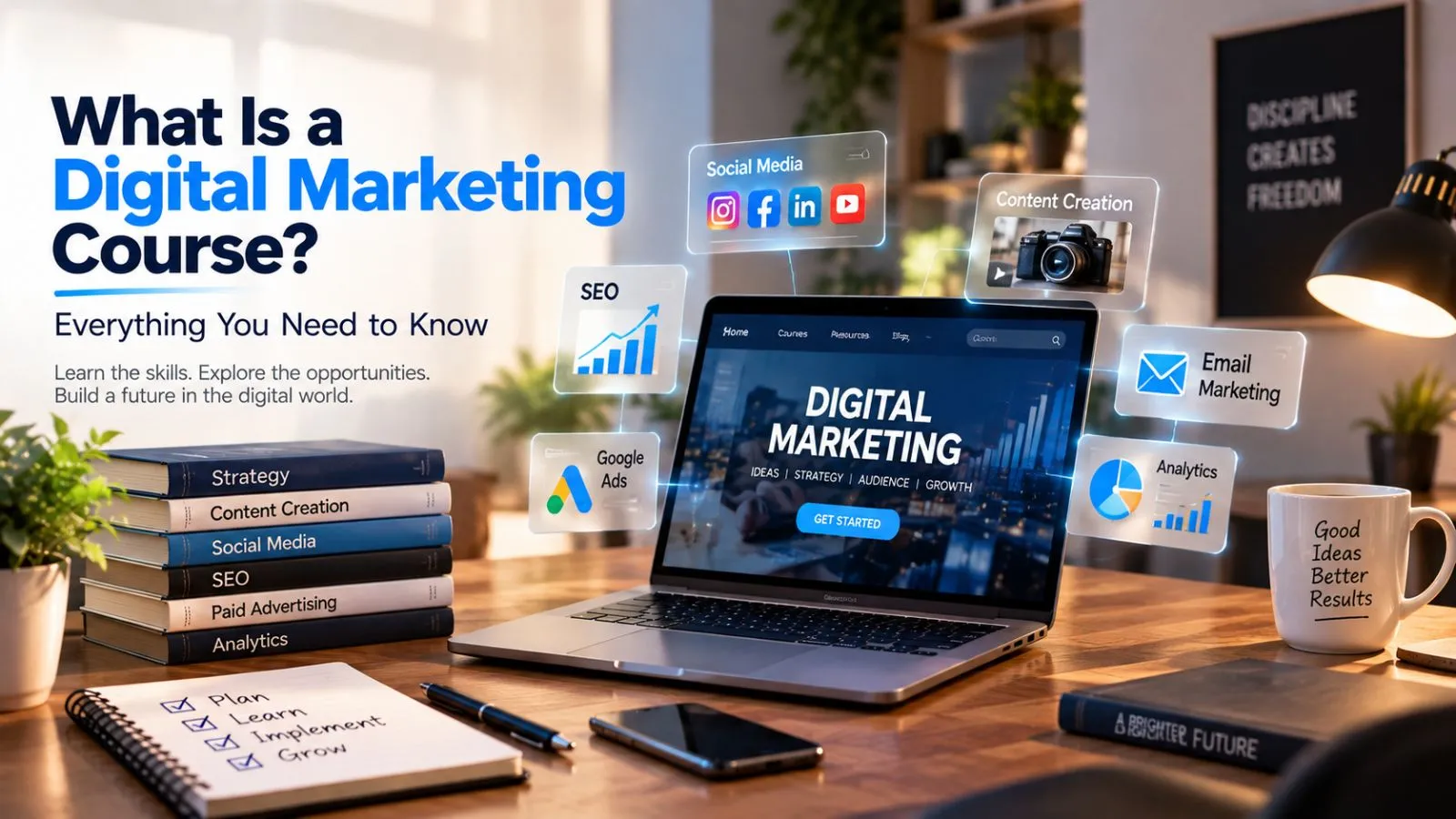
What Is a Digital Marketing Course?
A digital marketing course teaches the strategies, tools, and practical techniques used to market a business online.
Instead of focusing only on theory, a good program should help learners understand how different marketing channels work together. For example, SEO can bring organic visitors to a website, social media can build audience engagement, and paid advertising can generate targeted traffic and leads.
Modern digital marketing courses are also expanding beyond traditional techniques. Learners increasingly need to understand analytics, automation, AI-assisted content creation, search experiences, conversion tracking, and performance measurement.
The goal is not simply to learn marketing terminology. It is to develop skills that can be applied to real campaigns and business problems.
Who Should Join a Digital Marketing Course?
Digital marketing courses can be suitable for a wide range of learners, including:
- Students looking for a career-oriented skill
- Students searching for a digital marketing course after 12th
- Graduates from marketing, commerce, management, arts, or technical backgrounds
- Working professionals planning a career transition
- Entrepreneurs and small-business owners
- Freelancers who want to offer marketing services
- Content creators and social media professionals
- Traditional marketers who want to develop digital skills
You do not necessarily need a technical background to start. Basic computer knowledge, communication skills, curiosity, and a willingness to practice are generally more important starting points.
Why Digital Marketing Training Is Important
Digital marketing changes quickly. Search algorithms, advertising platforms, analytics tools, social media formats, and AI capabilities continue to evolve.
This makes structured training useful because it can provide a learning path instead of requiring beginners to study disconnected tools.
Practical training can also help learners build portfolios through activities such as keyword research, website optimization, campaign planning, social media calendars, ad creation, analytics reporting, and content projects.
Topics Covered in a Digital Marketing Course
The exact syllabus varies between digital marketing courses, but most comprehensive programs cover multiple channels rather than teaching only one skill.
Search Engine Optimization (SEO)
SEO focuses on improving a website’s visibility in organic search results.
A digital marketing course may cover:
- Keyword research
- Search intent
- On-page SEO
- Technical SEO
- Content optimization
- Internal linking
- Local SEO
- Website audits
- Search performance analysis
SEO is also evolving with AI-generated search experiences. Modern learners should understand how to create useful, well-structured content that can satisfy users across traditional search and emerging answer-based search experiences.
Social Media Marketing (SMM)
Social media marketing involves using social platforms to build awareness, engage audiences, distribute content, and support business goals.
Training may include:
- Social media strategy
- Content calendars
- Short-form video planning
- Community engagement
- Social media analytics
- Paid social campaigns
- Audience research
- Personal branding
The focus should move beyond simply posting content. Learners need to understand why a particular piece of content is created, which audience it targets, and how its performance will be measured.
Google Ads and PPC Advertising
Pay-per-click advertising allows businesses to reach users through paid campaigns.
A digital marketing course may introduce:
- Search advertising
- Display advertising
- Video advertising
- Keyword targeting
- Ad copy
- Bidding concepts
- Conversion tracking
- Campaign optimization
- Performance measurement
Current advertising training increasingly emphasizes measurement and optimization rather than simply learning how to launch an advertisement.
Types of Digital Marketing Courses
Learners can choose between different formats depending on their schedule, budget, and career goals.
Online Digital Marketing Courses
A digital marketing course online provides flexibility because learners can study from home or another location.
Online programs may include:
- Live instructor-led classes
- Recorded lessons
- Assignments
- Practical projects
- Online assessments
- Mentorship
- Career guidance
Online learning can be particularly useful for working professionals or students who cannot attend classroom sessions regularly.
However, learners should check whether an online course includes practical assignments and instructor interaction rather than relying entirely on recorded videos.
Offline Classroom Training
Offline classroom training provides direct interaction with trainers and other learners.
It can be useful for students who prefer structured schedules, face-to-face explanations, group activities, and immediate feedback.
Classroom programs may also provide opportunities to work on projects with other learners, which can help develop communication and teamwork skills.
Free vs Paid Certification Programs
Free courses can be a useful starting point for understanding basic concepts. They are particularly helpful when someone wants to explore digital marketing before investing in a longer program.
Paid programs generally offer a broader learning structure and may include:
- Instructor support
- Practical assignments
- Live projects
- Assessments
- Mentorship
- Portfolio development
- Career preparation
A digital marketing certification can demonstrate course completion or platform-specific knowledge, but the certificate alone does not guarantee a job.
For many entry-level roles, practical skills, projects, communication ability, and the ability to explain marketing results can be equally important.
Course Duration, Fees, and Certifications
Before enrolling, learners often compare digital marketing course duration, fees, syllabus, training format, and certification.
Digital Marketing Course Duration
There is no single standard duration for every digital marketing course.
Short introductory programs may take a few weeks, while intensive programs can run for around 2–3 months. More comprehensive career-oriented programs may extend to 4–6 months or longer.
The right duration depends on the depth of the syllabus.
A short course may be suitable for learning fundamentals, while a longer program can provide more time for SEO, paid advertising, social media, analytics, content, AI tools, and practical projects.
Instead of choosing a course only because it is short, compare the number of practical modules, projects, mentor sessions, and assessments included.
Digital Marketing Course Fees
Digital marketing course fees vary significantly depending on the institute, course duration, delivery format, curriculum, mentorship, projects, and career services.
As a broad market reference in India, introductory programs can cost around ₹10,000–₹25,000, while more comprehensive professional programs can range from approximately ₹25,000 to ₹75,000 or more.
Premium programs with extensive mentorship, advanced modules, longer durations, or specialized certifications can cost considerably more.
Before paying, compare:
- Course curriculum
- Total learning duration
- Live vs recorded training
- Number of practical projects
- Trainer experience
- Certification details
- Portfolio support
- Placement or career assistance
- Post-course support
The lowest fee is not automatically the best value. The most useful comparison is what practical skills and support you receive for the total investment.
Popular Digital Marketing Certifications
Certifications can help learners document specific skills.
Depending on the course, learners may pursue certifications related to:
- Search advertising
- Analytics and measurement
- Social media advertising
- Content marketing
- SEO
- Email marketing
- Marketing automation
Platform-based certifications can be particularly useful when they test knowledge of specific advertising or analytics tools.
However, certification should be treated as one part of a career profile. A portfolio demonstrating real projects can help learners show what they can actually do.
Career Opportunities After Completing the Course
A digital marketing course can open pathways across agencies, startups, e-commerce companies, service businesses, media teams, and in-house marketing departments.
The exact role depends on the learner’s specialization and experience.
Digital Marketing Executive
A digital marketing executive may work across multiple marketing activities.
Typical responsibilities can include:
- Website content coordination
- SEO activities
- Social media management
- Campaign support
- Email marketing
- Analytics reporting
- Lead generation
- Content planning
This role can be a useful starting point for learners who want exposure to multiple areas before choosing a specialization.
SEO Specialist and Social Media Manager
Learners who enjoy search and content can explore SEO-focused roles.
An SEO specialist may work on keyword research, technical audits, content optimization, internal linking, local SEO, and performance analysis.
Social media managers focus more on content strategy, audience engagement, social campaigns, creative planning, and performance measurement.
Both roles increasingly require data interpretation and AI literacy in addition to traditional marketing skills.
Freelancing and Agency Career Options
Digital marketing skills can also be used for freelancing.
Freelancers may provide services such as:
- SEO
- Social media management
- Paid advertising
- Content marketing
- Local SEO
- Analytics setup and reporting
- Website optimization
Agency careers can provide exposure to multiple industries and campaigns, while freelancing offers greater flexibility but requires strong client communication, project management, and business-development skills.
How to Choose the Right Digital Marketing Course
Before enrolling in digital marketing courses, ask a few practical questions:
- Does the syllabus cover SEO, social media, paid advertising, and analytics?
- Are AI-assisted marketing tools included?
- Does the course include live projects?
- Will you build a portfolio during training?
- Are classes live, recorded, or both?
- How much trainer interaction is available?
- Does the course teach campaign measurement and conversion tracking?
- Are certifications included or optional?
- Is career or interview preparation available?
- Does the course match your preferred career path?
A strong course should help you move from learning concepts to applying them.
Final Thoughts
So, what is digital marketing course? It is a structured learning program designed to teach the skills required to promote businesses, products, services, and brands through digital channels.
From SEO and social media to PPC, analytics, content, automation, and AI-assisted marketing, the field now covers much more than simply managing social media pages.
If you are considering a digital marketing course after 12th, changing careers, starting freelancing, or upgrading your existing marketing skills, focus on practical learning, current tools, measurable projects, and portfolio development.
A certification can document what you have studied, but your ability to plan campaigns, analyze data, solve marketing problems, and demonstrate real work is what turns training into a usable professional skill.