The demand for skilled developers continues to grow as businesses increasingly rely on websites and web applications to serve customers. Whether it is an e-commerce platform, SaaS product, educational portal, or business website, companies need professionals who can build fast, secure, and scalable digital solutions.
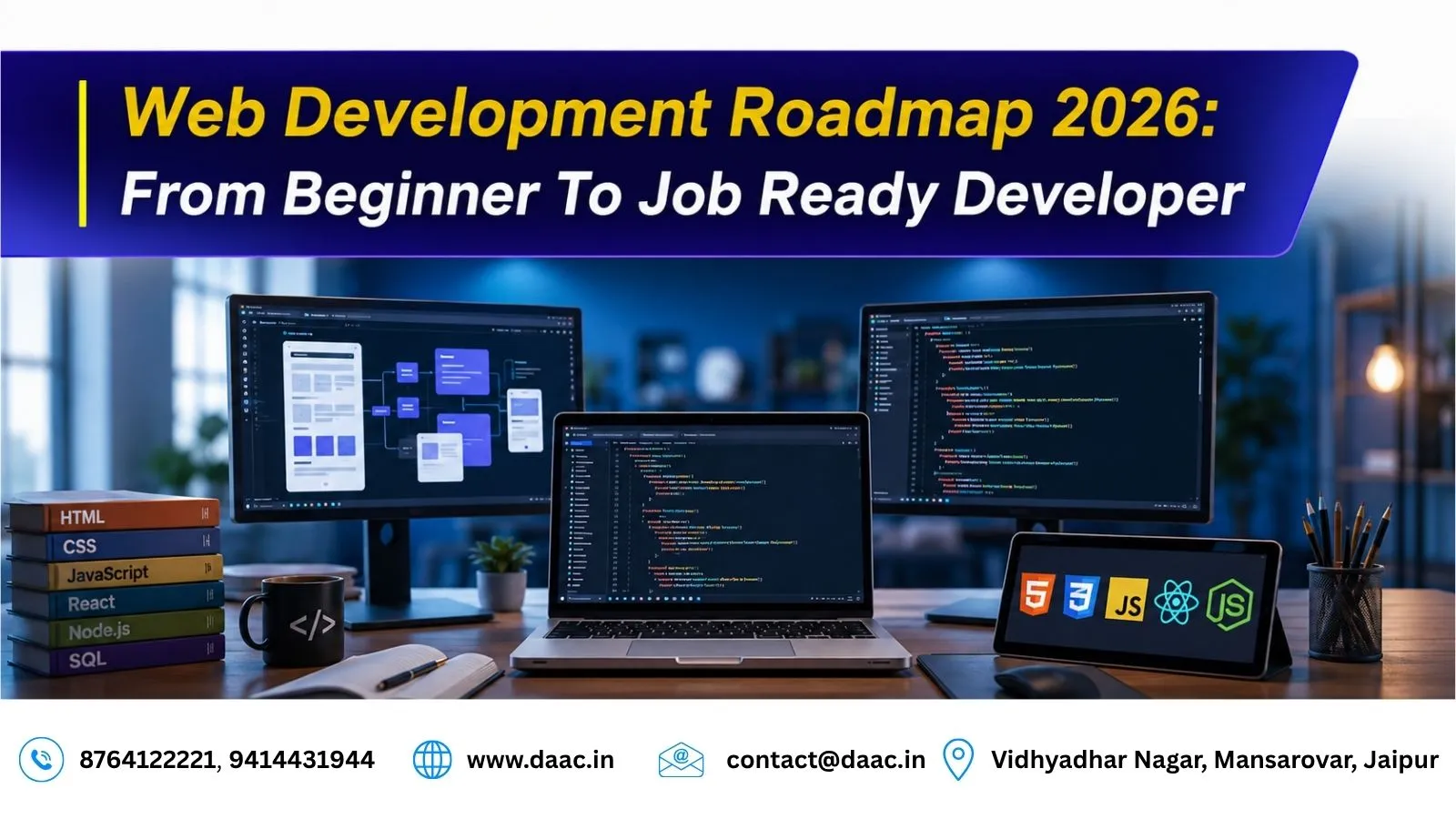
Following a structured Web Development Roadmap 2026 helps beginners learn the right technologies in the correct order. Instead of jumping between random tutorials, students can focus on building strong fundamentals and practical skills that employers actually require.
Today, web development offers excellent opportunities in freelancing, startups, agencies, and multinational companies. With the right learning approach, beginners can become job-ready within a few months of consistent practice.
Understanding the Modern Web Development Ecosystem
Before writing code, it is important to understand how websites and web applications work. Modern web development involves multiple technologies working together to deliver seamless digital experiences.
The ecosystem includes:
- Frontend technologies
- Backend development
- Databases
- APIs
- Cloud deployment
- Version control systems
Every successful developer understands how these components interact before choosing a specialization.
Types of Web Development
There are several career paths within web development:
| Type | Responsibility |
|---|---|
| Frontend Development | User interface and design |
| Backend Development | Server-side logic and databases |
| Full Stack Development | Frontend + Backend |
| DevOps | Deployment and infrastructure |
Most beginners start with frontend development because they can instantly see the results of their work inside a browser.
Step 1: Learn HTML for Website Structure
HTML is the foundation of every website. It defines the structure and content displayed on a web page.
Important HTML concepts include:
- Semantic tags
- Forms and inputs
- Tables
- Media elements
- Accessibility basics
Modern websites rely on semantic HTML because it improves both user experience and search engine understanding.
Students should focus on building multiple static webpages before moving to advanced topics. Strong HTML fundamentals make future learning significantly easier.
For beginners looking for structured training, a Web Designing Course in Jaipur can provide practical guidance on HTML, CSS, and responsive design concepts through real-world projects.
Step 2: Master CSS for Styling and Responsive Design
Once HTML is understood, the next step is learning CSS. CSS controls how websites look and behave visually.
A strong understanding of CSS includes:
- Colors and typography
- Box model
- Flexbox
- CSS Grid
- Responsive layouts
- Animations and transitions
Modern businesses expect websites to perform well across desktops, tablets, and smartphones. Therefore, responsive web development skills have become essential for every developer.
Before learning JavaScript, students should be able to recreate simple website layouts using only HTML and CSS.
Step 3: Learn JavaScript for Interactive Websites
JavaScript brings websites to life. It allows developers to create interactive experiences that respond to user actions.
Core JavaScript topics include:
- Variables and data types
- Functions
- Arrays and objects
- DOM manipulation
- Events
- ES6 features
- Async and Await
Most modern web applications depend heavily on JavaScript. Features such as login systems, dynamic content updates, notifications, and form validation are powered by JavaScript.
This stage often represents the biggest learning curve for beginners, but it is also where web development becomes exciting and practical.
Step 4: Learn Git and GitHub
Professional development teams rely on version control systems to manage projects efficiently.
Git helps developers:
- Track code changes
- Collaborate with teams
- Restore previous versions
- Manage project branches
GitHub serves as an online repository where developers store and showcase their projects.
Recruiters frequently review GitHub profiles when evaluating candidates. Consistent contributions demonstrate commitment and practical experience.
Building a strong GitHub portfolio should be a priority from the beginning of your development journey.
Step 5: Understand APIs and Databases
Modern websites rarely operate in isolation. They continuously exchange data with other systems using APIs.
Examples include:
- Weather applications
- Payment gateways
- Social media integrations
- Authentication systems
Developers should understand:
- REST APIs
- JSON
- Authentication
- API testing
Database knowledge is equally important.
Popular database technologies include:
- MySQL
- PostgreSQL
- MongoDB
Learning how data is stored and retrieved forms a crucial part of the web developer roadmap for 2026.
Step 6: Learn React and Modern Frontend Frameworks
After mastering JavaScript fundamentals, students should move to React.
React remains one of the most demanded frontend technologies because it powers applications developed by:
- Meta
- Netflix
- Airbnb
- Shopify
Benefits of React include:
- Component-based architecture
- Reusable code
- Faster development
- Strong ecosystem
Companies across India actively hire React developers because it enables efficient development of scalable applications.
Developers who want complete frontend and backend expertise often continue their learning through a Full Stack Developer Course in Jaipur, which covers technologies such as React, Node.js, Express, and MongoDB.
Step 7: Build Real-World Projects
Projects are the most important part of learning.
Employers hire developers based on what they can build rather than the number of courses they have completed.
Portfolio Website
Every beginner should create a portfolio website featuring:
- About section
- Skills
- Projects
- Contact information
Business Website
Build a multi-page website for:
- Restaurants
- Coaching institutes
- Local businesses
- Service providers
Dynamic Web Application
Create applications using APIs such as:
- Weather App
- Movie Search App
- News Portal
- GitHub Profile Finder
These projects demonstrate practical understanding of modern development workflows.
Step 8: Learn Deployment and Hosting
A project is incomplete until it is live.
Developers should understand deployment platforms such as:
- Netlify
- Vercel
- GitHub Pages
- AWS
Learning deployment helps students understand how applications move from development environments to production servers.
Companies expect junior developers to possess at least basic deployment knowledge.
How to Become Job-Ready in 2026
Technical knowledge alone is not enough.
To become job-ready, students should focus on:
Building a Strong Portfolio
A portfolio should include:
- Live project links
- GitHub repositories
- Case studies
- Technical explanations
Improving Problem-Solving Skills
Practice:
- JavaScript challenges
- Logic building
- Data structures basics
- Algorithm fundamentals
Preparing for Interviews
Common interview topics include:
- HTML and CSS concepts
- JavaScript fundamentals
- React lifecycle
- API integration
- Database basics
Interview preparation should start alongside project development rather than after completing the roadmap.
Why Structured Training Accelerates Growth
Self-learning works for many students, but structured training often helps learners progress faster.
A quality program should provide:
- Industry-oriented curriculum
- Mentor support
- Practical assignments
- Live projects
- Mock interviews
- Placement assistance
Students benefit from a guided path that eliminates confusion and focuses on industry-relevant skills.
Is Web Development a Good Career in 2026?
Yes. Web development remains one of the fastest-growing technology careers.
Reasons include:
- Increasing digital transformation
- Startup ecosystem growth
- Remote work opportunities
- Freelancing demand
- Global hiring trends
Entry-level developers with practical skills can find opportunities across multiple industries. As experience grows, developers can specialize in frontend, backend, full-stack, cloud computing, or software architecture.
Conclusion
The Web Development Roadmap 2026 provides a clear path from beginner to professional developer. By mastering HTML, CSS, JavaScript, APIs, databases, React, and deployment, students can build the skills required by modern employers.
Success depends on consistent practice, project development, and continuous learning. Whether your goal is freelancing, securing a job, or building your own products, following a structured roadmap can significantly improve your chances of success in the evolving technology industry.
FAQs
1. How long does it take to become a web developer?
Most beginners become job-ready within 6 to 9 months with consistent learning and project practice.
2. Which programming language should beginners learn first?
HTML, CSS, and JavaScript should be the first technologies every aspiring web developer learns.
3. Is React necessary in 2026?
Yes. React remains one of the most widely used frontend frameworks and is highly demanded by employers.
4. Can I become a web developer without a degree?
Yes. Many companies focus more on skills, projects, and practical knowledge than formal degrees.
5. What is the average salary of a web developer in India?
Freshers typically earn between ₹3.5 LPA and ₹7 LPA, while experienced developers can earn significantly higher depending on their expertise and specialization.