
As technology continues to evolve, software applications have become a critical part of everyday life. From banking apps and e-commerce websites to healthcare systems and mobile applications, businesses rely heavily on software to deliver services efficiently. However, even the most advanced software can fail if it is not properly tested before reaching users.
This is why software testing remains one of the most important functions in the IT industry. In 2026, organizations are releasing products faster than ever through Agile and DevOps practices. While development speed has increased, the need for quality assurance has grown equally. Companies cannot afford application crashes, security vulnerabilities, or poor user experiences.
For students, freshers, and career changers looking for a stable IT career, software testing offers excellent opportunities. It provides a lower entry barrier compared to some development roles while still offering long-term career growth, attractive salaries, and specialization options. This guide explains everything you need to know about software testing careers in 2026.
What Is Software Testing and Why Does It Matter?
Software testing is the process of evaluating an application to identify defects, verify requirements, and ensure that the software performs as expected. Testers examine different features, workflows, and functionalities to detect issues before users encounter them.
The primary objectives of software testing include:
- Finding bugs and defects
- Improving software quality
- Ensuring security and reliability
- Verifying business requirements
- Enhancing user experience
Consider a banking application that processes online transactions. If testing is skipped, users may face payment failures, security risks, or incorrect account balances. Such issues can damage a company’s reputation and lead to financial losses. This is why testing is considered a critical stage of software development.
Why Software Testing Is a Strong Career Choice in 2026
Many students mistakenly believe that testing has become outdated because of automation and artificial intelligence. The reality is quite different. Modern testing roles are becoming more advanced and valuable as software systems grow increasingly complex.
Several factors are driving demand for testing professionals:
- Faster software releases through Agile methodologies
- Increased focus on cybersecurity
- Growing adoption of automation testing
- Expansion of cloud-based applications
- Rising demand for mobile and web testing
- AI-powered software requiring quality validation
Companies now require skilled professionals who can combine manual testing expertise with automation knowledge. This creates strong career opportunities for individuals entering the field.
Who Should Learn Software Testing?
Software testing is suitable for individuals from various educational backgrounds. Unlike some technical roles that require extensive programming knowledge, testing offers a more accessible entry point into the IT industry.
This field is ideal for:
- IT students
- Non-IT graduates
- Freshers seeking IT careers
- Career switchers
- Working professionals looking to upskill
Analytical thinking, attention to detail, and problem-solving abilities are often more important at the beginner level than advanced coding skills. Many successful testers start with manual testing and gradually learn automation technologies as they gain experience.
Types of Software Testing You Should Know
Modern software testing includes multiple specialized areas. Understanding these categories helps students build a strong foundation and identify future career interests.
Functional Testing
Functional testing verifies whether the software performs according to business requirements. Testers validate features, workflows, and expected outputs to ensure everything functions correctly.
Performance Testing
Performance testing evaluates how applications behave under different levels of user traffic. It helps identify bottlenecks and system limitations.
Security Testing
Security testing focuses on protecting applications from cyber threats, vulnerabilities, and unauthorized access.
Usability Testing
Usability testing ensures that applications are easy to use and provide a positive experience for end users.
Each testing type plays an important role in delivering high-quality software products.
Essential Software Testing Categories to Learn
1. Manual Testing
Manual testing is the starting point for most beginners. Testers execute test cases manually and verify software behavior without using automation tools.
Key topics include:
- Test cases
- Test scenarios
- Bug life cycle
- SDLC
- STLC
- Defect management
Manual testing helps students understand software quality concepts before moving to advanced areas.
2. Automation Testing
Automation testing uses scripts and tools to execute repetitive test cases efficiently. Organizations increasingly prefer automation because it reduces testing time and improves accuracy.
Popular tools include:
- Selenium
- TestNG
- Cypress
- Playwright
Students interested in automation often strengthen their programming skills through a Core Python Course in Jaipur, as Python is widely used in test automation and scripting.
3. API Testing
Modern applications rely heavily on APIs for communication between systems. API testing ensures that these connections work properly.
Common tools include:
- Postman
- Swagger
- REST API Testing Tools
API testing is considered one of the most valuable skills in today’s testing industry.
4. Performance Testing
Performance testing helps organizations ensure that applications remain stable during high traffic periods.
Important concepts include:
- Load testing
- Stress testing
- Scalability testing
- Response time analysis
Tools such as JMeter are widely used for performance evaluation.
5. Mobile and Web Testing
Since most users access services through mobile devices and browsers, testing across multiple platforms is essential.
Areas covered include:
- Android testing
- iOS testing
- Responsive design testing
- Cross-browser testing
These skills are highly relevant for real-world projects.
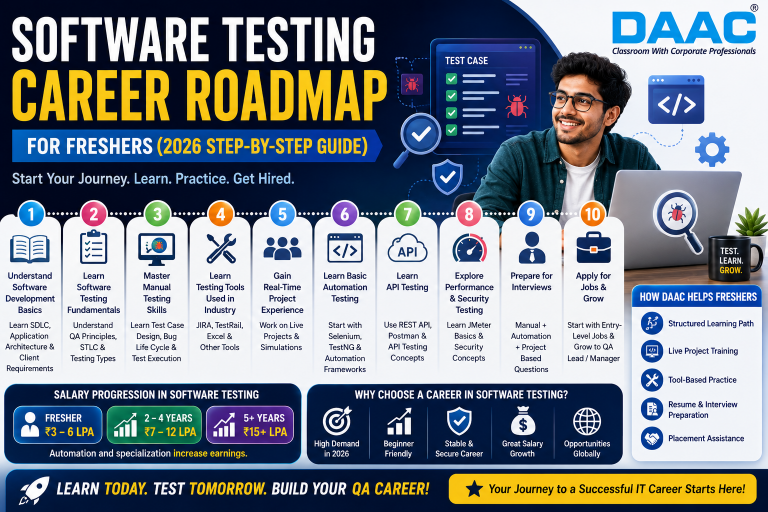
Software Testing Career Roadmap
A structured learning path helps students progress efficiently from beginner to advanced levels.
Beginner Level
Focus on:
- Manual testing fundamentals
- SDLC and STLC
- Test documentation
- Bug reporting tools
Intermediate Level
Learn:
- Automation testing basics
- Selenium
- API testing
- Framework concepts
Advanced Level
Master:
- CI/CD integration
- Performance testing
- Security testing
- AI-assisted testing tools
Students who understand both testing and development workflows often gain an advantage. Some professionals enhance their technical foundation through a Web Development Course in Jaipur, helping them collaborate effectively with development teams.
Popular Job Roles in Software Testing
Software testing offers multiple career paths with clear growth opportunities.
Common roles include:
Manual Tester
Responsible for executing test cases and identifying defects manually.
Automation Tester
Develops scripts and frameworks to automate testing processes.
QA Engineer
Ensures software quality throughout the development lifecycle.
Test Analyst
Analyzes requirements and designs comprehensive testing strategies.
QA Lead
Manages testing teams and oversees quality assurance activities.
As professionals gain experience, they can move into leadership, consulting, or specialized testing roles.
Software Testing Salary in India in 2026
Software testing salaries continue to improve as organizations seek skilled quality assurance professionals.
Average salary ranges:
| Experience Level | Salary Range |
|---|---|
| Fresher | ₹3–6 LPA |
| 2–5 Years | ₹7–12 LPA |
| Senior Level | ₹15–25+ LPA |
Professionals with automation, API testing, and performance testing skills generally earn higher salaries compared to manual testers.
Manual Testing vs Automation Testing
Many beginners wonder which path is better.
| Manual Testing | Automation Testing |
|---|---|
| Beginner-friendly | Higher industry demand |
| Less coding required | Requires scripting knowledge |
| Faster entry into IT | Better long-term salary growth |
| Strong foundation | Increased efficiency |
The most effective approach is to start with manual testing and gradually transition into automation as skills develop.
Common Myths About Software Testing
Several misconceptions discourage students from entering this field.
Myth 1: Testing Has No Career Growth
Reality: Testing offers structured growth from tester to QA lead, manager, architect, and consultant roles.
Myth 2: Automation Will Replace Testers
Reality: Automation tools require skilled professionals to design, maintain, and improve testing strategies.
Myth 3: Testing Is Easy
Reality: Effective testing requires analytical thinking, technical knowledge, and strong problem-solving skills.
Myth 4: Only Developers Earn High Salaries
Reality: Experienced automation and performance testing professionals can earn highly competitive salaries.
How DAAC Helps Students Become Job-Ready Testers
DAAC focuses on practical training that prepares students for industry requirements rather than only theoretical concepts.
Key learning benefits include:
- Real-time testing projects
- Live bug tracking exercises
- Manual and automation training
- Industry-oriented curriculum
- Interview preparation
- Placement assistance
Students gain hands-on experience with tools and methodologies used by modern software companies.
Conclusion
Software testing continues to be one of the most reliable and rewarding career options in the IT industry. As organizations accelerate software development through Agile, DevOps, and AI-powered technologies, the demand for skilled testing professionals is growing steadily.
For students and freshers looking to enter the technology sector, testing provides an accessible entry point with strong career growth, attractive salaries, and multiple specialization opportunities. By learning manual testing fundamentals, automation tools, API testing, and performance testing, aspiring professionals can build successful long-term careers in quality assurance.
FAQs
1. Is software testing a good career in 2026?
Yes. Software testing remains a high-demand field because organizations need reliable, secure, and high-performing applications.
2. Can non-IT students learn software testing?
Yes. Many non-IT graduates successfully enter software testing by learning testing fundamentals and practical tools.
3. Is coding required for software testing?
Coding is not mandatory for manual testing. However, automation testing requires basic programming knowledge.
4. Which software testing tool should beginners learn first?
Beginners should start with manual testing concepts and then move to Selenium and Postman for automation and API testing.
5. What is the average salary of a software tester in India?
Freshers typically earn between ₹3–6 LPA, while experienced professionals can earn ₹15 LPA or more depending on skills and expertise.