Salesforce continues to dominate the Customer Relationship Management (CRM) industry, helping businesses manage customers, automate processes, and improve sales performance. As Salesforce adoption grows worldwide, companies are actively hiring skilled professionals who can manage and customize their Salesforce environments.
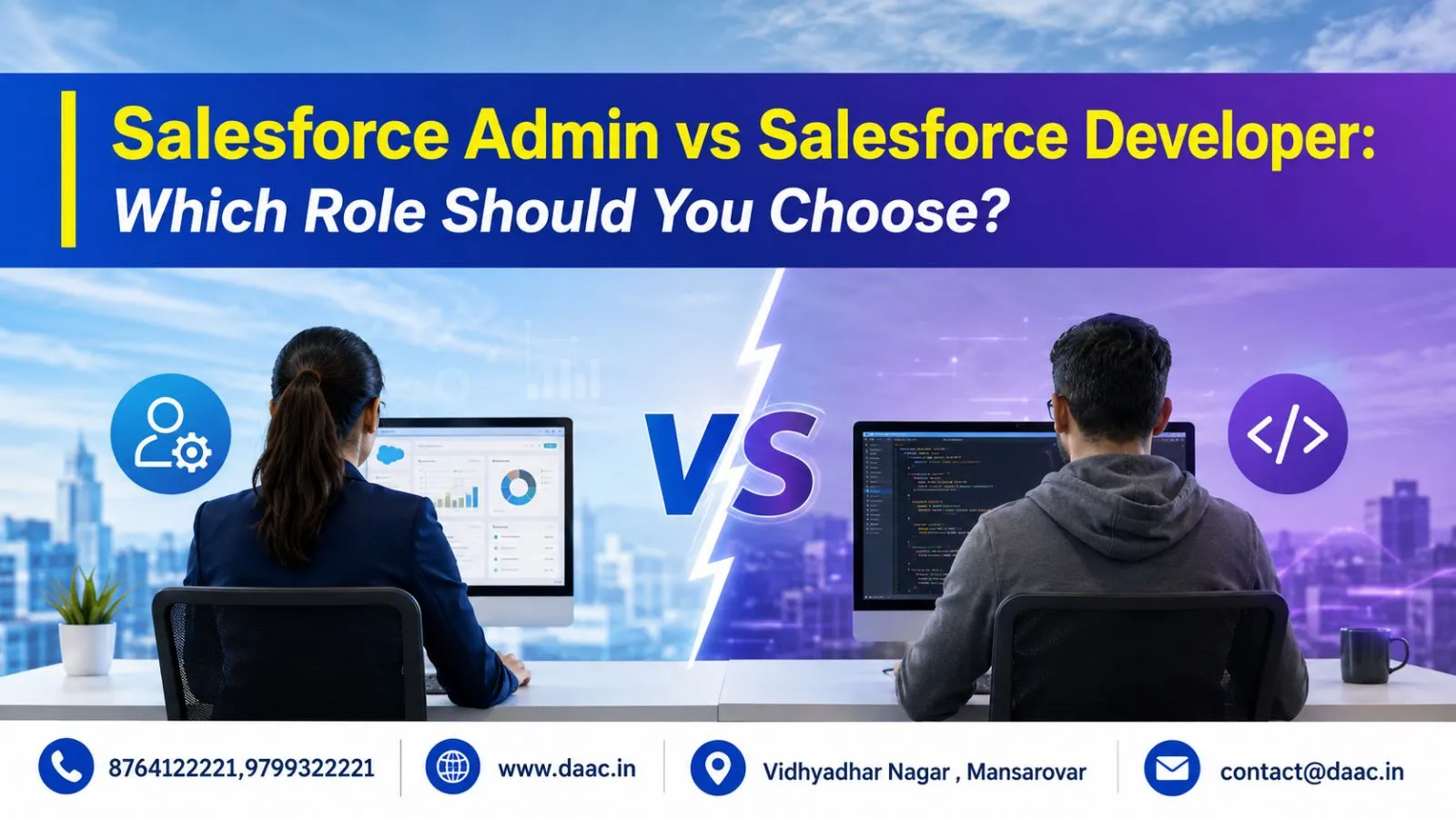
One of the most common questions among students and career changers is whether they should become a Salesforce Administrator or a Salesforce Developer. Both roles offer excellent career opportunities, competitive salaries, and long-term growth potential. However, the required skills, daily responsibilities, and career paths are significantly different.
Understanding these differences is essential before investing time in training and certifications. This guide compares both career options in detail, helping you choose the role that aligns with your interests, technical abilities, and future goals.
Why Salesforce Careers Are Growing Rapidly in 2026
Organizations across industries are investing heavily in cloud-based CRM solutions to improve customer experiences and business operations. Salesforce remains one of the leading platforms because of its flexibility, scalability, and extensive ecosystem.
Several factors are driving Salesforce job growth:
- Increased digital transformation projects
- Growing demand for CRM specialists
- Expansion of cloud technologies
- Automation of business workflows
- Rising adoption among startups and enterprises
According to industry hiring trends, Salesforce professionals continue to enjoy strong demand across India, the United States, the United Kingdom, Canada, Australia, and several European countries.
This growth has created multiple career opportunities for both administrators and developers.
What Does a Salesforce Admin Do?
A Salesforce Administrator manages the platform without extensive coding. Their primary responsibility is ensuring that business users can efficiently utilize Salesforce to perform their daily tasks.
The role focuses on configuration, user management, workflow automation, reporting, and system maintenance. Administrators work closely with sales, marketing, support, and management teams to ensure business processes run smoothly.
Typical responsibilities include:
- User account management
- Role and permission configuration
- Dashboard creation
- Report generation
- Workflow automation
- Data management
- Security implementation
- Process optimization
Salesforce Administrators often act as the bridge between business teams and technical teams, making communication and problem-solving important skills for success.
Essential Skills Required for a Salesforce Admin
Although coding is not a major requirement, administrators need strong platform knowledge and business understanding.
Key skills include:
Salesforce Configuration
Administrators must understand objects, fields, page layouts, validation rules, and workflow setup to customize the platform according to business requirements.
Data Management
Handling imports, exports, data quality, backups, and record maintenance is a critical responsibility.
Reporting and Analytics
Creating meaningful dashboards and reports helps organizations make data-driven decisions.
Flow Automation
Modern Salesforce environments increasingly rely on Flow for process automation, making it an essential skill for administrators.
Communication Skills
Admins regularly interact with users and stakeholders, making effective communication extremely important.
Professionals interested in CRM management often begin with a Salesforce Course in Jaipur to develop a strong foundation in administration and platform configuration.
What Does a Salesforce Developer Do?
A Salesforce Developer focuses on building custom solutions and extending platform functionality through programming.
While administrators configure existing features, developers create customized applications, automation systems, integrations, and advanced business logic.
Their work becomes essential when organizations require capabilities beyond standard Salesforce features.
Common responsibilities include:
- Custom application development
- Apex programming
- Lightning Web Component development
- API integrations
- Custom automation
- Performance optimization
- System enhancements
- Complex troubleshooting
Developers work closely with business analysts, architects, and administrators to deliver scalable solutions.
Essential Skills Required for a Salesforce Developer
The developer role requires stronger technical expertise compared to administration.
Apex Programming
Apex is Salesforce’s proprietary programming language and serves as the foundation of custom development.
Lightning Web Components (LWC)
LWC is widely used for building modern, interactive user interfaces within Salesforce applications.
JavaScript
JavaScript knowledge helps developers create dynamic and responsive user experiences.
HTML and CSS
Front-end customization often requires a solid understanding of web technologies.
API Integration
Developers frequently connect Salesforce with third-party applications such as ERP systems, payment gateways, and marketing platforms.
Debugging and Problem Solving
Identifying and resolving technical issues efficiently is a crucial developer responsibility.
Strong programming fundamentals can be developed further through a Full Stack Developer Course in Jaipur, which helps learners strengthen their coding skills and understand modern development practices.
Salesforce Admin vs Salesforce Developer: Key Differences
| Feature | Salesforce Admin | Salesforce Developer |
|---|---|---|
| Primary Focus | Configuration and Management | Custom Development |
| Coding Requirement | Minimal | High |
| Technical Complexity | Moderate | Advanced |
| User Interaction | Frequent | Moderate |
| Business Process Focus | High | Medium |
| Development Work | Limited | Extensive |
| Automation Tools | Flow, Reports | Apex, LWC, APIs |
| Learning Curve | Easier | Steeper |
| Entry-Level Accessibility | High | Moderate |
| Salary Potential | Strong | Higher in technical roles |
Both career paths are valuable, but they attract different types of professionals.
Salary Comparison in 2026
Salary expectations vary depending on experience, certifications, location, and company size.
Salesforce Admin Salary in India
- Fresher: ₹4–7 LPA
- 2–4 Years Experience: ₹7–12 LPA
- Senior Admin: ₹12–18 LPA
Salesforce Developer Salary in India
- Fresher: ₹6–10 LPA
- 2–5 Years Experience: ₹10–20 LPA
- Senior Developer: ₹20–35 LPA+
Global Salary Outlook
In countries such as the United States, Canada, Australia, and the United Kingdom, experienced Salesforce professionals can earn significantly higher salaries due to strong market demand.
While developers generally earn more because of technical expertise, experienced administrators with multiple certifications can also achieve impressive compensation packages.
Which Role Is Easier for Beginners?
For newcomers without programming experience, Salesforce Administration is generally the easier starting point.
Reasons include:
- Minimal coding requirements
- Faster learning curve
- Strong demand for entry-level admins
- Easier certification pathway
- Immediate business impact
Many professionals begin as administrators and later transition into development roles after gaining platform knowledge.
This progression allows learners to understand business processes before moving into advanced technical customization.
Future Career Growth Opportunities
Both career paths offer long-term growth opportunities.
Salesforce Admin Career Path
- Salesforce Administrator
- Senior Administrator
- Business Analyst
- Salesforce Consultant
- CRM Manager
- Salesforce Architect
Salesforce Developer Career Path
- Salesforce Developer
- Senior Developer
- Technical Lead
- Solution Architect
- Technical Architect
- Enterprise Architect
Organizations increasingly value professionals who understand both administration and development because they can manage complete Salesforce ecosystems more effectively.
How DAAC Helps Students Build Salesforce Careers
Choosing between administration and development can be challenging for beginners. DAAC helps learners explore both areas before specializing.
Key benefits include:
- Practical project-based learning
- Industry-focused curriculum
- Career counseling sessions
- Real-world CRM scenarios
- Hands-on Salesforce practice
- Certification preparation
- Placement assistance
Students gain exposure to both configuration and development environments, helping them make informed career decisions.
Which Salesforce Role Should You Choose?
Your choice should depend on your interests and strengths.
Choose Salesforce Admin if you:
- Prefer business processes over coding
- Enjoy working with users
- Like reporting and automation
- Want a faster entry into the industry
Choose Salesforce Developer if you:
- Enjoy programming
- Like solving technical challenges
- Want to build custom applications
- Prefer technical career growth
Both roles offer excellent opportunities and long-term career stability.
Conclusion
Salesforce remains one of the most promising career domains in 2026, offering rewarding opportunities for both administrators and developers. The right choice depends on your technical background, interests, and career goals.
If you enjoy business operations, process improvement, and user management, Salesforce Administration can be an excellent starting point. If coding, application development, and technical problem-solving excite you, Salesforce Development offers greater technical depth and higher earning potential.
Regardless of the path you choose, gaining practical experience, earning certifications, and working on real-world projects will significantly improve your career prospects in the growing Salesforce ecosystem.
FAQs
1. Is Salesforce Admin easier than Salesforce Developer?
Yes. Salesforce Administration typically requires less technical knowledge and has a shorter learning curve compared to development.
2. Can a Salesforce Admin become a Salesforce Developer later?
Yes. Many professionals start as administrators and later learn Apex, Lightning Web Components, and integrations to transition into development roles.
3. Which Salesforce role has a higher salary?
Salesforce Developers generally earn higher salaries because of their programming and customization expertise.
4. Do Salesforce Developers need coding skills?
Yes. Developers must learn Apex, JavaScript, HTML, CSS, and Salesforce development frameworks.
5. Is Salesforce a good career option in 2026?
Yes. Salesforce professionals remain highly sought after due to increasing CRM adoption and digital transformation initiatives worldwide.