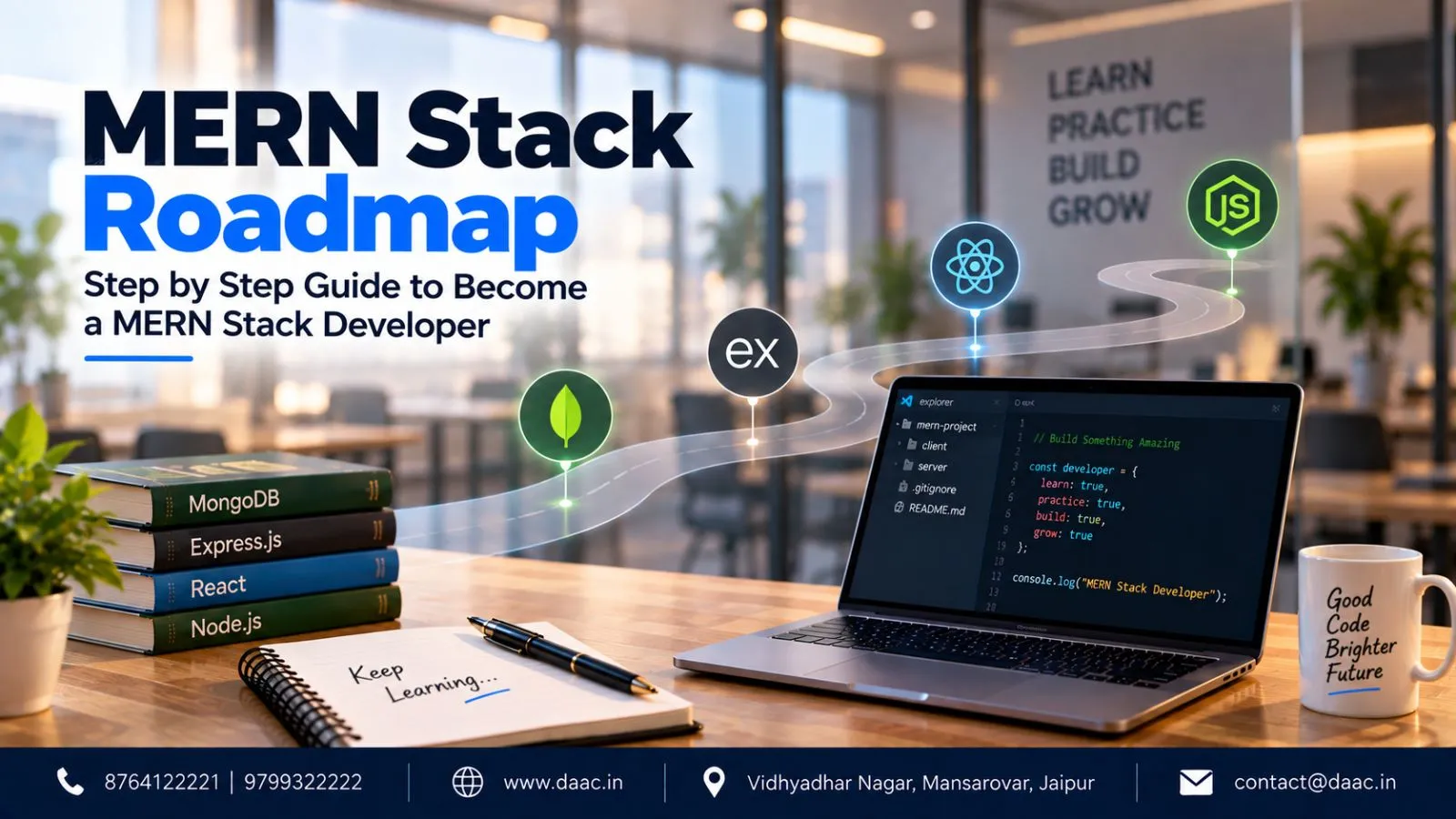
If you want to become a MERN full stack developer in 2026, following a structured learning path can make the process much easier. MERN is a popular JavaScript-based technology stack that combines MongoDB, Express.js, React, and Node.js to build complete web applications.
Instead of learning frontend and backend technologies separately, the MERN Stack roadmap helps you understand how the different parts of a modern web application work together.
A beginner does not need to master everything at once. The better approach is to build your skills progressively:
HTML & CSS → JavaScript → React → Node.js → Express.js → MongoDB → APIs → Authentication → Full-Stack Projects → Deployment
This roadmap explains what to learn at each stage and how to move from basic web development toward building complete MERN applications.
Understanding the MERN Stack Developer Role
What Does a MERN Stack Developer Do?
A MERN Stack developer is a full-stack web developer who uses four primary technologies:
- MongoDB – Database
- Express.js – Backend web framework
- React – Frontend library
- Node.js – JavaScript runtime
Together, these technologies can be used to create applications where the frontend communicates with backend APIs and the backend interacts with a database.
For example, consider an online shopping application.
The user sees products through the React frontend. React communicates with backend APIs built with Node.js and Express.js. Those APIs retrieve or update product and order information stored in MongoDB.
The overall architecture can be visualized as:
User → React → Express/Node.js → MongoDB
The response then travels back through the backend to the frontend.
This is why understanding how technologies connect is just as important as learning each technology individually.
Responsibilities in Frontend and Backend Development
A full stack MERN developer may work across several parts of an application.
On the frontend, responsibilities can include:
- Building user interfaces
- Creating reusable components
- Managing application state
- Handling forms
- Calling APIs
- Creating responsive layouts
- Managing frontend errors
On the backend, responsibilities may include:
- Building REST APIs
- Creating server-side logic
- Managing authentication
- Connecting databases
- Validating requests
- Handling errors
- Protecting application resources
Developers may also work with Git, testing, deployment, environment variables, debugging, and application performance.
Skills Companies Expect from MERN Developers
Knowing the names of MERN technologies is not enough.
Employers may expect developers to understand:
- HTML5
- Modern CSS
- JavaScript
- React
- Node.js
- Express.js
- MongoDB
- REST APIs
- Authentication
- Git and version control
- Debugging
- Database concepts
- Responsive design
- Deployment fundamentals
Problem-solving and communication skills are equally important.
A developer who can explain why a particular technical decision was made can often contribute more effectively than someone who only memorizes syntax.
Step 1 – Learn Frontend Development Fundamentals
Before learning React, build a strong foundation in HTML, CSS, and JavaScript.
These technologies form the base of modern web interfaces.
Master HTML5 and Modern CSS
HTML provides the structure of a webpage.
You should understand:
- Semantic HTML
- Headings and paragraphs
- Links
- Images
- Forms
- Tables
- Lists
- Input elements
- Accessibility basics
CSS controls presentation and layout.
Important concepts include:
- Selectors
- Box model
- Flexbox
- CSS Grid
- Positioning
- Responsive design
- Media queries
- Typography
- Transitions
- Modern layout techniques
Do not rush through HTML and CSS simply because they seem easier than JavaScript.
A strong foundation makes React development significantly easier because you will understand what your components are actually rendering.
Learn JavaScript ES6 and Beyond
JavaScript is the programming foundation of the MERN ecosystem.
Before moving deeply into React, learn:
- Variables
- Data types
- Operators
- Conditions
- Loops
- Functions
- Arrays
- Objects
- Array methods
- Scope
- DOM manipulation
- Events
- Error handling
Then move into modern JavaScript concepts such as:
letandconst- Arrow functions
- Destructuring
- Spread and rest operators
- Template literals
- Modules
- Classes
- Promises
async/await- Fetch API
- Higher-order functions
Asynchronous programming deserves special attention because frontend applications frequently communicate with backend APIs.
A learner who understands JavaScript well will find React much easier to understand.
Build Responsive User Interfaces
Before starting advanced frameworks, practise building responsive websites.
Create projects such as:
- Personal portfolio
- Landing page
- Restaurant website
- Product page
- Blog interface
- Admin dashboard
Make sure these projects work across desktop, tablet, and mobile screen sizes.
Responsive development also teaches you how real users interact with applications across different devices.
Step 2 – Learn React.js for Frontend Development
Once JavaScript fundamentals are strong, the next stage of the MERN Stack roadmap is React.
React is used to build component-based user interfaces.
Understanding Components and Props
Components are reusable building blocks of React applications.
For example, an e-commerce application might have:
- Header
- Navigation
- ProductCard
- ProductList
- Cart
- Checkout
- Footer
Breaking an application into components makes it easier to organize and maintain.
You should understand:
- Functional components
- JSX
- Props
- Component composition
- Conditional rendering
- Lists and keys
- Event handling
Props allow components to receive information from other components.
For example, a reusable ProductCard can receive a product’s name, image, price, and availability as props.
State Management and React Hooks
React applications also need to manage changing information.
This is where state becomes important.
You should learn common React hooks such as:
useStateuseEffectuseContextuseRef
Hooks allow functional components to manage state and interact with application behaviour.
For example, useState can manage a shopping cart count, while useEffect can be used for certain side effects such as fetching data.
As applications become larger, learners can explore more advanced state-management approaches. However, beginners should first understand React’s core state and component concepts.
Creating Dynamic Single-Page Applications
After learning components, props, and state, start building complete React applications.
Useful projects include:
- Task management application
- Movie search application
- Weather application
- Expense tracker
- Product catalogue
- Admin dashboard
These projects should consume real or mock APIs rather than relying entirely on static data.
The goal is to understand the complete frontend workflow:
User Action → State Change → API Request → Response → UI Update
That workflow becomes essential when you later connect React to your MERN backend.
Step 3 – Learn Backend Development with Node.js and Express.js
After frontend development, move to the backend.
Node.js allows JavaScript to run outside the browser, making it possible to build server-side applications using JavaScript.
Express.js provides a framework for creating web servers and APIs.
Building REST APIs
APIs allow different parts of an application to communicate.
For example:
React Frontend → API Request → Node.js/Express → Database → API Response → React
Learn concepts such as:
- HTTP methods
- GET
- POST
- PUT
- PATCH
- DELETE
- Request and response objects
- Status codes
- Routing
- Middleware
- Error handling
- JSON
You can then create APIs for applications such as:
- User management
- Product management
- Blog posts
- Orders
- Tasks
- Customer records
REST API development is one of the most important MERN Stack developer skills because frontend and backend applications frequently communicate through APIs.
Authentication and Authorization Basics
Authentication answers:
“Who is the user?”
Authorization answers:
“What is this user allowed to do?”
These are different concepts.
A basic MERN application may require:
- User registration
- Login
- Logout
- Password protection
- Session or token handling
- Protected routes
- Role-based permissions
For example, an e-commerce application could allow customers to view products while only authorized administrators can add or delete products.
Security should be considered throughout development rather than added at the very end.
Developers should also learn about secure password handling, input validation, environment variables, access control, and common web security risks.
Connecting Backend Services with Frontend Applications
Once your API works independently, connect it to React.
For example:
React Login Form → POST Request → Express API → Authentication Logic → Response → React
Then the application can display different information depending on the user’s authentication state.
This is the stage where the MERN stack begins to feel like one complete technology stack rather than four separate technologies.
Step 4 – Master MongoDB and Build Real MERN Projects
The final core technology in the MERN stack is MongoDB.
MongoDB is a document-oriented database that stores information in flexible document structures.
Understanding Collections and Documents
MongoDB organizes data using concepts such as:
- Databases
- Collections
- Documents
- Fields
A collection can be compared conceptually to a group of related records.
For example, an e-commerce application might have collections for:
- Users
- Products
- Orders
- Reviews
A product document could contain information such as its name, price, category, description, and stock status.
The important part is understanding how application data is structured and related.
Database Operations and CRUD Functionality
CRUD stands for:
Create → Read → Update → Delete
These operations are fundamental to most applications.
For example, a product management application might allow an administrator to:
- Create a product
- Read product information
- Update product details
- Delete a product
Your MERN backend should connect these operations to API endpoints.
A typical workflow could be:
React Form → Express Route → Server Logic → MongoDB → Response → React UI
Learning this workflow gives you a practical understanding of full-stack development.
Creating Full-Stack MERN Applications from Scratch
Once you understand all four technologies, stop building isolated practice exercises and start creating complete applications.
Good portfolio projects can include:
1. E-Commerce Application
Features could include:
- Product catalogue
- Search
- Filtering
- User accounts
- Shopping cart
- Orders
- Admin panel
2. Job Portal
Possible features:
- User registration
- Job listings
- Search and filtering
- Applications
- Employer dashboard
- Candidate profiles
3. Learning Management System
Possible features:
- Student accounts
- Course catalogue
- Video or lesson content
- Progress tracking
- Instructor dashboard
- Assessments
4. Project Management Application
Possible features:
- Teams
- Projects
- Tasks
- Status tracking
- User roles
- Notifications
The objective is not to create the biggest project possible.
Instead, build an application that demonstrates your ability to solve a complete problem.
Essential Tools to Add to Your MERN Stack Roadmap
The four core MERN technologies are important, but professional development involves more than MongoDB, Express, React, and Node.js.
Add these skills to your roadmap:
Git and Version Control
Learn:
- Repositories
- Commits
- Branches
- Merging
- Pull requests
- Collaboration workflows
API Testing
Understand how to test API endpoints independently before connecting them to the frontend.
Debugging
Learn how to investigate:
- Console errors
- API failures
- Database problems
- Authentication issues
- Frontend rendering problems
Deployment Basics
A full-stack developer should understand how an application moves from local development to a production environment.
Learn concepts such as:
- Environment variables
- Build processes
- Hosting
- Domains
- Backend deployment
- Database deployment
- Production configuration
Testing
As your applications become larger, testing becomes increasingly important.
Learn the basics of:
- Unit testing
- Integration testing
- API testing
- Component testing
- End-to-end testing
MERN Stack Roadmap: Beginner to Job-Ready
A simplified learning sequence looks like this:
Phase 1: HTML5 + CSS
↓
Phase 2: JavaScript fundamentals
↓
Phase 3: Modern JavaScript + APIs
↓
Phase 4: React fundamentals
↓
Phase 5: React projects
↓
Phase 6: Node.js + Express.js
↓
Phase 7: REST APIs + Authentication
↓
Phase 8: MongoDB + CRUD
↓
Phase 9: Full-stack MERN projects
↓
Phase 10: Git + Testing + Deployment
↓
Phase 11: Portfolio + Interview Preparation
The timeline will depend on your existing programming knowledge and the amount of time you can practise.
What Should You Build After Learning MERN?
Your portfolio should demonstrate progression.
Start with small projects, then increase complexity.
For example:
Beginner: To-do application
Intermediate: Expense tracker with authentication
Advanced: E-commerce application with products, users, cart, orders, and admin functionality
This progression demonstrates that you understand more than individual technologies.
For every project, be prepared to explain:
- Why you selected the technology
- How the frontend communicates with the backend
- How data is stored
- How authentication works
- How errors are handled
- How the application is deployed
- What challenges you encountered
These discussions can be valuable during technical interviews.
MERN Stack Skills for 2026
The MERN ecosystem continues to evolve, so learning should not stop after completing the four core technologies.
Modern developers should also understand:
- AI-assisted development
- API integration
- Cloud deployment
- Application security
- Automated testing
- Performance optimisation
- Accessibility
- Type safety concepts
- Modern frontend architecture
AI coding tools can help developers generate boilerplate code, explain errors, create test cases, and explore implementation approaches.
However, developers still need to understand the generated code, verify its behaviour, identify security problems, and debug unexpected results.
The most useful approach is to treat AI as a development assistant rather than a substitute for programming fundamentals.
Final Thoughts
The MERN Stack roadmap is essentially a progression from frontend fundamentals to complete full-stack application development.
Start with HTML and CSS, build strong JavaScript fundamentals, then learn React for frontend development. After that, move to Node.js and Express.js for backend development and MongoDB for data storage.
Once the four core technologies are comfortable, focus on APIs, authentication, Git, testing, deployment, security, and real-world projects.
If your goal is to become a MERN full stack developer, don’t measure your progress only by the number of technologies you have completed. Measure it by what you can build independently.
The ultimate goal of the roadmap is simple:
Learn → Practise → Build → Debug → Deploy → Improve
Following this cycle consistently can turn a beginner’s knowledge of individual technologies into practical full-stack development skills.