Salesforce has become one of the most widely used Customer Relationship Management (CRM) platforms worldwide. Organizations across industries rely on Salesforce to manage customer relationships, automate business processes, improve sales performance, and streamline operations. As Salesforce adoption continues to grow, the demand for skilled professionals is increasing rapidly.
Among the most sought-after Salesforce careers are Salesforce Administrator and Salesforce Developer roles. While both professionals work within the Salesforce ecosystem, their responsibilities, technical requirements, and career paths differ significantly.
Many students and working professionals entering the CRM industry often struggle to choose between these two career options. Understanding the differences between administration and development can help you select a role that aligns with your interests, skills, and long-term career goals.
This guide explains the responsibilities, required skills, certifications, salary expectations, and future opportunities associated with both career paths.
Understanding Salesforce Admin vs Developer Roles
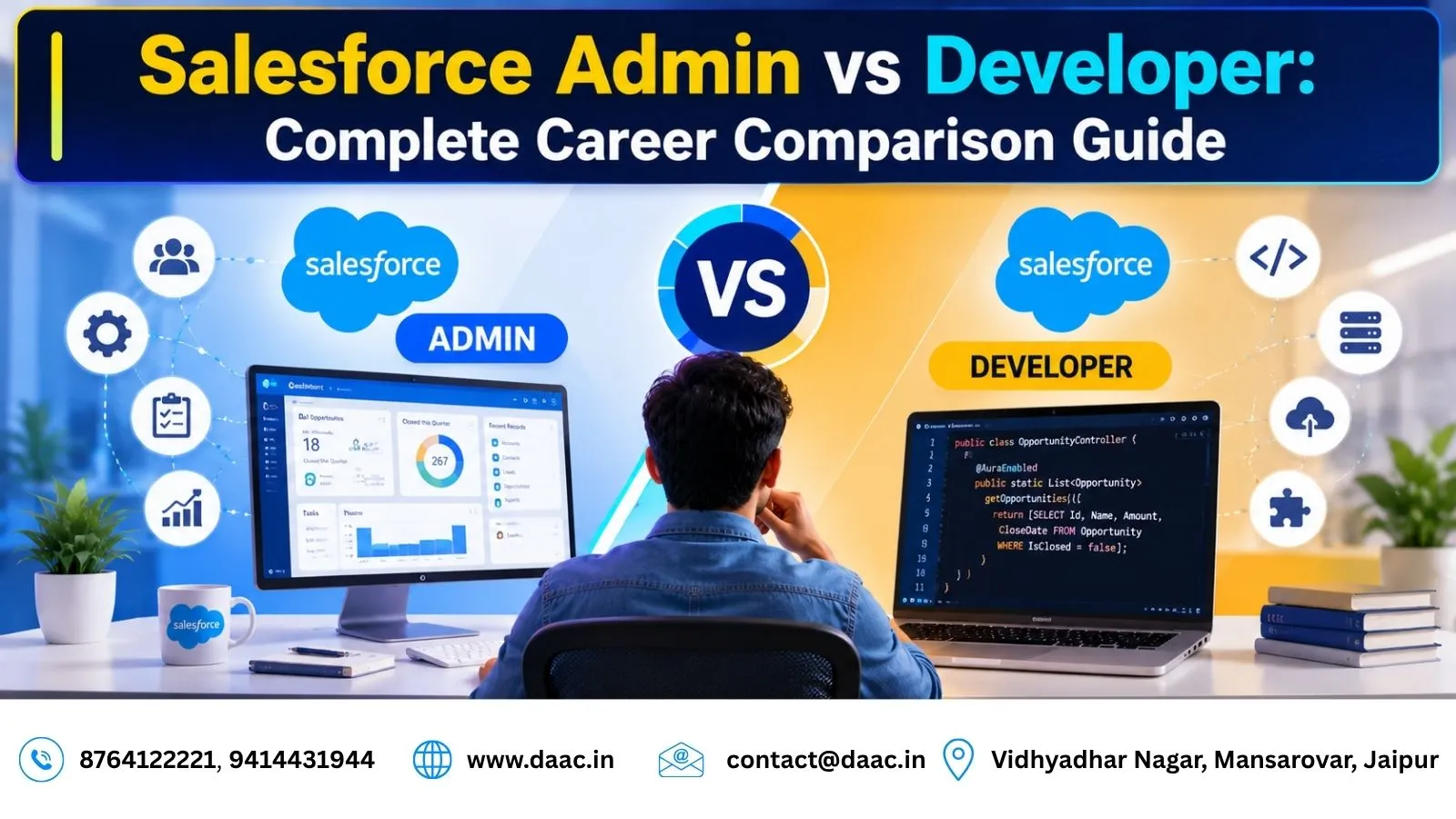
The primary difference between a Salesforce Administrator and a Salesforce Developer lies in how they interact with the platform.
A Salesforce Administrator focuses on configuring Salesforce using built-in tools, automation features, and business process management. They help organizations use Salesforce effectively without extensive coding.
A Salesforce Developer, on the other hand, creates custom functionality using programming languages, APIs, and advanced development frameworks. Developers build solutions when standard Salesforce features cannot meet business requirements.
Although their responsibilities differ, both roles play a critical part in successful Salesforce implementations.
What Does a Salesforce Administrator Do?
A Salesforce Administrator acts as the bridge between business users and the Salesforce platform. Their primary responsibility is ensuring that the CRM system functions efficiently and supports organizational goals.
Typical Salesforce Administrator responsibilities include:
- Managing users and permissions
- Creating reports and dashboards
- Configuring workflows and automation
- Maintaining data quality
- Customizing objects and fields
- Supporting end users
- Implementing security settings
- Monitoring platform performance
Administrators work closely with sales, marketing, customer service, and management teams to improve productivity through automation and process optimization.
Professionals who enjoy working with business processes and solving operational challenges often find the administrator role highly rewarding.
What Does a Salesforce Developer Do?
Salesforce Developers focus on extending Salesforce functionality through coding and advanced customization. They create solutions that go beyond standard platform capabilities.
Common Salesforce Developer responsibilities include:
- Writing Apex code
- Building Lightning Web Components
- Creating custom applications
- Developing integrations with external systems
- Managing APIs
- Designing custom business logic
- Optimizing platform performance
- Supporting large-scale implementations
Developers collaborate with administrators, architects, and stakeholders to create scalable solutions that address complex business requirements.
The developer role is ideal for individuals who enjoy programming, problem-solving, and building technical solutions.
Salesforce Admin vs Developer Skills Comparison
Both careers require different skill sets, although some foundational Salesforce knowledge overlaps.
Salesforce Administrator Skills
Successful administrators typically possess:
- Salesforce configuration expertise
- Flow Builder knowledge
- Dashboard creation skills
- Report generation
- Data management capabilities
- Business analysis skills
- Communication abilities
- Problem-solving mindset
Administrators spend much of their time understanding business requirements and translating them into platform configurations.
Salesforce Developer Skills
Developers require stronger technical capabilities, including:
- Apex programming
- Lightning Web Components (LWC)
- JavaScript
- HTML and CSS
- API integrations
- Database concepts
- Version control systems
- Application architecture
The technical depth required for development makes this role more programming-focused compared to administration.
Salesforce Certifications for Career Growth
Certifications play an important role in validating Salesforce expertise and improving job opportunities.
Popular Salesforce Administrator Certifications
- Salesforce Certified Administrator
- Salesforce Advanced Administrator
- Salesforce Platform App Builder
These certifications demonstrate proficiency in configuration, automation, reporting, and user management.
Popular Salesforce Developer Certifications
- Salesforce Platform Developer I
- Salesforce Platform Developer II
- Salesforce JavaScript Developer I
Developer certifications validate coding expertise and advanced customization skills.
Students planning a CRM-focused career often begin with a structured Salesforce Course in Jaipur to build practical skills before pursuing official certifications.
Certifications improve credibility and increase employability in the competitive Salesforce job market.
Salesforce Admin vs Developer Salary Comparison
Salary is often a major factor when choosing a career path.
Salesforce professionals generally enjoy attractive compensation due to the platform’s global demand.
Average Salesforce Administrator Salaries
- Entry-Level: ₹4–7 LPA
- Mid-Level: ₹8–15 LPA
- Senior-Level: ₹15–25 LPA
Average Salesforce Developer Salaries
- Entry-Level: ₹6–10 LPA
- Mid-Level: ₹12–20 LPA
- Senior-Level: ₹20–40+ LPA
Developers usually earn higher salaries because of their coding expertise and ability to build custom solutions.
However, experienced administrators with specialized business knowledge can also command impressive compensation packages.
Career Growth Opportunities
Both roles offer excellent long-term career growth.
Salesforce Administrator Career Path
A typical administrator career progression includes:
- Junior Salesforce Administrator
- Salesforce Administrator
- Senior Salesforce Administrator
- Salesforce Consultant
- CRM Manager
- Product Owner
This path focuses on business process optimization and CRM strategy.
Salesforce Developer Career Path
Developers often progress through the following stages:
- Junior Salesforce Developer
- Salesforce Developer
- Senior Salesforce Developer
- Technical Lead
- Solution Architect
- Technical Architect
Architect-level professionals are among the highest-paid experts within the Salesforce ecosystem.
Which Role Is Easier for Beginners?
For most beginners, Salesforce Administration is easier to start with because it requires minimal programming knowledge.
Administrators primarily work with:
- Drag-and-drop tools
- Automation builders
- Reports and dashboards
- Security settings
- Business workflows
Developers must learn programming concepts, application architecture, and Salesforce development frameworks before handling complex projects.
Students without a technical background often begin as administrators and later transition into development after gaining platform experience.
Industry Demand for Salesforce Professionals in 2026
Salesforce remains one of the fastest-growing enterprise technologies globally.
Organizations across industries actively hire:
- Salesforce Administrators
- Salesforce Developers
- Salesforce Consultants
- Salesforce Architects
- Business Analysts
Industries creating strong demand include:
- Banking
- Healthcare
- Retail
- Education
- IT Services
- Manufacturing
- Telecommunications
Many companies also value professionals who combine Salesforce expertise with broader development knowledge. This is why some learners pursue a Full Stack Developer Course in Jaipur alongside CRM training to strengthen their technical profile.
Hybrid skill sets often create additional career opportunities.
How to Choose Between Salesforce Admin and Developer
Choosing the right path depends on your interests and strengths.
Choose Salesforce Administration if you:
- Prefer business processes
- Enjoy working with users
- Like solving operational challenges
- Want minimal coding
- Enjoy data management
Choose Salesforce Development if you:
- Enjoy programming
- Like building applications
- Prefer technical problem-solving
- Want deeper customization capabilities
- Aspire to become a technical architect
There is no universally better role. The best choice depends on your career objectives and personal interests.
Future Scope of Salesforce Careers
The Salesforce ecosystem continues expanding through innovations in artificial intelligence, automation, analytics, and customer experience management.
Future opportunities include:
- Salesforce AI Specialist
- CRM Consultant
- Solution Architect
- Technical Architect
- Automation Expert
- Customer Success Manager
As businesses invest more heavily in digital transformation, Salesforce professionals will remain among the most sought-after technology experts.
Conclusion
Salesforce Administrator and Salesforce Developer careers both offer strong growth opportunities, attractive salaries, and global demand. While administrators focus on business process optimization and platform configuration, developers specialize in coding, integrations, and advanced customization.
For beginners, administration often provides a smoother entry point into the Salesforce ecosystem. For those passionate about programming and technical problem-solving, development offers deeper specialization and higher earning potential.
Before choosing a path, assess your interests, technical skills, and long-term career goals. Regardless of which role you pursue, Salesforce expertise remains one of the most valuable skills in today’s technology-driven job market.
FAQs
1. What is the main difference between a Salesforce Admin and Developer?
Salesforce Administrators configure and manage Salesforce using built-in tools, while Salesforce Developers create custom solutions through coding and integrations.
2. Can a Salesforce Administrator become a Salesforce Developer?
Yes. Many professionals start as administrators and later learn Apex, JavaScript, and Lightning Web Components to transition into development roles.
3. Which role earns a higher salary?
Salesforce Developers generally earn higher salaries because of their technical expertise, although experienced administrators can also earn competitive packages.
4. Is coding required for Salesforce Administration?
No. Most administrator responsibilities can be performed using Salesforce’s no-code and low-code tools.
5. Which Salesforce role is best for freshers?
Salesforce Administration is usually the best starting point for freshers because it has a lower technical barrier and provides a strong foundation in CRM concepts.