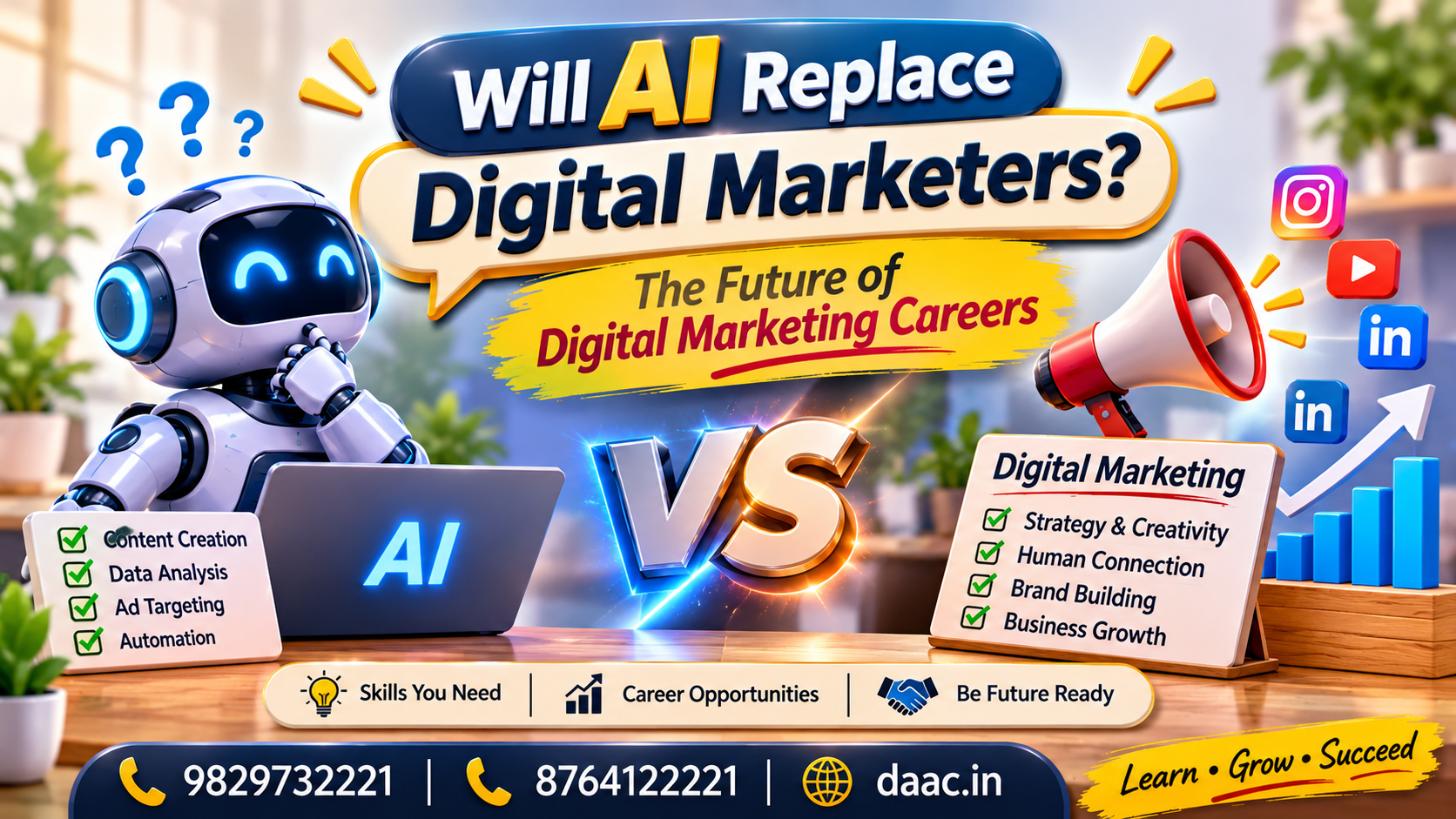
Will AI replace digital marketers? This is one of the most common questions among students, business owners, and marketing professionals as artificial intelligence continues transforming the online business environment. In 2026, AI can generate content, analyse customer behaviour, automate advertising activities, and improve marketing campaigns. However, digital marketing involves much more than completing repetitive tasks. It requires creativity, strategic thinking, audience understanding, and business knowledge. Artificial intelligence is changing how marketers work, but it is also creating new opportunities for professionals who understand how to use technology effectively. The future belongs to marketers who combine human intelligence with AI-powered digital marketing strategies.
The Rise of AI in Digital Marketing
Artificial intelligence has become an important part of modern marketing operations. Businesses use intelligent technologies to understand customer preferences, identify market trends, improve advertising performance, and deliver personalised experiences. Instead of depending entirely on manual research and campaign management, marketing teams can now use automated systems to process information and make faster decisions.The role of AI in digital marketing is expanding across search engine optimisation, social media, paid advertising, email marketing, content creation, and customer relationship management. These developments allow companies to manage campaigns more efficiently while giving marketing professionals additional time for planning and creative activities.
How AI Is Changing Marketing Strategies
Earlier, marketers spent considerable time researching keywords, analysing competitors, preparing campaign reports, and identifying potential customers. AI-powered applications can now support these activities by processing large amounts of information and identifying useful patterns.Some important changes include:
- Audience research: AI analyses customer behaviour, interests, and interactions to identify relevant audience groups.
- Campaign personalisation: Marketing messages can be adapted according to customer preferences and previous interactions.
- Predictive analytics: Intelligent systems help identify potential trends and estimate campaign outcomes using available data.
- Search optimisation: AI assists with keyword research, content analysis, search intent identification, and performance monitoring.
- Advertising optimisation: Automated bidding and targeting features help advertisers improve campaign delivery.
- Content planning: Marketers can generate topic ideas, campaign outlines, and creative suggestions more efficiently.
However, AI recommendations are only as useful as the information and objectives behind them. Marketers must review the results, understand business requirements, and decide which recommendations are appropriate.
Popular AI Tools Used by Marketers
Several applications are helping professionals improve different areas of marketing. Understanding their capabilities allows marketers to select suitable technologies for specific business objectives.Some commonly used options include:
- ChatGPT: Helps with content ideas, research assistance, campaign planning, and marketing copy drafts.
- Google Gemini: Supports research, brainstorming, content development, and productivity tasks.
- Canva AI: Assists with graphic design, visual content creation, and marketing creatives.
- HubSpot AI: Supports customer relationship management, content assistance, and marketing automation.
- Semrush: Provides SEO research, keyword analysis, competitor insights, and content optimisation features.
- Google Ads AI: Supports automated bidding, campaign optimisation, audience targeting, and advertising performance improvements.
Benefits of AI-Powered Marketing
AI-powered marketing offers several advantages to businesses of different sizes. Small companies can use automation to manage activities that previously required larger teams, while established organisations can process information more efficiently.Major benefits include faster campaign execution, improved audience segmentation, personalised communication, and better access to performance insights. Automated reporting also helps teams identify changes in campaign results without manually reviewing every data point.
Another important advantage is scalability. Businesses can manage multiple campaigns and communication channels while using automation to handle repetitive operations.
Nevertheless, automation does not guarantee successful marketing. Incorrect audience information, poor campaign objectives, and unsuitable content can still produce disappointing results. Human supervision remains necessary to maintain accuracy, brand consistency, and customer trust.
Tasks AI Can Automate
Artificial intelligence is particularly effective at handling structured, repetitive, and data-intensive activities. Marketing teams can use automation to improve productivity and reduce the time required for routine operations.However, not every marketing responsibility can be automated completely. Tasks involving judgement, emotional understanding, brand positioning, and complex business decisions still require human involvement.
Content Generation and Optimization
Content creation is one of the areas where artificial intelligence has introduced significant changes. Marketers can use generative applications to prepare initial drafts, social media captions, advertising headlines, product descriptions, email content, and blog outlines.AI can also help identify relevant topics, suggest keywords, improve readability, and organise information according to search intent.
For example, an SEO professional can use an AI application to generate content ideas around a business topic. The professional can then research the subject, verify information, add practical insights, and develop an original article.
Content optimisation also benefits from intelligent assistance. Applications can identify missing topics, suggest related search terms, and highlight areas that may need improvement.
However, publishing automatically generated material without reviewing its accuracy or originality can damage content quality. Effective digital marketing with AI requires fact-checking, editorial judgement, audience understanding, and a consistent brand voice.
The best approach is to treat AI-generated material as a starting point rather than a finished marketing product.
Data Analysis and Reporting
Marketing campaigns generate information through website visits, search impressions, advertising clicks, social media engagement, and customer conversions. Analysing this information manually can become difficult when businesses manage multiple platforms.AI-assisted analytics can help marketers organise information, identify unusual performance changes, and understand patterns across different campaigns.
For example, a marketing team may notice that a particular advertisement receives many clicks but generates very few enquiries. Data analysis can help identify possible problems with the landing page, audience targeting, or campaign message.
Automation also makes regular reporting easier. Instead of preparing every report manually, marketers can use dashboards and intelligent summaries to monitor important performance indicators.
However, interpreting the reasons behind performance changes requires business understanding. Marketers must evaluate campaign objectives, customer behaviour, market conditions, and available budgets before making decisions.
Customer Support Through Chatbots
AI-powered chatbots are increasingly used to handle common customer questions and provide assistance outside regular business hours.Businesses can implement conversational systems on websites, messaging platforms, and customer service applications to answer frequently asked questions, collect enquiry details, and guide visitors towards relevant products or services.
For example, an educational institute can use a chatbot to explain course information, share basic admission details, and collect contact information from interested students.
These systems can improve response times and reduce the workload of customer support teams. They also help businesses maintain communication with potential customers when human representatives are unavailable.
However, complicated complaints, sensitive conversations, and situations requiring empathy should be handled by trained professionals. Human support is essential when customers need personalised assistance or when automated responses cannot resolve their concerns.
Why Digital Marketers Are Still Important
Although automation is becoming more advanced, businesses still need professionals who understand people, markets, competition, and organisational objectives. Technology can process information and generate recommendations, but successful marketing requires decisions that connect customer needs with business goals.The future of digital marketing will depend on combining technological efficiency with human capabilities. Professionals who understand both areas can provide greater value than those who depend entirely on automated applications.
Human Creativity and Storytelling
Creativity is one of the most important elements of successful marketing. Businesses need original ideas, memorable messages, and engaging stories to communicate their value to customers.AI can suggest headlines, generate visual concepts, and prepare content drafts. However, developing a meaningful brand story requires understanding the audience, cultural context, emotions, and the message a business wants to communicate.
For example, two companies may sell similar products, but their marketing campaigns can be completely different because they target different customer groups.
A human marketer can identify the emotional connection that makes one campaign more relevant than another. They can also recognise when a message feels unnatural, insensitive, or inconsistent with the brand.
This ability to understand context makes creative thinking an important professional advantage.
Strategic Decision-Making
Marketing decisions involve more than selecting keywords or generating advertisements. Professionals must understand business objectives, identify target audiences, allocate budgets, evaluate competition, and decide which channels offer the best opportunities.AI can provide recommendations based on available information, but marketers must determine whether those recommendations support the organisation's actual goals.
For example, an automated system may suggest increasing advertising expenditure because a campaign receives strong engagement. However, a marketer must evaluate whether that engagement produces qualified leads, sales, or meaningful business growth.
Strategic decision-making also involves managing risks, maintaining brand positioning, and adjusting plans when market conditions change.
Businesses need professionals who can interpret information rather than simply follow automated suggestions.
Building Brand Relationships
Marketing is ultimately about connecting businesses with people. Customers expect brands to understand their needs, communicate honestly, and provide reliable experiences.AI can personalise messages and automate communication, but building lasting relationships requires trust, empathy, and consistent human interaction.
A marketing professional understands that customer expectations can vary depending on age, location, interests, and previous experiences. This understanding helps businesses create communication that feels relevant rather than mechanical.
Human involvement is particularly important when managing customer complaints, responding to public feedback, developing brand communities, and maintaining long-term client relationships.
As automated communication becomes more common, authentic brand experiences can become an important competitive advantage.
How AI and Digital Marketers Work Together
The most effective marketing approach is not necessarily choosing between human professionals and artificial intelligence. It is creating a workflow where both contribute their strengths.AI can process information, automate repetitive activities, and provide recommendations. Marketers can use those outputs to develop strategies, improve communication, and make informed decisions.
This collaboration allows businesses to improve efficiency without losing the creativity and personal understanding required for successful campaigns.
Improving Productivity with AI
Marketing professionals can use automation to complete repetitive activities faster and dedicate more time to important responsibilities.For example, an SEO executive can use AI to organise keyword research, prepare content briefs, and summarise website performance. The executive can then focus on search intent, content quality, technical improvements, and overall website strategy.
Similarly, social media professionals can generate initial content calendars and creative suggestions before reviewing them for brand relevance.
The objective should not be to automate everything. It should be to identify activities where automation creates measurable value.
Marketers should also learn how to write clear prompts, evaluate generated results, protect confidential information, and verify important facts before using AI outputs.
Enhancing Customer Experiences
AI can help businesses understand customer preferences and provide more relevant communication across different digital channels.Personalised recommendations, automated email sequences, intelligent chatbots, and behaviour-based advertising can make customer journeys more convenient.
For example, an e-commerce company can use customer browsing information to recommend relevant products. Its marketing team can review these recommendations and ensure that promotional messages remain useful and appropriate.
Customer experience also depends on website usability, accurate information, transparent communication, and effective support. Human professionals must monitor these areas to ensure automation does not create frustrating experiences.
Combining intelligent technology with customer-focused planning can help businesses build stronger relationships and improve customer satisfaction.
Using AI for Better Campaign Performance
AI-assisted advertising and analytics can help marketing teams identify performance patterns and improve campaign management.Platforms such as Google Ads provide automated campaign features that support bidding, targeting, and optimisation. Google Analytics also offers insights that help businesses understand website traffic and user behaviour.
Marketers can use these capabilities to compare campaign performance, identify opportunities, and evaluate conversions.
However, successful campaigns still require clear objectives, relevant landing pages, appropriate budgets, and accurate conversion tracking.
Professionals must regularly review results instead of assuming that automated recommendations are always correct. Combining data analysis with practical business knowledge helps improve marketing decisions.
Future Career Opportunities in AI-Driven Marketing
The increasing adoption of artificial intelligence is changing the skills expected from marketing professionals. Some routine responsibilities are becoming automated, while new opportunities are emerging around AI implementation, campaign analysis, customer experience, and marketing strategy.Rather than preparing only for traditional execution-based responsibilities, aspiring professionals should develop a broader understanding of digital platforms, analytics, automation, and intelligent technologies.
AI Marketing Specialist Roles
Professionals who understand marketing principles and AI applications can explore several career opportunities.Some emerging and evolving roles include:
- AI Marketing Specialist: Uses intelligent applications to improve campaign planning, content development, and marketing workflows.
- Marketing Automation Specialist: Develops automated communication systems and customer journeys.
- Performance Marketing Executive: Manages paid advertising campaigns and evaluates their business performance.
- SEO and GEO Specialist: Works on search visibility, content optimisation, and discoverability across search engines and AI-powered platforms.
- Marketing Data Analyst: Studies campaign information and identifies opportunities for improvement.
- AI Content Strategist: Plans content using audience research, search intent, and AI-assisted production methods.
- Digital Marketing Consultant: Helps businesses select suitable channels, develop marketing strategies, and improve online growth.
Skills Needed for Future Marketers
Future professionals should focus on developing a balanced combination of marketing fundamentals and technological knowledge.skills include:
- SEO and GEO: Understand search visibility, keyword research, content optimisation, and how people discover information through AI-powered platforms.
- Social Media Marketing: Learn content planning, audience engagement, platform management, and campaign measurement.
- Google Ads and Performance Marketing: Understand paid campaigns, bidding strategies, conversion tracking, and budget management.
- Analytics: Learn to interpret website traffic, campaign performance, customer behaviour, and conversion data.
- AI Tool Proficiency: Practise using generative applications, automation systems, and intelligent research tools.
- Content Strategy: Develop skills in storytelling, copywriting, content planning, and audience communication.
- Critical Thinking: Evaluate AI recommendations, identify errors, and make decisions based on business requirements.
Preparing for the Next Generation of Digital Marketing Careers
Preparing for future marketing careers requires continuous learning because platforms, technologies, and customer expectations change regularly.Beginners should first understand SEO, social media marketing, paid advertising, content strategy, and analytics. Once these foundations are clear, they can explore automation, generative AI, and advanced campaign optimisation.
Practical experience is equally important. Creating a website campaign, managing social media content, conducting keyword research, analysing advertising results, and preparing reports can help build a portfolio.
DAAC (Doomshell Academy of Advance Computing) is an IT training institute in Jaipur offering professional digital marketing training in Jaipur with practical learning opportunities. Its programme covers SEO, social media marketing, Google Ads, email marketing, analytics, content marketing, and marketing automation. Through practical projects, industry-oriented training, and placement assistance, DAAC helps students develop the skills needed to explore digital marketing careers. Learning these fundamentals alongside AI applications can help aspiring professionals prepare for the changing marketing industry.