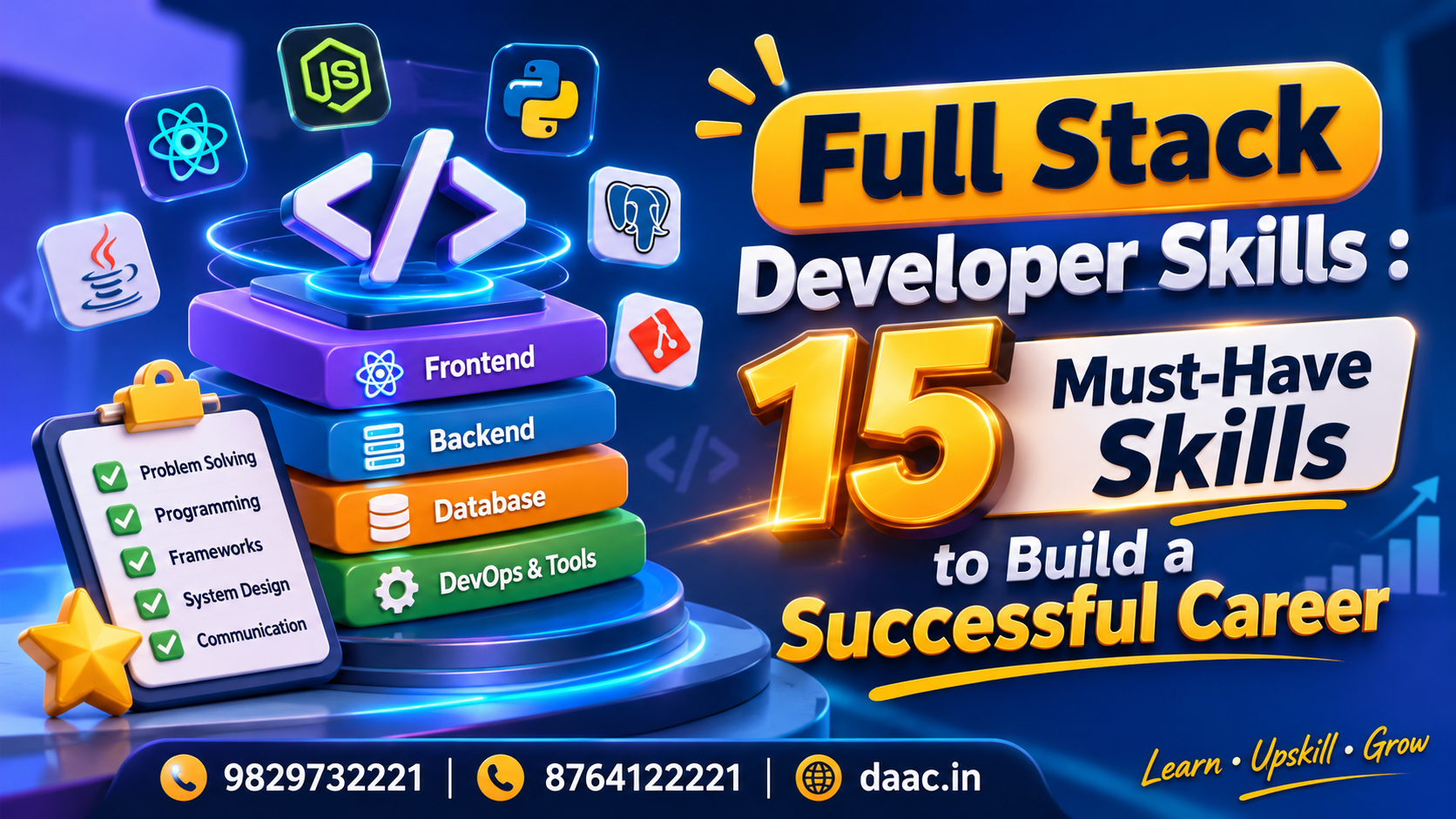
Core Front-End Skills Every Full Stack Developer Must Learn
Front-end development is the part of an application that users see and interact with. A full stack developer should understand how to create attractive, responsive, accessible, and functional interfaces. These skills help developers convert design concepts into working websites and applications.HTML5, CSS3, and Modern JavaScript
1. HTML5: HTML5 provides the structure of a website. Developers use semantic elements, forms, tables, multimedia elements, and structured page layouts to organise website content. Understanding semantic HTML also improves accessibility and helps search engines interpret web pages.2. CSS3: CSS3 controls the appearance and presentation of websites. Developers should understand selectors, layouts, typography, animations, transitions, Flexbox, and CSS Grid. These concepts help create visually consistent interfaces across different devices.
3. Modern JavaScript: JavaScript makes websites interactive and dynamic. Developers should understand variables, functions, objects, arrays, promises, asynchronous programming, DOM manipulation, and ES6+ features. Knowledge of JavaScript is especially important because it is widely used in both frontend and backend development.
TypeScript is another valuable addition to modern JavaScript knowledge. It introduces static typing, making larger applications easier to maintain and reducing certain coding errors.
React, Angular, and Front-End Frameworks
4. React: React is a popular JavaScript library for building reusable user interface components. Developers should learn components, props, state, hooks, routing, and API integration. Understanding component-based development helps create applications that are easier to maintain and expand.5. Angular: Angular is a comprehensive frontend framework used for building structured web applications. Developers should understand components, services, dependency injection, routing, and forms. It is particularly useful in projects that require organised development architecture.
Other frameworks and libraries, including Vue.js and Next.js, are also worth exploring depending on project requirements. However, beginners should develop a strong understanding of one framework before learning several alternatives.
Responsive Design and User Experience Basics
6. Responsive Design and UI/UX: Websites must work properly on desktops, tablets, and smartphones. Developers should understand media queries, responsive layouts, mobile-first design, accessibility, and usability principles.Basic UI/UX knowledge helps developers create interfaces that are easy to navigate. They should also understand loading speed, readable typography, consistent spacing, and clear navigation. These practices improve user experience and support better website performance.
Back-End Development Skills That Employers Look For
Back-end development manages the server-side functionality of applications. It handles business logic, user requests, authentication, data processing, and communication between different systems.Understanding backend technologies allows developers to build applications that work reliably beyond their visual interface. These capabilities are essential when evaluating the skills required for full stack developer roles.
Node.js, Java, Python, and PHP Development
7. Node.js: Node.js allows developers to use JavaScript for server-side programming. It is commonly used to build APIs, real-time applications, and scalable backend services. Developers should understand asynchronous operations, modules, event handling, package management, and Express.js.8. Java: Java is widely used in enterprise application development. Developers interested in Java full stack developer skills should learn object-oriented programming, collections, exception handling, multithreading, and Spring Boot. These concepts support the development of structured backend systems.
9. Python and PHP: Python is used for backend development, automation, data processing, and AI-related applications. Frameworks such as Django and Flask help developers create web services efficiently. PHP remains useful for website development and platforms such as WordPress.
The right programming language depends on project requirements, company technology, application complexity, and personal career goals. A developer should understand programming fundamentals before specialising in a particular stack.
REST APIs and Microservices Architecture
10. API Development: Application Programming Interfaces allow different software components to communicate. Developers should understand REST principles, HTTP methods, request-response cycles, JSON, status codes, and API testing.For example, when a customer logs into an online shopping application, the frontend sends an authentication request to the backend. The server processes the information and returns an appropriate response.
Developers should also learn API documentation, validation, error handling, and integration with external services.
11. Microservices Architecture: Microservices divide an application into smaller, independently manageable services. Each service handles a specific business function and communicates with other services through defined interfaces.
Understanding service communication, scalability, fault handling, and deployment is useful when working on complex applications. Beginners should first understand monolithic application architecture before moving towards microservices.
Authentication and Security Best Practices
12. Authentication and Security: Developers must understand how to protect applications and user information. Important concepts include password hashing, secure sessions, role-based access control, JSON Web Tokens, input validation, and secure API communication.They should also learn about common vulnerabilities such as SQL injection, cross-site scripting, cross-site request forgery, and insecure authentication practices.
Security should be considered throughout development rather than added only before deployment. Regular dependency updates, secure configuration, and proper error handling help reduce application risks.
Database Skills for Full Stack Development
Databases store, organise, retrieve, and manage information used by applications. A full stack developer must understand how to connect applications with databases and manage information efficiently.Choosing the right database depends on the type of application, data structure, performance requirements, and scalability needs. Knowledge of both relational and non-relational systems makes developers more flexible when working with different projects.
Working with SQL Databases
13. SQL and Relational Database Management: SQL databases organise information into tables containing rows and columns. Developers should learn SQL commands, database relationships, primary keys, foreign keys, joins, indexing, and transactions.Popular relational databases include:
-
MySQL: Commonly used in websites and business applications.
-
PostgreSQL: Supports advanced queries, complex data structures, and reliable data management.
-
Microsoft SQL Server: Frequently used in enterprise application environments.
For example, an e-commerce website may use relational databases to manage customer accounts, product information, orders, payments, and inventory. Proper relationships between these records help maintain accurate information.
Understanding NoSQL Databases
14. NoSQL Database Management: NoSQL databases are designed to handle different types of information without relying exclusively on traditional relational table structures. They are useful for applications requiring flexible data models and particular scalability requirements.MongoDB is a widely used document-oriented database that stores information in BSON documents. Developers should understand collections, documents, queries, aggregation, indexing, and schema design.
Other NoSQL technologies include Redis, which is commonly used for caching and fast data access, and Apache Cassandra, which supports distributed data storage.
Understanding when to use SQL or NoSQL is more important than learning database names individually. Relational databases are suitable for structured data and complex relationships, while document databases can be useful when application data requires flexible structures.
Database Optimization Techniques
Developers should understand how to improve database performance as applications grow. Important practices include:-
Creating suitable indexes for frequently accessed information.
-
Avoiding unnecessary database queries.
-
Using pagination for large result sets.
-
Optimising joins and query structures.
-
Applying caching where appropriate.
-
Monitoring database performance and resource usage.
Modern Tools and Technologies Full Stack Developers Use
Learning programming languages and frameworks is only one part of professional development. Developers also need tools that support collaboration, code management, testing, deployment, and application maintenance.Modern full stack technologies include version control systems, cloud platforms, containerisation tools, and automation practices. These technologies help teams develop and deliver applications more efficiently.
Git and GitHub for Version Control
15. Git and GitHub: Git is a version control system that tracks changes made to source code. GitHub provides an online platform for hosting repositories and collaborating with development teams.Developers should understand essential Git commands such as git init, git add, git commit, git push, git pull, and git merge.
They should also practise creating branches, resolving merge conflicts, reviewing code, and maintaining meaningful commit histories.
GitHub supports collaborative development through pull requests, issues, project management, and code reviews. These features help multiple developers contribute to the same application without constantly overwriting one another's work.
Understanding version control is important for individual projects as well as professional software development environments.
Cloud Computing and Deployment Platforms
Cloud computing allows applications to run on remote infrastructure instead of depending entirely on local machines. Developers should understand basic cloud concepts, application hosting, storage, networking, server configuration, and environment variables.Popular cloud platforms include Amazon Web Services (AWS), Microsoft Azure, and Google Cloud Platform (GCP).
A developer should know how to deploy a web application, configure production environments, connect databases, and manage application updates. They should also understand the importance of monitoring, access control, backups, and cloud security.
Deployment knowledge is particularly valuable because building an application locally is different from making it available to real users.
Docker and DevOps Fundamentals
Docker helps developers package applications and their dependencies into containers. This makes applications easier to run consistently across different development and deployment environments.Developers should understand images, containers, Dockerfiles, volumes, and basic container networking.
DevOps introduces practices that connect software development with deployment and operations. Important concepts include continuous integration, continuous delivery, automated testing, and deployment pipelines.
Tools such as GitHub Actions and Jenkins help automate repetitive development tasks. Kubernetes is another technology worth exploring when working with container orchestration and larger application environments.
Cloud computing, Docker, and DevOps knowledge help developers understand the complete application lifecycle rather than focusing only on writing code.
Soft Skills That Help Full Stack Developers Grow Faster
Technical knowledge helps developers build applications, but professional success also depends on communication, teamwork, adaptability, and analytical thinking. Developers regularly work with designers, project managers, clients, testers, and other engineers. Strong interpersonal skills help them understand requirements and deliver better solutions.Problem-Solving and Critical Thinking
Problem-solving is one of the most important abilities in software development. Developers regularly encounter coding errors, performance issues, unexpected application behaviour, and technical challenges.Critical thinking helps them identify the actual cause of a problem instead of applying temporary solutions. They should practise debugging, analysing errors, breaking complex requirements into smaller tasks, and evaluating different approaches.
Working on real-world projects is an effective way to develop these abilities. Building applications independently also improves confidence and encourages developers to take responsibility for their technical decisions.
Communication and Team Collaboration
Professional developers rarely work in complete isolation. They collaborate with different departments to understand project requirements, discuss technical decisions, review code, and complete development tasks.Good communication helps developers explain technical concepts, ask relevant questions, share progress, and handle feedback professionally.
They should also understand Agile development, task management, documentation, and teamwork practices. These abilities make it easier to contribute to professional development environments and manage projects efficiently.
Continuous Learning and Adaptability
Technology changes continuously. New frameworks, programming languages, development tools, security practices, and AI-powered coding assistants influence how software is created.Developers should regularly update their knowledge through practical experimentation, documentation, technical communities, and personal projects. AI coding assistants can improve productivity, but developers must review generated code, test solutions, and understand security implications.
Learning strategy: Focus on mastering fundamentals first, choose a technology stack, build complete applications, and gradually explore advanced tools. Consistent practice is more valuable than collecting certificates without practical experience.
For beginners looking to develop these abilities, DAAC offers a structured Full Stack Development programme in Jaipur. Its seven-month training covers HTML, CSS, JavaScript, React, Node.js, Express.js, MongoDB, Git, GitHub, and deployment, with practical projects and placement assistance. Students searching for an IT course in Vidhyadhar Nagar Jaipur can explore DAAC's Full Stack Developer Course in Jaipur to learn about its training programme.