If you want to build a career in web development, becoming a full stack developer can be a practical option. But before starting, you need to understand what technologies to learn, which skills matter, and in what order you should study them.
A full stack developer works across different layers of a web application. This typically includes the front end that users interact with, the back end that handles application logic, and databases that store information.
The right full stack developer roadmap can help beginners avoid a common problem: trying to learn too many technologies at the same time. Instead, you can build your skills step by step, starting with web fundamentals and gradually moving toward frameworks, APIs, databases, cloud platforms, and deployment.
In 2026, companies increasingly value developers who can understand the complete application workflow. However, becoming a full stack developer does not mean mastering every technology available. The goal is to develop strong fundamentals and become comfortable working across the major parts of a web application.
Full Stack Developer Meaning Explained
A full stack developer is a software professional who can work on both the client-side and server-side components of an application.
The front end is the part users see and interact with. The back end handles business logic, data processing, authentication, APIs, and communication with databases.
For example, consider an online shopping website.
When a customer opens a product page, the front end displays the product information. The back end retrieves that information from the database and sends it to the browser through an application or API.
A full stack developer understands how these different components connect.
Therefore, a simple definition is:
A full stack developer is a developer who can work across the front end, back end, database, and supporting application infrastructure.
Front-End, Back-End, and Database Responsibilities
A web application can be understood through three major development areas.
Front End:
The front end handles the user interface and interaction. Technologies commonly include HTML, CSS, JavaScript, and frameworks such as React or Angular.
Back End:
The back end manages business logic, APIs, authentication, application processing, and communication with external services.
Database:
The database stores application information such as users, products, orders, posts, or customer records.
A full stack developer may also work with Git, testing tools, cloud services, deployment systems, and basic security practices.
For example:
User → Front End → API → Back End → Database → Back End → API → Front End → User
Understanding this complete flow is one of the most important goals of a full stack web developer roadmap.
Industry Demand for Full Stack Developers in 2026
Businesses increasingly depend on websites, web applications, dashboards, APIs, e-commerce platforms, SaaS products, and internal software systems.
This creates demand for developers who understand multiple layers of application development.
However, companies may use different technology stacks. One organization might use React and Node.js, while another could use Angular with Java or .NET.
Therefore, beginners should focus on transferable concepts such as:
- Programming fundamentals
- Problem-solving
- Web architecture
- APIs
- Databases
- Version control
- Testing
- Security
- Deployment
Learning these concepts makes it easier to adapt to different full stack technologies throughout your career.
Essential Front-End Skills Every Full Stack Developer Needs
The front end is where users interact with a website or web application. A strong understanding of front-end development is therefore essential in any full stack development roadmap.
You do not need to start with advanced frameworks. Beginners should first understand how websites work and then move toward modern development tools.
HTML, CSS, and JavaScript Fundamentals
HTML, CSS, and JavaScript form the foundation of front-end development.
HTML defines the structure of a webpage. It creates elements such as headings, paragraphs, forms, buttons, images, links, and sections.
CSS controls presentation and layout. It helps developers create attractive interfaces, responsive layouts, typography, spacing, animations, and visual components.
JavaScript adds behavior and interactivity. It can handle user actions, manipulate webpage elements, communicate with APIs, validate forms, and create dynamic interfaces.
A beginner should understand:
- HTML semantic elements
- Forms and input fields
- CSS selectors
- Flexbox
- CSS Grid
- Responsive layouts
- JavaScript variables
- Functions
- Arrays and objects
- DOM manipulation
- Events
- Promises
- Async/await
- API requests
These fundamentals are more important than quickly moving to a framework.
Modern Frameworks Like React and Angular
Once you understand HTML, CSS, and JavaScript, you can start learning a modern front-end framework or library.
React is widely used for creating component-based user interfaces. It allows developers to break interfaces into reusable components and manage application state.
Angular is a comprehensive framework that provides tools and patterns for developing structured web applications.
Other technologies also exist, but beginners generally benefit from choosing one primary front-end technology rather than trying to learn several frameworks simultaneously.
The important concepts include:
- Components
- Props or inputs
- State management
- Routing
- Forms
- API integration
- Reusable UI components
- Application structure
Once these concepts are understood, switching between frameworks becomes easier.
Responsive and Mobile-First Design Principles
A modern website must work across different screen sizes.
Users may access an application from desktops, laptops, tablets, or smartphones. Responsive design ensures that layouts adjust appropriately to different devices.
Important concepts include:
- Flexible layouts
- CSS media queries
- Responsive images
- Flexible typography
- Mobile navigation
- Touch-friendly controls
Mobile-first design generally means starting with the constraints of smaller screens and progressively enhancing the experience for larger screens.
A full stack developer does not necessarily need to become a specialist UI/UX designer, but understanding responsive design is an important part of becoming a well-rounded developer.
Back-End Technologies You Should Learn
The back end is responsible for application logic and server-side operations.
A beginner following a roadmap for full stack developer should understand backend concepts before worrying about mastering multiple programming languages.
Node.js, Java, Python, and PHP Options
There are several popular choices for backend development.
Node.js allows developers to use JavaScript on the server side. It is commonly used for APIs, web applications, real-time applications, and services.
Java is widely used for enterprise applications and backend systems. Frameworks such as Spring Boot are commonly associated with Java web development.
Python is popular for web development, automation, data-related applications, and backend services. Frameworks such as Django and Flask are frequently used.
PHP has a long history in web development and continues to power many websites and web applications. Frameworks such as Laravel provide structured development approaches.
For beginners, the best choice depends on career goals, local job opportunities, course structure, and personal interest.
You do not need to learn Node.js, Java, Python, and PHP simultaneously.
Instead, choose one backend stack and develop strong programming fundamentals.
APIs and Server-Side Development
APIs allow different software components to communicate with each other.
For example, when a front-end application requests a user’s profile, the front end can send a request to a backend API. The server processes the request, retrieves the relevant information, and returns a response.
Beginners should understand:
- HTTP
- GET, POST, PUT, and DELETE
- Request and response
- JSON
- REST APIs
- Status codes
- API authentication
- Error handling
A typical application flow could be:
React Application → REST API → Backend → Database
Understanding this flow is essential for practical full stack development.
Authentication and Security Basics
Security should not be treated as an optional skill.
Full stack developers often work with user accounts and potentially sensitive application data. Basic security knowledge can therefore prevent common development mistakes.
Important concepts include:
- Authentication
- Authorization
- Password hashing
- Sessions
- Tokens
- HTTPS
- Input validation
- Access control
- Secure API design
Developers should also understand common web security risks and follow secure coding practices.
The objective at the beginner level is not to become a cybersecurity specialist. It is to understand how security should be incorporated into application development from the beginning.
Databases, Cloud, and DevOps Fundamentals
A complete full stack developer roadmap should not stop at front-end and back-end programming.
Modern applications also depend on databases, version control, deployment systems, and cloud infrastructure.
SQL vs NoSQL Databases
Databases store application information and make it available when needed.
SQL databases use structured tables and relationships. Examples include MySQL, PostgreSQL, and Microsoft SQL Server.
NoSQL databases use different data models and can be useful for applications with particular scalability or data-structure requirements. MongoDB is a popular example.
Beginners should first understand database fundamentals rather than focusing only on product names.
Important concepts include:
- Tables
- Rows and columns
- Primary keys
- Foreign keys
- Relationships
- Queries
- Joins
- Indexes
- CRUD operations
Understanding SQL is particularly valuable because database concepts transfer across many development environments.
Git and Version Control Systems
Git is a version control system that helps developers track changes in code.
Instead of keeping multiple copies of a project folder, developers can use Git to maintain a history of changes and collaborate with other developers.
Beginners should learn commands and concepts such as:
- Repository
- Commit
- Branch
- Merge
- Pull
- Push
- Clone
- Pull request
- Conflict resolution
GitHub and similar platforms can also be used to showcase projects and collaborate with development teams.
For job seekers, having organized Git repositories can provide employers with evidence of practical development experience.
Cloud Platforms and Deployment Basics
Building an application locally is only one part of development. A complete application eventually needs to be deployed so users can access it.
Cloud platforms provide infrastructure and services that can support application hosting, databases, storage, networking, monitoring, and other requirements.
Beginners can start by understanding:
- Domain and DNS basics
- Web hosting
- Servers
- Environment variables
- Application deployment
- Database hosting
- SSL/HTTPS
- Basic CI/CD concepts
You do not need advanced cloud engineering knowledge at the beginning. Basic deployment experience is enough to understand how a project moves from a development environment to a live application.
Step-by-Step Full Stack Developer Roadmap for Beginners
The biggest challenge for beginners is often deciding what to learn first.
A structured learning sequence can make the process easier and prevent unnecessary confusion.
Learning Sequence from Beginner to Advanced
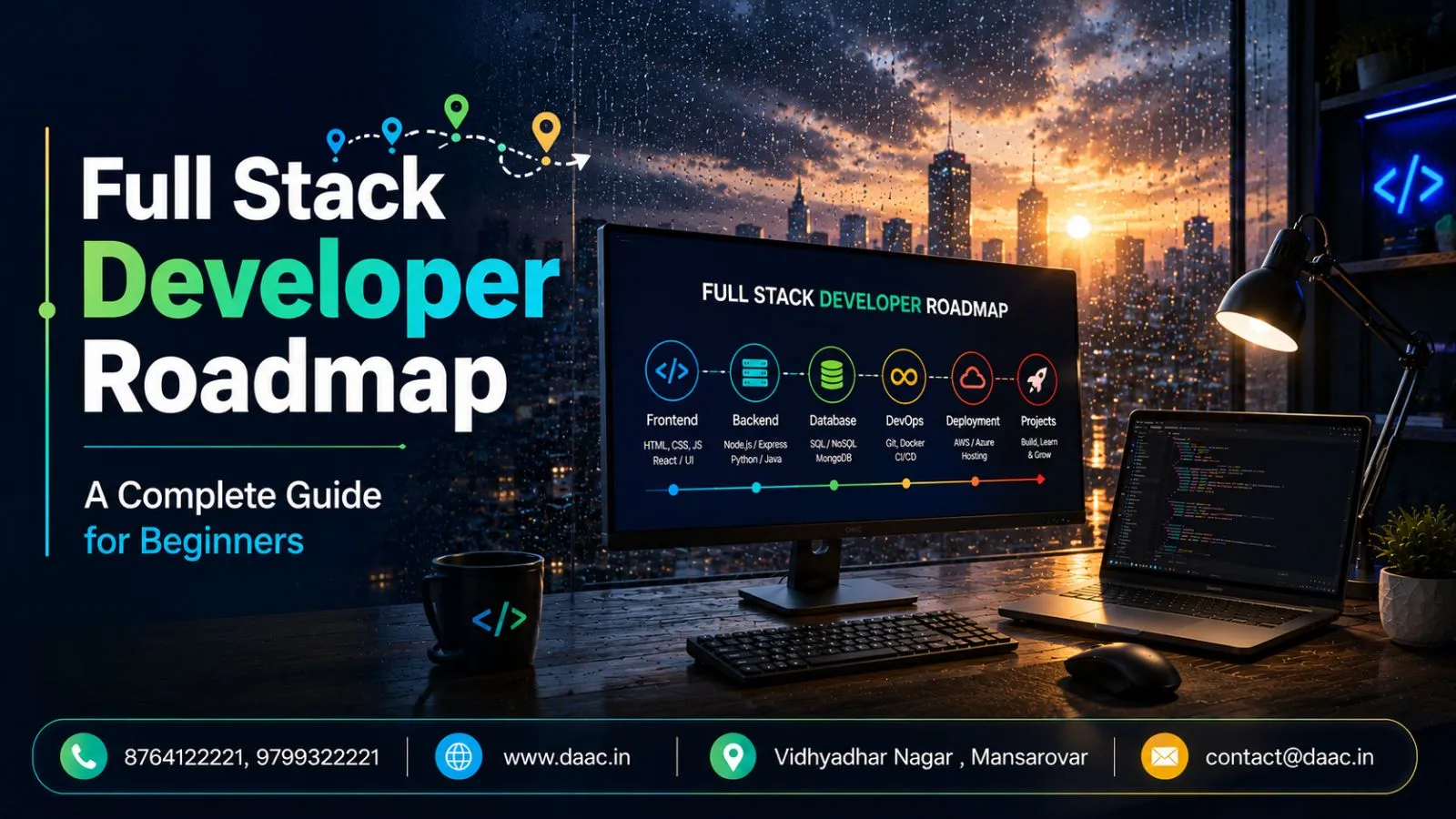
A practical full stack developer roadmap for beginners can follow this sequence:
Step 1: Web Fundamentals
Understand how websites, browsers, servers, domains, and HTTP work.
Step 2: HTML and CSS
Learn webpage structure, styling, layouts, Flexbox, Grid, and responsive design.
Step 3: JavaScript
Learn programming fundamentals, DOM manipulation, events, asynchronous programming, and API requests.
Step 4: Front-End Framework
Choose React or Angular and learn components, routing, state, forms, and API integration.
Step 5: Backend Development
Choose one technology such as Node.js, Java, Python, or PHP and learn server-side programming.
Step 6: APIs
Build and consume REST APIs while learning authentication and error handling.
Step 7: Database
Learn SQL and database design. Then explore a NoSQL database if required.
Step 8: Git and GitHub
Practice version control and collaborative development.
Step 9: Deployment
Deploy your applications and understand basic cloud concepts.
Step 10: Advanced Development
Explore testing, performance optimization, security, system design, CI/CD, containers, and architecture.
The timeline will vary depending on your background, learning schedule, and practical experience.
Building Real-World Projects
Projects are one of the most important parts of learning full stack development.
Reading tutorials can teach concepts, but projects require you to solve actual development problems.
Beginners can start with:
Project 1: Personal Portfolio
Build a responsive portfolio using HTML, CSS, and JavaScript.
Project 2: Task Management Application
Create a full stack application where users can add, update, and delete tasks.
Project 3: Blog Application
Create authentication, posts, categories, comments, and an administrative interface.
Project 4: E-commerce Application
Build product listings, user accounts, shopping cart functionality, orders, and APIs.
Project 5: Business Dashboard
Create a dashboard connected to a backend API and database.
Each project should gradually introduce new concepts.
Instead of copying a tutorial exactly, try to modify the project by adding your own features. This helps develop problem-solving skills.
Getting Your First Full Stack Developer Job
After building fundamental skills and projects, the next step is preparing for employment.
Start by creating a clear resume that highlights:
- Technical skills
- Projects
- Development tools
- Internship experience
- Certifications
- GitHub portfolio
Your projects should explain what you built, which technologies you used, and what problems you solved.
You should also prepare for technical interviews covering:
- HTML/CSS
- JavaScript
- Programming fundamentals
- Data structures
- APIs
- Databases
- Git
- Backend concepts
- Basic system design
For students looking for structured full stack development training in {City}, a practical course can provide a guided learning sequence, instructor support, and project-based practice.
At DAAC, learners can use full stack development as a pathway to understand both front-end and backend technologies while building practical applications.
Final Thoughts
A successful full stack developer roadmap is not about learning every programming language or framework available. It is about developing a strong understanding of how complete web applications work. Start with HTML, CSS, and JavaScript, then move into a modern front-end framework, one backend technology, APIs, databases, Git, and deployment. Each stage should build on the knowledge gained in the previous one.
For beginners, practical experience is just as important as theoretical knowledge. Building websites, APIs, dashboards, e-commerce applications, and other projects helps turn concepts into usable development skills. If you are considering full stack development training in {City}, choose a learning program that combines structured lessons with hands-on projects and current industry practices. At DAAC, learners can use this structured approach to develop the technical foundation needed to begin their journey toward a full stack development career.
Frequently Asked Questions
1. What is the best full stack developer roadmap for beginners?
A practical roadmap starts with HTML and CSS, followed by JavaScript, a front-end framework such as React or Angular, one backend technology, APIs, databases, Git, and deployment. Projects should be included throughout the learning process.
2. How long does it take to become a full stack developer?
The time varies according to your programming background, learning schedule, and practice. A beginner should focus on developing strong fundamentals and completing several real-world projects rather than targeting a fixed number of months.
3. Which technology is best for full stack development?
There is no single best technology for everyone. Popular combinations include React with Node.js, Angular with Java, or React with Python. Choose a stack based on your career goals and the skills required by your target employers.
4. Do I need to learn multiple programming languages to become a full stack developer?
No. You do not need to master several programming languages. It is generally better to become strong in one backend language while developing solid front-end, database, API, and deployment skills.
5. Is full stack development a good career option in 2026?
Full stack development can be a strong career path for people who enjoy programming and building web applications. Employers may use different technology stacks, so strong fundamentals, practical projects, problem-solving, and the ability to learn new technologies are important.