
Introduction: A Common Confusion Among Students
In 2026, students who enter the data field face difficulties when selecting between Data Analyst and Data Scientist positions because both careers show high job demand and offer good salaries and permanent employment. The Data Analyst career 2026 applies basic Data Analyst skills to create business insights whereas the Data Scientist career 2026 needs advanced technical skills together with all Data Scientist abilities. Students who learn about data analytics and data science together with Data Analyst salary 2026 and Data Scientist salary 2026 and complete job market information will arrive at a career choice that supports their development.
What is a Data Analyst? (Simple Explanation)
A Data Analyst uses current datasets to develop business insights which help businesses discover their declining sales, their most successful products, and their marketing campaigns which produce the best returns on investment. The Data Analyst career 2026 exists because the Data Analyst profession requires specific Data Analyst skills which provide a positive job outlook and offer an attractive salary. The Data Analyst career 2026 exists because the Data Analyst profession requires specific Data Analyst skills which provide a positive job outlook and offer an attractive salary. The Data Scientist career 2026 requires Data Scientist skills which Data Scientists must possess. The Data Scientist career 2026 includes a complete job outlook. The Data Scientist career 2026 offers a higher salary than other professions.
Key Responsibilities of a Data Analyst:
Data Collection & Management: Through his work as a Data Analyst, he collects structured data from both databases and systems, which constitutes his essential work duty that requires him to possess specific Data Analyst skills that create a distinct difference between Data Analyst work and Data Scientist work and between data analytics work and data science work.
Data Cleaning & Organization: The team performs data cleaning and validation and data organization activities, which enable them to create accurate and usable data sets that support their work, thus creating a favorable job outlook for Data Analysts, while Data Scientists need advanced Data Scientist skills for their research-based occupational path.
Reporting & Dashboard Creation: A Data Analyst creates reports and dashboards to display trends and performance data, which helps the business achieve its goals while supporting the justification of the increasing Data Analyst salary 2026, which compares to the more difficult Data Scientist salary 2026.
Business Decision Support: Through their work in data translation, Data Analysts convert data into insights that help leadership reach decisions, which strengthens their strategic importance to the organization while they work together with Data Scientist professionals who focus on predictive analytics.
Data Analysts focus more on analysis and reporting, not complex algorithms.
What is a Data Scientist? (Simple Explanation)
Data scientists use artificial intelligence and machine learning to solve complex data problems which include sales forecasting and recommendation system development and fraud detection. Data scientists who work in the field of data science require advanced data scientist skills which lead to a positive job outlook and a better salary package than data analysts who focus on generating business insights in their profession.
Key Responsibilities of a Data Scientist:
- Large-Scale Data Handling: A Data Scientist works with massive and complex datasets to extract patterns which constitutes the main part of their job according to Data Scientist career 2026 which shows the differences between Data Analyst and Data Scientist roles in data analytics and data science fields.
- Machine Learning Model Development: The team creates and implements machine learning models which require Data Scientist expertise and result in strong employment opportunities for Data Scientists compared to the more reporting-focused Data Analyst career 2026.
- Predictive Analytics & Forecasting: Data Scientists create future outcome and trend predictions which provide organizations with high strategic value because Data Scientist salaries 2026 exceed the fixed Data Analyst salaries 2026.
- Advanced Coding & Algorithm Design: The job requires professionals to develop advanced software systems through programming and algorithm creation which demonstrates the essential technical competencies needed for Data Scientist positions while showing how these skills differ from those needed by Data Analysts.
Data Scientists focus more on prediction, modeling, and automation.
Core Difference: Data Analyst vs Data Scientist
| Aspect | Data Analyst | Data Scientist |
| Focus | Past & present data | Future predictions |
| Coding Level | Basic to intermediate | Advanced |
| Tools | Excel, SQL, Power BI | Python, ML, AI |
| Difficulty | Beginner-friendly | Advanced |
| Entry Barrier | Low | High |
| Suitable For | Freshers | Experienced professionals |
Skills Required in 2026
Data Analyst Skills:
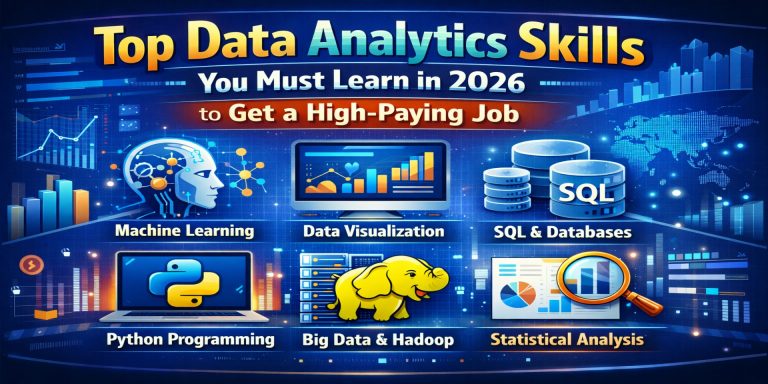
Excel: Data cleaning and analysis and reporting work constitute essential skills which Data Analysts need for their professional work in 2026.
SQL: The SQL language functions as a critical tool which enables users to retrieve and handle database information within actual business settings.
Power BI / Tableau: The platform allows users to build dashboards and display data which helps organizations make quicker management decisions.
Basic Python: The program helps users conduct basic data analysis work and automate processes which boosts their analytical capacity.
Business Understanding: The process enables organizations to convert their data findings into practical plans which enhance decision making and professional development.
Data Scientist Skills:
Python and R: Serve as fundamental programming languages which data analysts use to conduct their analytical work and create their models and perform their automation tasks.
Machine Learning: Serves as a tool to create predictive systems and recommendation engines which solve actual business challenges.
The field of statistics: Provides the essential knowledge required for data modeling and hypothesis testing and accuracy assessment.
Deep Learning: Operates through its application to solve intricate problems which include image recognition and text analysis and speech processing.
Big Data Tools: Provide organizations with the capacity to handle extensive datasets through their utilization of distributed computing technologies.
👉 For beginners, Data Analytics is much easier to start.
Why DAAC Recommends Data Analytics for Beginners
DAAC focuses on:
Job-Oriented Curriculum: The DAAC programs provide training which meets current industry standards because it prepares students for entry-level data jobs through practical skill development.
Real Company Use Cases: The program uses actual business situations to teach beginners about data analytics application in real-world corporate decision-making processes.
Industry-Standard Tools: DAAC provides students with practical experience using common workplace tools which help them transition from their training to their professional environments.
Practical-First Training Approach: DAAC improves student readiness for employment because it teaches practical skills which help students build confidence and succeed in interviews and workplace tasks.
Students can later upgrade to Data Science after gaining experience.
Final Conclusion
The Data Analyst profession and the Data Scientist profession both display equal growth potential for 2026. The field of data analytics provides beginners with a better method to enter the data profession than data analytics. The Data Analyst career path for 2026 provides students with essential skills which are needed by employers. The Data Analyst career path will provide students with essential skills which are required by employers. Students who complete the Data Analyst career path will acquire essential skills which lead to advanced data science positions after they gain more expertise.
Important FAQs
1. Which is better for beginners: Data Analyst or Data Scientist?
The Data Analyst position serves as a better entry-level option for beginners because it requires less technical skills than the Data Scientist career path.
2. Is Data Scientist a higher-paying role than Data Analyst in 2026?
Data Scientist positions generally pay more than Data Analyst positions because Data Scientists need to possess advanced skills, but Data Analysts can expect to see substantial and consistent salary increases.
3. Can a Data Analyst become a Data Scientist later?
Many people begin their careers in data analytics before they develop programming and machine learning and statistics skills to become data scientists.